Wholesale Plus Size Leggings: A Complete Buying Guide for Clothing Brands
The demand for comfortable, stylish, and well-fitting clothing continues to create opportunities for fashion businesses. Plus size leggings are an important part of this market. Customers want leggings that provide comfort, flexibility, coverage, and a flattering fit. Retailers and clothing brands need products that meet these expectations while supporting their business goals.
Choosing the right wholesale plus size leggings supplier is an important step for any retailer, boutique owner, or fashion brand. The right supplier can help you source suitable fabrics, offer inclusive sizing, maintain product consistency, and manage inventory costs.
Whether you operate an online clothing store or plan to launch your own activewear collection, understanding the wholesale process can help you make better decisions.
This guide explains how to source wholesale leggings plus size, compare suppliers, evaluate materials, understand sizing, and explore private-label manufacturing options.
What Are Wholesale Plus Size Leggings?
Wholesale plus size leggings are leggings purchased in larger quantities from manufacturers, distributors, or wholesale suppliers. Retailers and brands buy these products at wholesale prices and sell them to customers.
They are designed for customers who need extended sizing and comfortable clothing. Depending on the product, they may be suitable for everyday wear, workouts, travel, casual outfits, or layering.
Plus size leggings are available in different styles, including:
- High-waisted leggings
- Full-length leggings
- Cropped leggings
- Capri leggings
- Sports and gym leggings
- Seamless leggings
- Printed leggings
- Flared leggings
- Compression-style leggings
- Everyday cotton leggings
Each style serves a different customer need. For example, high-waisted leggings may appeal to shoppers who prefer additional waist coverage. Performance leggings may suit customers looking for flexible workout clothing.
When sourcing plus size leggings wholesale, retailers should consider more than the purchase price. Fabric quality, measurements, stretch recovery, construction, and size consistency all affect customer satisfaction.
Why Is There Demand for Plus Size Leggings?
Leggings are popular because they can be worn in many situations. Customers use them for exercise, relaxing at home, running errands, and creating casual outfits.
The extended-size segment gives retailers an opportunity to serve customers with different body shapes and fit preferences.
Inclusive Fashion Creates Retail Opportunities
Inclusive sizing helps clothing businesses serve a wider customer base. Customers should have access to comfortable clothing without feeling limited by a narrow size range.
Retailers can build a more useful collection by offering different sizes, lengths, colors, and fits.
However, adding larger sizes requires thoughtful product development. Simply increasing the measurements of a smaller garment may not create a comfortable fit.
Leggings Offer Multiple Styling Options
Leggings can be styled with T-shirts, hoodies, sweatshirts, tunics, and sports tops. This makes them useful for several clothing categories.
Retailers can offer them as individual products or include them in coordinated outfits.
For example, an online boutique might sell black leggings alongside oversized T-shirts and casual sweatshirts. An activewear store might combine performance leggings with sports bras and training tops.
Different Customers Need Different Features
Not every customer wants the same type of leggings. Some prefer soft everyday fabrics, while others look for moisture management and supportive construction.
Understanding your target audience helps you choose suitable products instead of purchasing styles without a clear retail plan.
Popular Types of Wholesale Plus Size Leggings
Before placing a wholesale order, decide which styles fit your customers and business model.
1. High-Waisted Plus Size Leggings
High-waisted leggings feature a waistband that sits around the waist or above the hips. Many customers prefer this style because it offers additional coverage.
When evaluating high-waisted designs, check the waistband width, elastic strength, stitching, and comfort while sitting or moving.
The waistband should feel secure without creating unnecessary pressure.
2. Plus Size Workout Leggings
Workout leggings are designed for physical activities such as gym training, walking, cycling, and fitness classes.
Important features may include:
- Stretch fabric
- Moisture-management properties
- Secure waistbands
- Flat or smooth seams
- Suitable fabric opacity
- Flexible construction
The fabric should support movement without becoming uncomfortable. Retailers should test workout leggings through practical movement checks before approving a large order.
3. Seamless Plus Size Leggings
Seamless leggings use specialized knitting methods to reduce or remove certain garment seams.
They can provide a smooth appearance and flexible fit. However, seamless construction does not automatically mean better quality.
Check stretch recovery, fabric thickness, waistband construction, and how the garment performs across the intended size range.
4. Cotton Plus Size Leggings
Cotton leggings are often selected for casual and everyday clothing.
Cotton can provide a soft feel, but the final performance depends on the fabric construction and blend. Some products combine cotton with elastane or another stretch fibre.
Retailers should check whether the fabric keeps its shape after washing and regular wear.
5. Printed Plus Size Leggings
Printed leggings allow brands to offer more visual variety. Designs may include geometric patterns, abstract artwork, floral prints, or brand-specific graphics.
Before ordering, review the print quality, color consistency, placement, and fabric compatibility.
Request a sample when print accuracy is important to your collection.
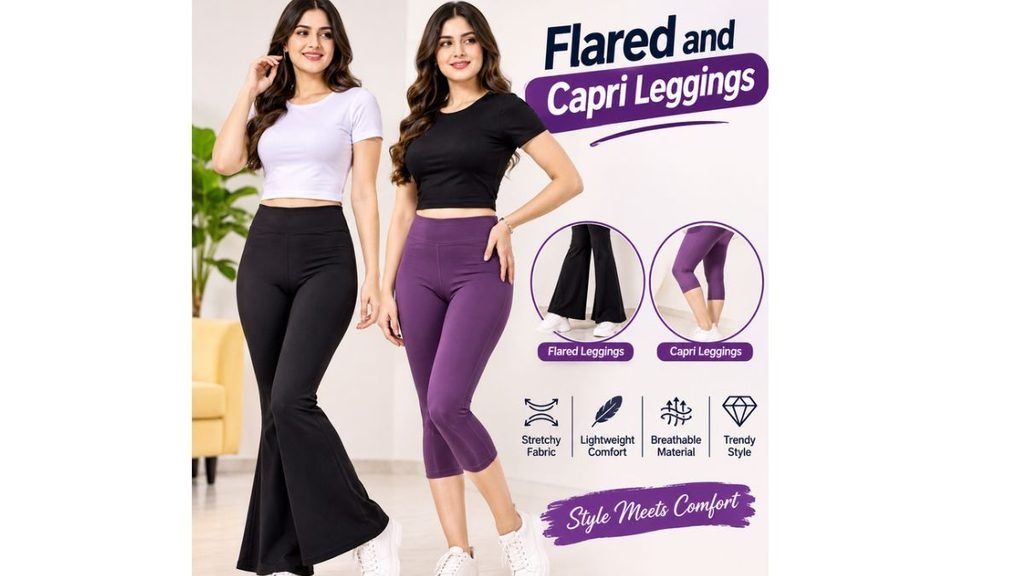
6. Flared and Capri Leggings
Flared leggings have a wider lower leg, while capri leggings end above the ankle.
Both styles can expand a retailer’s product range. They also allow customers to choose different silhouettes and lengths.
Check the finished garment measurements carefully. Length preferences can vary across customers and markets.
How to Choose the Right Fabric for Plus Size Leggings
Fabric selection is one of the most important parts of sourcing leggings. The material affects comfort, stretch, coverage, durability, and appearance.
A product that looks attractive in a photograph may not perform well during everyday use. Retailers should understand the fabric before approving bulk production.
Polyester and Elastane Blends
Polyester blended with elastane is commonly used in performance clothing.
Polyester can provide durability and moisture-management options, while elastane adds stretch.
This combination may work for workout leggings, depending on the fabric construction and weight.
Nylon and Elastane Blends
Nylon and elastane blends are also used in activewear. They can provide a smooth feel and flexible performance.
The exact feel and durability depend on fibre quality, knitting, fabric weight, and finishing.
Ask suppliers for the fabric composition and a physical swatch before making a decision.
Cotton and Elastane Blends
Cotton and elastane blends may suit casual leggings. Cotton provides a familiar soft feel, while elastane supports stretch.
These fabrics may be suitable for everyday clothing, but they are not automatically ideal for every workout.
Consider the intended activity, washing requirements, and desired garment performance.
Understanding GSM
GSM means grams per square metre. It describes the weight of a fabric.
For leggings, fabric weight can affect coverage, thickness, drape, and comfort. However, GSM alone does not determine quality.
A higher GSM fabric is not always better. The right weight depends on the product design, material composition, and intended use.
When comparing suppliers, request fabric samples and evaluate them under normal lighting and movement.
Why Fit and Size Consistency Matter
A good plus size leggings collection should offer a comfortable fit across its intended size range.
Customers may have different proportions, including differences in waist, hip, thigh, and leg measurements. A successful size range should account for these differences.
Use a Clear Size Chart
A size chart should provide actual garment or body measurements. It should explain which measurement method is being used.
Common measurements include:
- Waist
- Hip
- Front rise
- Back rise
- Inseam
- Outseam
- Thigh
- Leg opening
The size chart should match the final approved product. Avoid using generic measurements without checking the actual garment.
Understand Grading
Size grading is the process of adjusting a base pattern to create additional sizes.
Good grading considers how body proportions change across sizes. It should not simply add the same amount to every measurement.
For example, waist and hip measurements may need different adjustments. Rise and thigh measurements also affect overall comfort.
Ask the manufacturer how it develops and checks patterns across the full size range.
Test Fit Across Multiple Sizes
Approving only one sample size may not reveal problems in other sizes.
Where possible, review samples from different points in the range. Check the waistband, seat, thigh, crotch area, and leg length.
Movement tests can also help identify problems that are not visible when the garment is lying flat.
How to Find Reliable Wholesale Leggings Plus Size Suppliers
Finding a suitable supplier requires research and careful comparison. A low price is not enough to establish whether a supplier can meet your product requirements.
1. Research the Supplier’s Experience
Look for suppliers with relevant experience in leggings, activewear, sportswear, or stretch garments.
Ask about the products they manufacture and the materials they work with. A supplier’s experience with general clothing does not automatically prove expertise in performance leggings.
Request product examples or samples where available.
2. Compare Product Specifications
Compare suppliers using the same product requirements.
Check:
- Fabric composition
- Fabric weight
- Size range
- Measurements
- Waistband design
- Stitching and seams
- Colors and available finishes
- Branding options
- Packaging
- Minimum order quantity
This makes it easier to identify differences between quotations.
3. Request Physical Samples
Samples allow you to evaluate the actual product before ordering in bulk.
Check the fit, fabric feel, stretch, recovery, stitching, opacity, and finishing. If you plan to sell workout leggings, test them during suitable movements.
A physical sample is more useful than relying only on product photographs.
4. Ask About Minimum Order Quantity
Minimum order quantity, or MOQ, is the smallest order a supplier accepts under specific production terms.
MOQ may vary by style, fabric, color, and customization. Ask whether the minimum applies per style, color, or size run.
You should also confirm whether different sizes can be included in one order.
5. Check Communication and Documentation
A reliable supplier should explain specifications, prices, production stages, and delivery expectations clearly.
Keep important details in writing. This includes sample approval, measurement tolerances, fabric composition, decoration, packaging, and shipping terms.
Clear documentation can help prevent misunderstandings.
Wholesale Pricing: What Affects the Cost of Plus Size Leggings?
The wholesale price depends on several factors. There is no single price that applies to every leggings order.
Fabric and Material Costs
Fabric type, composition, weight, finish, and availability can affect the unit price.
Specialized performance materials may cost more than basic fabrics. Custom colors or materials may also involve additional requirements.
Order Quantity
Larger orders may reduce the unit cost because certain setup and production expenses are spread across more garments.
However, a larger order also requires more upfront investment and inventory space.
Choose quantities based on realistic sales expectations.
Design and Construction
Simple leggings may require fewer production steps than styles with multiple panels, pockets, special waistbands, or decorative details.
Complex construction can increase material use and labor time.
Branding and Packaging
Custom labels, printed logos, hang tags, and branded packaging may add to the total order cost.
Ask whether these services are included in the quotation or priced separately.
Shipping and Import Costs
International orders may involve freight, customs clearance, duties, and other charges.
Compare the complete landed cost rather than looking only at the factory price.
Private Label Plus Size Leggings for Your Clothing Brand
Private-label manufacturing allows a business to sell products under its own brand name.
Instead of purchasing only generic wholesale products, you can develop leggings with selected materials, fits, colors, and branding details.
This approach can help your business create a more recognizable product range.
Custom Fabric and Colors
You may choose fabrics based on your target customers and product use.
Color options can include classic black, navy, grey, and other shades that match your brand identity.
Custom colors may require additional material quantities or supplier approvals. Confirm availability before finalizing your order.
Custom Waistbands and Construction
The waistband can affect comfort, fit, and appearance.
Depending on manufacturing capabilities, you may explore different waistband widths, elastic options, pocket placements, and seam designs.
All changes should be documented in the product specifications.
Custom Labels and Branding
Branding options may include:
- Woven brand labels
- Printed care labels
- Heat-transfer logos
- Embroidered details where suitable
- Custom hang tags
- Branded packaging
Check the placement, dimensions, and artwork before bulk production.
Packaging for Retail and Online Sales
Packaging should protect the garment and support your brand presentation.
Options may include individual polybags, size stickers, product labels, and custom packaging.
If you sell internationally, confirm any packaging and labelling requirements that apply to your destination market.
Quality Control for Plus Size Leggings
Quality control is essential because leggings need to maintain their fit and function through regular use.
A good inspection plan should check both appearance and performance.
Fabric Inspection
Inspect fabric for holes, stains, uneven dyeing, defects, and unwanted variations.
Check whether the material matches the approved composition, weight, and color.
Stretch and Recovery Testing
Leggings need suitable stretch for movement. They should also recover their shape after being stretched.
Test the material in different directions and check whether it becomes loose or distorted.
Opacity and Coverage
Fabric opacity is important, especially for workout leggings.
Check the garment under appropriate lighting and during movement. Do not rely only on how the fabric looks when folded.
Stitching and Seam Inspection
Inspect the seams for skipped stitches, loose threads, broken stitching, and uneven construction.
Stretch garments need suitable stitches and seam construction. Poor stitching can cause discomfort or damage during wear.
Measurement Checks
Compare finished garments with the approved measurement chart.
Check several pieces from the production order where possible. This can help identify inconsistent sizing before shipment.
How the Manufacturing Process Works
If you want custom leggings rather than ready-made wholesale products, you may work directly with an apparel manufacturer.
The process usually includes several stages.
Step 1: Share Your Product Requirements
Provide the garment design, intended use, size range, fabric preferences, and estimated order quantity.
You can begin with a tech pack, sketch, reference images, or a product brief.
Step 2: Confirm Materials and Specifications
Review fabric composition, GSM, colors, waistband construction, measurements, and other details.
Ask for fabric swatches when necessary.
Step 3: Develop a Sample
The manufacturer creates a sample for review. Check its measurements, fit, fabric, construction, and branding.
Request changes before approving the final sample.
Step 4: Approve Bulk Production
Confirm the final specifications and approve the physical pre-production sample in writing.
Bulk production should follow the approved reference.
Step 5: Inspect and Finish the Order
The production team completes the garments and conducts the agreed quality checks.
Approved labels, packaging, and finishing details are added before shipment.
Step 6: Arrange Delivery
Confirm the shipping method, destination, export documents, delivery terms, and responsibility for import duties.
Keep the agreed timeline in your purchasing records.
Is Fashion Soul International Suitable for Custom Activewear Manufacturing?
Fashion Soul International is a factory-owned clothing manufacturer based in Sialkot, Punjab, Pakistan. The company offers private-label, OEM, ODM, white-label, cut-and-sew, and full-package apparel manufacturing.
Its stated services include product development, fabric and trim sourcing, sampling, bulk production, quality control, custom branding, packaging, export documentation, and international shipping.
The company lists activewear and sportswear among its product categories. Its stated fabric options include polyester and four-way stretch spandex, which are relevant materials for certain activewear products.
For a specific plus size leggings project, buyers should confirm the manufacturer’s current leggings capabilities, available fabric options, size range, construction requirements, and quotation before proceeding.
Fashion Soul International publishes a standard MOQ starting at 100 pieces. Actual order requirements may vary by product, fabric, color, and construction.
The company’s stated process includes physical sample approval before bulk production. This gives buyers an opportunity to review the product before confirming the main order.
If you are developing a custom activewear range, prepare your design references, size chart, material requirements, and estimated quantity before requesting a quotation.
You can learn more about its manufacturing services at https://fashionsoulintl.com/.
Tips for Selling Plus Size Leggings Successfully
Sourcing a good product is only one part of running a clothing business. You also need a clear product range and a useful customer experience.
Understand Your Target Audience
Identify the customers you want to serve.
Some may prefer everyday leggings, while others may need workout styles or fashion-focused designs.
Use customer feedback and sales information to decide which features matter most.
Offer a Useful Size Range
Choose sizes based on your target market and supplier capabilities.
Display accurate measurements on product pages. Explain how customers should measure their waist and hips.
Clear sizing information can help shoppers select the right product.
Start With a Focused Collection
You do not need dozens of styles for your first launch.
A focused collection might include a few core colors and different lengths or waistband options.
This approach can make inventory planning easier.
Use Accurate Product Photography
Show the leggings clearly from different angles. Include close-up images of the waistband, fabric, seams, and other important features.
Use accurate product descriptions. Avoid claiming that a garment is squat-proof, compression-rated, or moisture-wicking unless those features have been tested and confirmed.
Monitor Customer Feedback
Reviews and customer questions can reveal common fit or quality concerns.
Pay attention to feedback about waistband comfort, fabric coverage, length, and sizing.
Use this information when planning future orders.
Common Mistakes to Avoid When Buying Plus Size Leggings Wholesale
Avoiding a few common mistakes can help protect your budget and product quality.
Choosing a supplier based only on price: Compare materials, construction, sample quality, and complete costs.
Ignoring size grading: Check whether the garment fits properly across the full size range.
Skipping samples: Always review a physical sample before committing to bulk production.
Ordering too much inventory: Estimate demand and start with quantities that match your business plan.
Ignoring fabric opacity: Test leggings under suitable lighting and during movement.
Failing to confirm customization costs: Ask about labels, logos, packaging, and special construction charges.
Overlooking delivery terms: Confirm shipping costs, timelines, customs requirements, and responsibilities.
Frequently Asked Questions
Where can I buy wholesale plus size leggings?
You can source them from clothing wholesalers, activewear suppliers, and custom apparel manufacturers. Compare their product specifications, size ranges, MOQ, samples, and shipping terms before placing an order.
What should I look for in wholesale leggings plus size?
Look for accurate sizing, comfortable fabric, suitable stretch, good recovery, reliable stitching, and appropriate coverage. Also check the supplier’s consistency and ability to meet your order requirements.
Can I order plus size leggings with my own brand label?
Many private-label manufacturers offer custom branding. Options may include woven labels, printed care labels, logos, hang tags, and packaging. Confirm the available services and additional costs before production.
What fabrics are suitable for plus size leggings?
Polyester and elastane, nylon and elastane, and cotton and elastane blends are common options. The best choice depends on whether the leggings are designed for workouts, casual wear, or everyday use.
What is the MOQ for plus size leggings?
MOQ depends on the supplier, product design, fabric, color, and customization. Always ask whether the minimum applies per style, color, or size run.
Are wholesale plus size leggings suitable for online boutiques?
Yes. They can be part of an online boutique’s activewear, casualwear, or everyday clothing collection. Accurate size charts, clear photographs, and detailed product descriptions can help customers make informed choices.
How do I check leggings quality before buying in bulk?
Request a sample and check the fabric, stretch recovery, opacity, stitching, waistband, measurements, and finishing. Test the garment according to its intended use.
Can a clothing manufacturer develop custom plus size leggings?
A manufacturer with suitable activewear capabilities may be able to develop custom leggings. Confirm its experience with stretch garments, pattern grading, fabric selection, and your required size range before starting.
Final Thoughts
The market for wholesale plus size leggings offers opportunities for retailers, boutiques, and activewear brands. However, successful sourcing requires more than finding a low wholesale price.
Focus on fabric quality, size consistency, fit, stretch recovery, construction, and supplier communication. Request physical samples and confirm all product specifications before approving bulk production.
If you want to build your own collection, private-label manufacturing may provide more control over materials, colors, fit, and branding.
Take time to compare suppliers and understand the full cost of your order. A well-planned sourcing process can help you offer comfortable leggings and build a stronger clothing collection.