textile industry world history definition
Textile Industry World History Definition: From Ancient Textiles to Modern Manufacturing
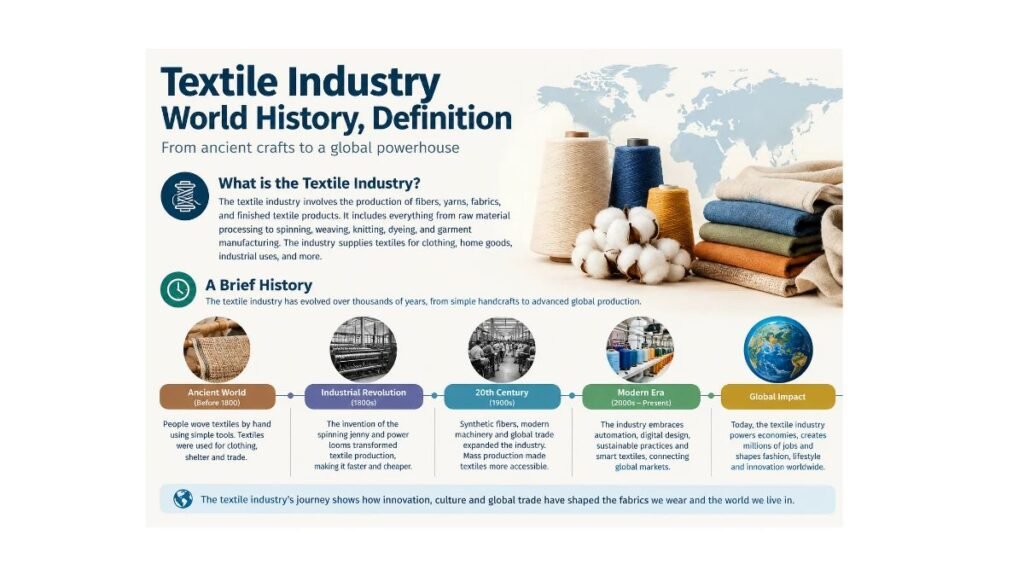
The textile industry world history definition explains how people developed methods to create, process, dye, weave, knit, and manufacture textiles over thousands of years. Initially, textiles were basic materials made from natural fibers. Over time, they became an important part of trade, culture, technology, and industrial development.
Today, the textile industry includes much more than making fabric. It connects fiber production, spinning, weaving, knitting, dyeing, finishing, textile technology, garment manufacturing, and global supply chains.
Understanding textile history helps explain how modern clothing and fabric production developed. It also makes it easier to understand the difference between textiles and finished garments.
This guide explains the textile industry definition, answers what is the textile industry, and explores the textile industry meaning from ancient production to modern manufacturing.
What Is the Textile Industry?
The textile industry is the broad industry involved in producing and processing fibers, yarns, fabrics, and other textile materials.
It begins with raw materials and can continue through the production of finished fabrics and textile-based products.
Common stages include:
- Fiber production or sourcing
- Fiber preparation
- Spinning
- Yarn production
- Weaving or knitting
- Dyeing
- Printing
- Finishing
- Fabric inspection
- Conversion into finished products
Textiles can be produced from natural or synthetic fibers.
Natural fibers include:
- Cotton
- Wool
- Silk
- Flax
- Hemp
- Jute
Synthetic fibers include:
- Polyester
- Nylon
- Acrylic
- Elastane
- Other manufactured fibers
The industry also uses blended fibers. For example, cotton and polyester may be combined to create specific performance or durability characteristics.
The exact production method depends on the type of fiber, yarn, fabric, and final product.
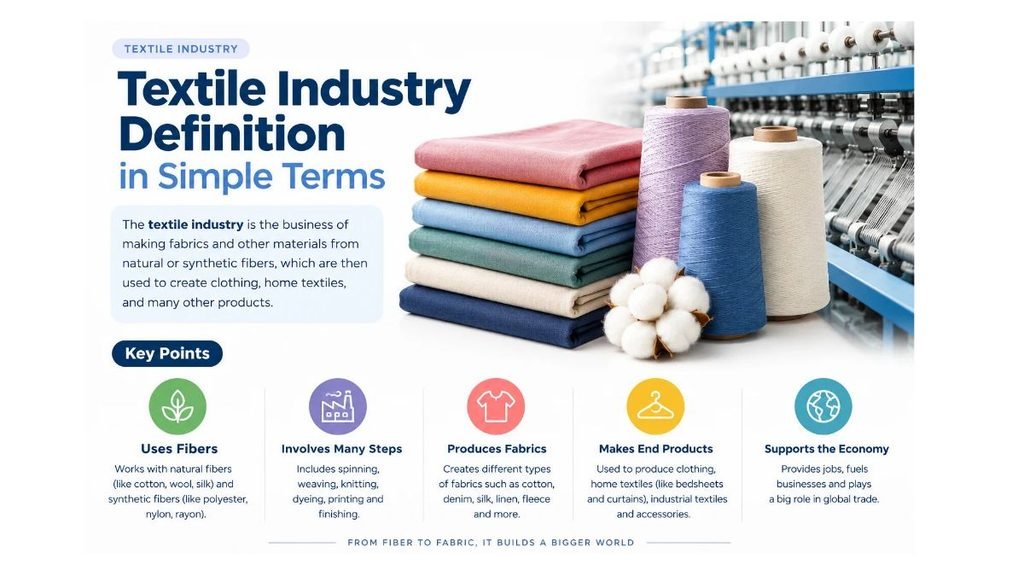
Textile Industry Definition in Simple Terms
A simple textile industry definition is:
The textile industry is the sector that produces and processes fibers, yarns, fabrics, and related textile materials for use in clothing, home products, technical applications, and other goods.
This definition covers a large supply chain.
For example, cotton clothing can involve several different stages. Cotton is first harvested and prepared. The fibers are spun into yarn. The yarn is woven or knitted into fabric. The fabric can then be dyed, printed, finished, inspected, and eventually used to manufacture garments.
Therefore, textile production is not the same as simply making clothes.
A textile factory may produce fabric, while a garment factory may use that fabric to produce T-shirts, hoodies, jackets, uniforms, sportswear, or other apparel.
Textile Industry Meaning: Why Textiles Matter
The textile industry meaning becomes clearer when we look at its role in everyday life.
Textiles are used in many products, including:
- Clothing
- Bedding
- Towels
- Curtains
- Upholstery
- Bags
- Footwear components
- Medical textiles
- Protective clothing
- Automotive textiles
- Industrial fabrics
- Sportswear
- Technical textiles
The industry therefore supports both consumer and industrial markets.
Historically, textiles were also closely connected with trade and economic development. Fabrics could be valuable trade goods, while textile skills often became important sources of employment and community income.
The Earliest History of Textile Production
Textile production began long before modern factories existed.
Early humans used available natural materials to make basic coverings, ropes, nets, and other useful objects. Plant fibers, animal skins, and other natural materials provided some of the earliest forms of protection from weather.
Archaeological discoveries show that early societies developed increasingly sophisticated methods for working with fibers.
People learned how to:
- Separate useful fibers
- Twist fibers together
- Make yarn
- Create simple woven structures
- Dye materials using natural substances
- Produce different types of cloth
These developments were important because textiles were useful beyond clothing.
They could also be used for storage, transportation, shelter, fishing, household goods, and ceremonial purposes.
Ancient Textile Production
Ancient civilizations developed textile techniques suited to their local environments.
Different regions had access to different raw materials. Some societies became known for particular fibers or textile techniques.
Ancient Egypt
Ancient Egypt became strongly associated with linen production.
Linen was made from flax fibers. The warm climate and availability of flax helped support its use.
Linen appeared in clothing and other products. Textile production also became connected with social status, religion, and trade.
Ancient China
China developed important silk-producing traditions.
Silk was produced from silkworm cocoons and became an important luxury material. Chinese silk was traded across long-distance routes connecting Asia with other regions.
The development of silk production had a major influence on international trade.
Ancient India
The Indian subcontinent developed long traditions of cotton cultivation, spinning, weaving, dyeing, and printing.
Indian textiles became important trade goods. Skilled artisans developed different methods for creating decorated and colored fabrics.
Cotton was especially significant because it could be processed into lightweight fabrics suited to warm climates.
Ancient Mediterranean Regions
Wool, linen, and other fibers were widely used across Mediterranean societies.
Textile production became part of household work, skilled craftsmanship, local commerce, and regional trade.
These early textile traditions established many of the basic processes that later became mechanized.
The Development of Spinning and Weaving
Two fundamental textile processes are spinning and weaving.
Spinning
Spinning turns loose fibers into yarn.
Before industrial machinery, spinning was generally performed by hand. Tools such as the spindle and later the spinning wheel helped increase productivity.
The basic principle remains similar today. Fibers are prepared and twisted together to create yarn with useful strength and structure.
Weaving
Weaving creates fabric by interlacing yarns.
The two main yarn directions are traditionally known as:
- Warp
- Weft
The warp yarns run along the length of the fabric. The weft yarns pass across them.
Early looms were operated manually. Over time, improvements in loom design made weaving faster and more consistent.
These developments eventually helped create the conditions for industrial textile manufacturing.
The Textile Industry and the Industrial Revolution
One of the biggest changes in textile history occurred during the Industrial Revolution.
Before industrialization, textile production depended heavily on skilled manual labor. Spinning and weaving could take considerable time.
The introduction of machinery changed production dramatically.
During the Industrial Revolution, inventors and manufacturers developed machines that increased the speed of textile production.
Important developments included improved spinning machinery and mechanized looms.
The spinning jenny, water frame, spinning mule, and power loom are often associated with the transformation of textile production in Britain.
Factories began bringing machines and workers together in centralized production environments.
This changed the textile industry from a largely decentralized craft activity into a major industrial sector.
Why the Industrial Revolution Changed Textiles
Mechanization allowed manufacturers to produce larger quantities of yarn and fabric.
This had several effects.
First, production became faster.
Second, textile products became more widely available.
Third, factories created new forms of employment.
Fourth, textile manufacturing became an important part of industrial economies.
However, industrialization also created serious social challenges. Factory workers often faced difficult working conditions, long hours, and low wages during the early stages of industrial development.
The history of textiles is therefore connected not only with technological progress but also with changes in labor, cities, trade, and economic organization.
The Growth of Cotton Textiles
Cotton became one of the most important fibers in modern textile history.
Cotton offered several useful characteristics. It could be spun into different yarns and made into many types of fabric.
As textile machinery improved, cotton manufacturing expanded significantly.
Cotton textiles became important in both domestic and international markets.
The expansion of cotton production also connected textile history with colonial trade, agriculture, transportation, and international commerce.
This history includes serious issues such as forced labor and slavery, particularly in the production of raw cotton in parts of the world during earlier periods.
Understanding the history of cotton therefore requires looking at both technological development and the human systems surrounding production.
Textile Manufacturing in the 19th and 20th Centuries
Textile manufacturing continued to develop throughout the nineteenth and twentieth centuries.
Factories adopted improved machinery, better power systems, and more organized production methods.
Synthetic fibers later introduced another major change.
Fibers such as rayon, nylon, polyester, and acrylic expanded the range of materials available to textile manufacturers.
These fibers could provide characteristics that differed from traditional natural fibers.
For example, certain synthetic fibers can offer:
- Strength
- Durability
- Stretch
- Quick drying
- Lightweight construction
- Consistent performance
Blended fabrics also became common.
A manufacturer might combine different fibers to balance comfort, durability, appearance, stretch, or performance.
From Textile Production to Garment Manufacturing
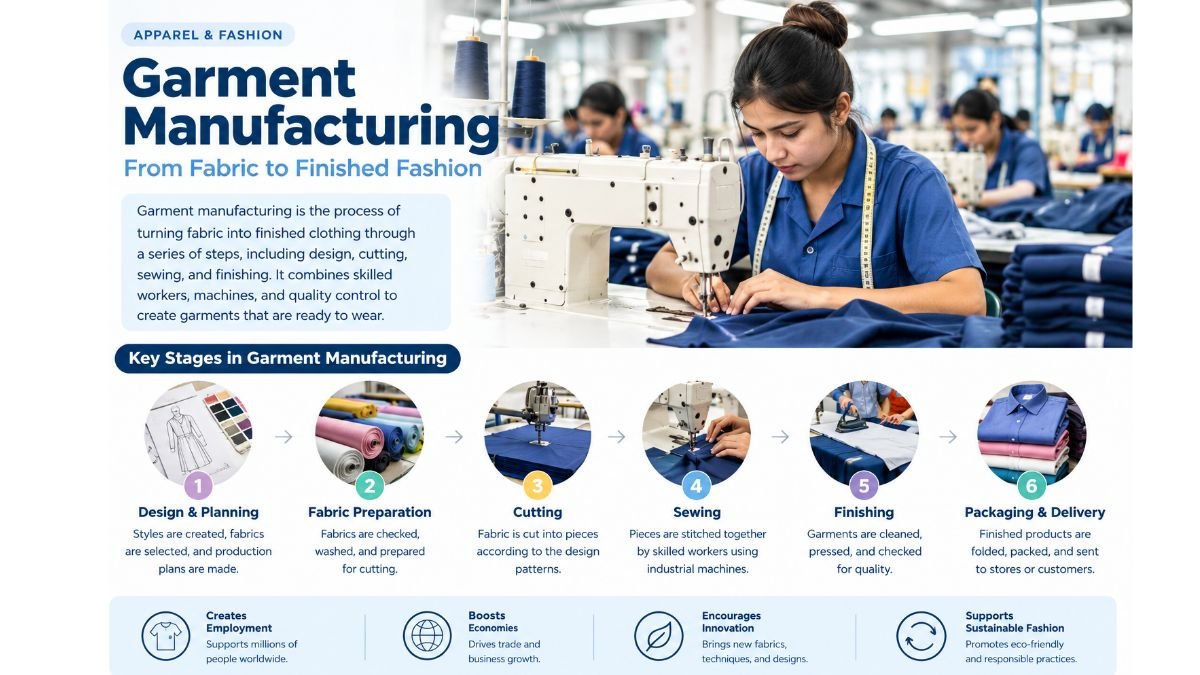
Textile production and garment manufacturing are closely connected, but they are not identical.
Textile production generally focuses on fibers, yarns, and fabrics.
Garment manufacturing uses fabrics and other materials to create finished clothing.
For example:
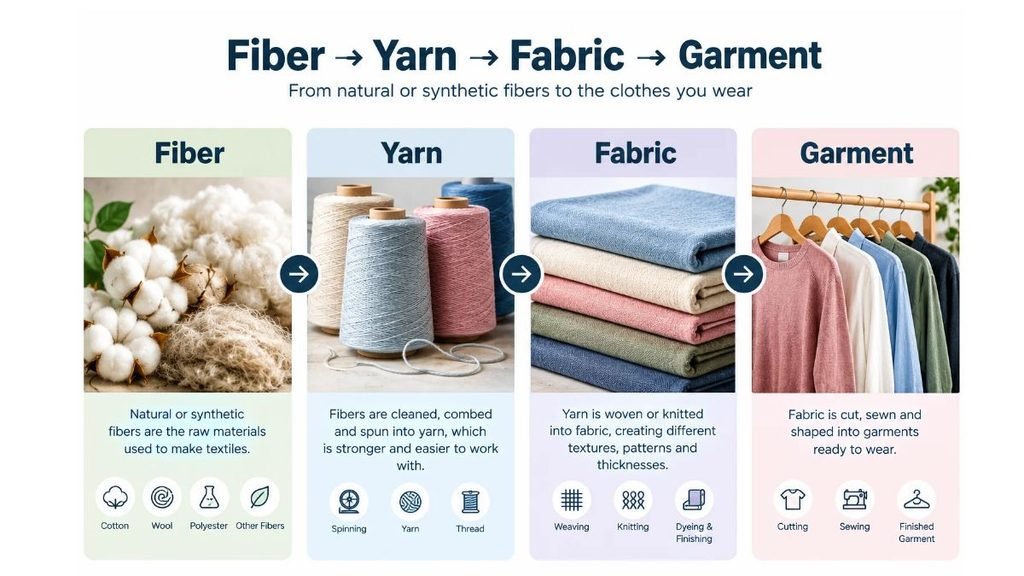
Fiber → Yarn → Fabric → Garment
A cotton fiber may become yarn. The yarn can become knitted fabric. That fabric can then be cut and sewn into a T-shirt.
Modern apparel production can include:
- Pattern development
- Fabric selection
- Fabric cutting
- Sewing
- Printing
- Embroidery
- Label application
- Quality control
- Packaging
This distinction is important when researching the textile industry meaning because the textile industry is part of a much wider supply chain.
How Modern Textile Manufacturing Works
Modern textile manufacturing combines traditional principles with advanced machinery and quality systems.
A simplified process may look like this:
1. Fiber Selection
Manufacturers select natural, synthetic, or blended fibers based on the intended product.
2. Fiber Preparation
Raw fibers are cleaned and prepared for further processing.
3. Spinning
Fibers are converted into yarn.
4. Fabric Formation
Yarn is woven or knitted into fabric.
5. Dyeing
The fabric or yarn can be colored using suitable dyeing methods.
6. Printing
Designs can be applied through different printing techniques.
7. Finishing
Finishing processes can change the fabric’s appearance, hand feel, performance, or other characteristics.
8. Inspection
Fabric is checked for issues such as defects, measurements, color consistency, and construction.
9. Garment Manufacturing
When the fabric is intended for clothing, it can move into cutting, sewing, decoration, and finishing.
This process varies depending on the material and product.
The Role of Fabric Weight and GSM
Fabric weight is another important part of modern textile production.
GSM means grams per square meter. It describes the weight of a fabric.
A lower GSM fabric may feel lighter, while a higher GSM fabric may feel heavier. However, GSM alone does not determine quality.
Other factors matter too, including:
- Fiber composition
- Yarn construction
- Fabric structure
- Finishing
- Stretch
- Density
- Intended use
For example, a lightweight T-shirt and a heavy hoodie require different fabric specifications.
Understanding fabric characteristics helps brands make better product-development decisions.
Textile Technology and Modern Innovation
Technology continues to change the textile industry.
Modern textile development includes automated machinery, digital design systems, improved testing, advanced finishing methods, and technical textiles.
Digital textile printing allows detailed designs to be applied to fabric.
Modern knitting systems can produce complex structures with less manual intervention.
Technical textiles are also becoming increasingly important.
They can be designed for applications such as:
- Sports performance
- Medical products
- Protective equipment
- Transportation
- Construction
- Filtration
- Industrial applications
Textiles are therefore no longer limited to traditional clothing and household fabrics.
Sustainable Textile Development
Environmental concerns have also influenced modern textile production.
The industry faces questions about:
- Water use
- Energy consumption
- Chemical management
- Textile waste
- Fiber selection
- Product durability
- Recycling
- Production efficiency
Different manufacturers and researchers are exploring ways to reduce waste and improve resource efficiency.
Examples include recycled fibers, improved dyeing systems, longer-lasting products, and production processes designed to reduce unnecessary material use.
Sustainability is a complex subject, so claims should be evaluated based on specific materials, processes, evidence, and supply-chain practices.
The Global Textile Industry Today
The modern textile industry is global.
Raw materials may come from one country, yarn may be produced in another, fabric may be manufactured somewhere else, and finished garments may be made in another location.
This creates complex international supply chains.
Modern textile and apparel businesses often coordinate:
- Material sourcing
- Product development
- Fabric production
- Sampling
- Manufacturing
- Quality control
- Packaging
- Export documentation
- International shipping
Different countries and regions have developed strengths in different parts of textile and apparel production.
This global structure allows brands to source materials and manufacturing services from international suppliers.
Textile Industry vs Apparel Industry
The terms textile industry and apparel industry are sometimes used together, but they describe different areas.
| Textile Industry | Apparel Industry |
| Focuses on fibers, yarns, and fabrics | Focuses on finished clothing |
| Includes spinning | Includes cutting and sewing |
| Includes weaving and knitting | Includes garment construction |
| Includes dyeing and finishing | Includes branding and packaging |
| Supplies fabric to many industries | Primarily creates wearable products |
There is significant overlap between the two.
A vertically integrated company may handle several stages, while other businesses specialize in only one part of the supply chain.
Why Textile History Still Matters to Clothing Brands
Understanding textile history can help modern clothing businesses appreciate how materials and production methods developed.
It also helps explain why different fabrics behave differently.
A brand developing a new garment may need to consider:
- Fiber composition
- Fabric structure
- GSM
- Stretch
- Durability
- Color
- Finishing
- Printing
- Embroidery
- Construction
- Intended use
For custom apparel, these decisions can affect both product performance and manufacturing requirements.
A technical specification or tech pack can help communicate these requirements clearly to a manufacturer.
The Role of Textile Manufacturers in Modern Clothing Production
A modern clothing manufacturer may work with different textile materials depending on the product.
For example, Fashion Soul International operates as a factory-owned custom clothing manufacturer in Sialkot, Pakistan. Its services include private-label, OEM, ODM, white-label, cut-and-sew, and full-package apparel production.
Its manufacturing workflow can include fabric and trim sourcing, product development, sampling, bulk production, quality control, branding, packaging, and export documentation.
This illustrates how modern apparel manufacturing connects with the wider textile supply chain.
A clothing brand may begin with an idea, reference image, sketch, or tech pack. The manufacturer then helps translate that product concept into a physical garment through material selection, sampling, production, and quality checks.
How Textile History Influences Modern Fabric Choices
Historical textile development gave manufacturers a wide range of materials and techniques.
Today, brands can choose from many fabric categories.
Common options include:
- Cotton
- French terry
- Fleece
- Polyester
- Interlock
- Stretch fabrics
- Nylon
- Denim
- Twill
- Canvas
- Oxford fabric
The right choice depends on the product.
A heavyweight hoodie may require a very different fabric from a lightweight performance T-shirt.
Similarly, activewear may require stretch and moisture-management properties, while workwear may prioritize durability and construction.
The Future of the Textile Industry
The textile industry will continue to change as technology, consumer expectations, and manufacturing systems develop.
Future developments may involve greater automation, digital manufacturing, advanced materials, recycling technologies, and improved production efficiency.
Artificial intelligence and digital tools may also influence textile design, product development, forecasting, and manufacturing management.
However, fundamental textile principles will remain important.
Fibers still need to become yarn. Yarn still needs to become fabric. Fabric still needs to meet the requirements of its intended use.
Technology changes the tools, but material knowledge and manufacturing fundamentals remain essential.
Frequently Asked Questions
What is the textile industry?
The textile industry is the sector involved in producing and processing fibers, yarns, fabrics, and related textile materials. It supports clothing, home textiles, industrial products, technical textiles, and many other applications.
What is the textile industry definition in simple words?
The textile industry can be defined as the industry that converts fibers and other raw materials into yarn, fabric, and textile products through processes such as spinning, weaving, knitting, dyeing, printing, and finishing.
What does textile industry meaning refer to?
The textile industry meaning refers to the complete economic and manufacturing sector associated with textile materials. It includes raw fibers, yarns, fabrics, processing, finishing, and related production activities.
When did the textile industry begin?
Textile production began thousands of years ago with people using natural fibers and other materials to create basic textiles. Industrial textile manufacturing developed much later, particularly during the Industrial Revolution.
Why was the Industrial Revolution important to textiles?
The Industrial Revolution introduced machines that greatly increased spinning and weaving productivity. Factory-based production changed the scale, speed, organization, and economics of textile manufacturing.
What is the difference between textiles and clothing?
Textiles include fibers, yarns, and fabrics, while clothing is made from fabrics and other components. Textile production can supply many industries beyond apparel.
What are the main natural textile fibers?
Common natural fibers include cotton, wool, silk, flax, and hemp. Each has different physical characteristics and uses.
What are synthetic textile fibers?
Synthetic fibers are manufactured materials such as polyester, nylon, acrylic, and elastane. They can provide characteristics such as strength, stretch, durability, and quick drying.
Why is textile manufacturing important today?
Textile manufacturing supports clothing, home products, industrial applications, sportswear, medical textiles, technical products, and many other markets. It also connects raw-material suppliers with finished-product manufacturers around the world.
Conclusion
The textile industry world history definition covers a long journey from handmade fibers and simple woven materials to advanced global manufacturing systems.
Ancient societies developed spinning, weaving, dyeing, and other textile skills. Later, mechanization transformed these crafts during the Industrial Revolution. The development of synthetic fibers and modern machinery expanded the industry’s capabilities even further.
Today, the textile industry includes fiber processing, yarn production, weaving, knitting, dyeing, printing, finishing, and technical textile development. It also plays a major role in the wider apparel supply chain.
Understanding what is the textile industry helps explain where fabrics come from and how they eventually become finished products. The textile industry definition also shows why textile production is broader than clothing manufacturing alone.
For modern fashion brands, this history provides useful context when choosing fabrics, developing products, communicating specifications, and working with manufacturers. The technology may continue to evolve, but the basic connection between fibers, yarns, fabrics, and finished products remains at the heart of the textile industry.