How Is a Cloth Made? Understanding the Process
Have you ever wondered how is a cloth made from basic fibers? The cloth used in T-shirts, dresses, hoodies, jackets, uniforms, and other garments goes through several manufacturing stages before it reaches a clothing brand or consumer.
Cloth making starts with raw fibers. These fibers are prepared, spun into yarn, formed into fabric, dyed or printed, finished, and checked for quality. The exact process depends on the type of fiber and the fabric being produced.
Understanding how material is made can help clothing brands make better decisions about fabric quality, weight, appearance, durability, and production. It is also useful for anyone interested in textile manufacturing or fashion production.
This guide explains how textile is made, how is fabric created, and how fabric eventually becomes finished clothing.
What Is Cloth?
To understand how a cloth is made, it is important to know that fabric is created by processing fibers into yarn and then converting that yarn into a usable textile material.
Cloth is a textile material made by processing fibers into a usable fabric. Fibers can come from natural sources, such as cotton and wool, or from manufactured materials, such as polyester and nylon.
The fibers are first prepared and converted into yarn in many textile processes. The yarn can then be woven, knitted, or processed using other methods to create fabric.
After the fabric is formed, it may go through dyeing, printing, finishing, and quality inspection.
The final material can then be used to make clothing and other textile products.
How Is a Cloth Made?
The basic cloth making process usually includes these stages:
- Fiber selection
- Fiber preparation
- Spinning
- Yarn preparation
- Weaving or knitting
- Dyeing
- Printing
- Finishing
- Quality control
- Fabric inspection
- Cutting and garment production
Not every fabric follows exactly the same sequence. Different fibers and fabric constructions require different processes.
For example, woven cotton fabric and knitted polyester fabric may use different production methods.
1. Natural Fibers Used in Cloth Making
The first stage is choosing the appropriate fiber.
Fiber selection has a major effect on the final fabric’s appearance, feel, strength, stretch, weight, and performance.
Natural Fibers
Natural fibers come from plants or animals.
Common examples include:
- Cotton
- Linen
- Wool
- Silk
- Hemp
Cotton is widely used for everyday apparel because it can provide softness and breathability.
Wool is commonly used for warmer clothing because of its insulation properties.
Linen is known for its lightweight feel and natural appearance.
Synthetic Fibers in the Fabric Manufacturing Process
Synthetic fibers are manufactured through industrial processes.
Common examples include:
- Polyester
- Nylon
- Acrylic
- Elastane
Synthetic fibers can provide useful properties such as durability, stretch, moisture management, and shape retention.
Some fabrics also combine natural and synthetic fibers. These blends are designed to combine different characteristics in one material.
How Is Fabric Made Through Yarn Spinning?
Once the fiber has been selected, it needs to be prepared for textile production.
For natural fibers, preparation can involve cleaning and removing unwanted materials. The fibers may then be aligned and organized.
Manufacturers need consistent fibers to produce consistent yarn.
The quality of the raw fiber can affect the final fabric. Fiber length, strength, cleanliness, and consistency are among the factors that can influence production.
This stage is an important part of understanding how material is made because the finished textile starts with the characteristics of its raw materials.
3. Spinning Fibers Into Yarn
Many fabrics are made by converting loose fibers into yarn.
This process is called spinning.
During spinning, fibers are aligned and twisted together to create a continuous strand of yarn.
The characteristics of the yarn can affect the finished fabric.
Yarn may differ in:
- Thickness
- Strength
- Twist
- Texture
- Fiber composition
- Appearance
A finer yarn can produce a different fabric feel from a thicker yarn.
Manufacturers select yarn specifications based on the intended fabric construction and end use.
For example, lightweight apparel may require different yarn characteristics from heavyweight outerwear.
4. How Textile Is Made Through Weaving
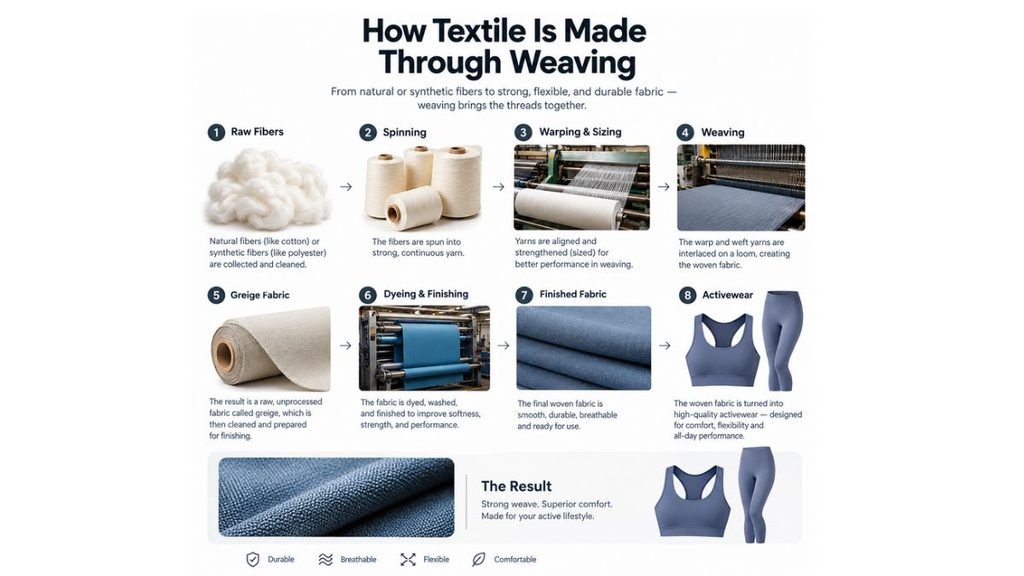
One major method of fabric production is weaving.
In weaving, two sets of yarns are interlaced.
The lengthwise yarns are called the warp. The crosswise yarns are called the weft.
The yarns are arranged in a specific structure to create the fabric.
Common woven structures include:
- Plain weave
- Twill
- Satin
Different structures produce different visual and physical characteristics.
For example, twill structures are commonly used for products such as denim, trousers, jackets, and workwear.
Woven fabrics generally have a stable structure and are widely used across fashion and apparel production.
5. How Is Fabric Created Through Knitting?
Knitting is another major way to produce fabric.
Unlike weaving, knitting forms fabric by creating interconnected loops of yarn.
Knitted fabrics can provide flexibility and stretch, depending on the construction.
They are widely used for:
- T-shirts
- Sweatshirts
- Sportswear
- Activewear
- Polo shirts
- Underwear
- Casual clothing
There are different types of knitting, including weft knitting and warp knitting.
The construction selected depends on the required fabric properties.
When asking how is fabric created, it is important to remember that there is no single production method. Fabric construction depends on the desired end product.
6. Understanding Fabric Weight and GSM
Fabric weight is an important consideration in apparel production.
One common measurement is GSM, which means grams per square meter.
GSM helps describe how heavy a fabric is.
For example, a lightweight T-shirt fabric may have a lower GSM than a heavyweight hoodie fabric.
However, GSM does not tell you everything about fabric quality.
Two fabrics can have similar GSM values but feel and perform differently because they use different fibers, yarns, constructions, and finishes.
Fashion brands should therefore consider GSM together with fiber composition, fabric construction, stretch, softness, durability, and intended use.
7. Dyeing the Fabric
After fabric construction, the material may be dyed.
Dyeing adds color to the textile.
The exact dyeing method depends on the fiber, fabric construction, desired color, and production requirements.
Color consistency is important in apparel production. A brand may require the fabric color to match an approved sample or a specific color standard.
Manufacturers also need to consider how the fabric will behave during washing and use.
Poor color control can create differences between production batches.
For clothing brands, fabric approval before bulk production can therefore help reduce unexpected results.
8. Printing the Fabric
Some fabrics are printed with patterns, graphics, logos, or other designs.
Printing can be performed using different techniques depending on the material and design.
For apparel, decoration methods may include:
- Screen printing
- Digital printing
- Sublimation
- Discharge printing
- Heat transfer
- Foil printing
The appropriate technique depends on the fabric, artwork, durability requirements, quantity, appearance, and production budget.
There is no single printing method that works best for every garment.
For example, sublimation is commonly associated with certain polyester-based applications, while screen printing is widely used for apparel graphics.
9. Fabric Finishing
After dyeing or printing, fabric may receive additional finishing treatments.
Finishing can change the fabric’s appearance, texture, performance, or handle.
Depending on the material, finishing can include treatments such as:
- Softening
- Brushing
- Washing
- Enzyme treatment
- Stone washing
- Pigment finishing
- Overdyeing
Finishing requirements should be selected according to the intended product.
For example, a fashion brand may want a particular washed appearance, while an activewear brand may prioritize performance characteristics.
10. Fabric Quality Control
Quality control is an important part of fabric production.
Manufacturers need to check the material before it moves into garment production.
Quality checks can consider:
- Fabric width
- GSM
- Color
- Construction
- Surface appearance
- Defects
- Shrinkage
- Stretch
- Measurements
- Color consistency
The exact inspection process depends on the fabric and product requirements.
Quality control helps identify problems before large quantities of garments are cut and sewn.
This is especially important for clothing brands ordering custom production.
How Are Clothes Produced From Fabric?
Fabric production and garment production are related but different processes.
Fabric is first produced as a textile material. That material then becomes part of the cloth making process for finished garments.
So, how are clothes produced after the fabric is ready?
The garment manufacturing process commonly includes:
- Design development
- Technical specifications
- Pattern development
- Fabric selection
- Sample development
- Cutting
- Sewing
- Decoration
- Quality control
- Labeling
- Packaging
- Shipping
Each stage affects the final garment.
11. Creating the Garment Design
Before production begins, a clothing brand needs to define the garment.
The design may include:
- Garment style
- Measurements
- Fabric
- Color
- Fit
- Construction
- Stitching
- Trims
- Labels
- Graphics
- Packaging
A brand may start with a sketch, mood board, reference garment, reference images, creative brief, or technical pack.
Clear information helps the manufacturer understand what the final product should look like.
12. Pattern Development
The garment pattern defines the shapes and pieces that will be cut from the fabric.
Patterns must be developed according to the garment’s measurements and construction.
A T-shirt, hoodie, jacket, pair of trousers, and sports uniform all require different pattern structures.
The pattern also affects fit.
A small adjustment to a pattern can change how a garment sits on the body.
For custom clothing, pattern development is therefore an important stage before bulk cutting.
13. Making the First Sample
Before bulk production, manufacturers generally develop a sample.
A physical sample allows the brand to review the actual garment.
The sample can be checked for:
- Fit
- Measurements
- Fabric
- Color
- Construction
- Stitching
- Decoration
- Labels
- Overall appearance
If changes are needed, the sample can be revised.
Approving a physical pre-production sample helps establish a clear production reference.
Fashion Soul International states that its workflow includes fabric and material sourcing, pre-production sample development, physical sample approval, bulk production, inline quality control, pre-shipment inspection, AQL audit, packaging, export documentation, and shipping. Bulk production begins after physical pre-production sample approval.
14. Cutting the Fabric
Once the sample and specifications are approved, fabric can be prepared for cutting.
Fabric layers are arranged according to the production requirements.
Patterns are then used to cut the individual garment components.
Accurate cutting is important because incorrect pieces can affect the final garment.
The cutting process must also consider fabric direction, pattern placement, print alignment, and other construction requirements.
15. Sewing the Garment
After cutting, the fabric pieces move to sewing.
Different sewing operations are used to assemble the garment.
For example, a T-shirt may require operations for:
- Shoulder seams
- Neckline
- Sleeves
- Side seams
- Bottom hem
A jacket can require considerably more construction steps.
The type of stitch, seam, thread, and machine can depend on the garment design and fabric.
16. Adding Branding and Decoration
Once the garment is constructed, branding elements can be added.
These may include:
- Woven labels
- Printed labels
- Hang tags
- Embroidery
- Screen printing
- Heat transfers
- Rubber patches
- Other custom details
Branding should be planned before production because placement, materials, and decoration methods can affect construction.
For private-label clothing, branding is often an important part of the finished product.
17. Final Quality Control
Finished garments need to be checked before packaging and shipping.
Quality control can compare production garments against the approved specifications and sample.
Checks may include:
- Measurements
- Stitching
- Fabric appearance
- Color
- Print placement
- Embroidery
- Labels
- Trims
- Construction
- General workmanship
For example, Fashion Soul International states that its quality process includes inline inspection, pre-shipment inspection, measurement checks against specifications, approved-sample comparison, print registration, trim attachment, and an AQL 2.5 audit.
Fabric Production vs Garment Production
It is useful to understand the difference between fabric production and garment production.
Fabric Production
Fabric production turns fibers or yarns into textile material.
It can include:
- Fiber preparation
- Spinning
- Weaving
- Knitting
- Dyeing
- Printing
- Finishing
- Inspection
Garment Production
Garment production turns fabric into finished clothing.
It can include:
- Design
- Pattern development
- Sampling
- Cutting
- Sewing
- Decoration
- Quality control
- Packaging
Therefore, when someone asks how is a cloth made, they may be asking about fabric production. When they ask how are clothes produced, they are usually asking about the garment manufacturing stage.
How Material Choice Affects Clothing
The material selected for a garment affects many parts of production.
A brand should consider:
Comfort
The fiber and fabric construction influence how the garment feels against the skin.
Weight
GSM can help brands define whether a fabric is lightweight, medium-weight, or heavyweight.
Durability
Fiber type, yarn construction, fabric structure, and finishing can affect durability.
Stretch
Knitted construction and stretch fibers can provide different levels of flexibility.
Appearance
Dyeing, printing, finishing, and fabric construction affect the final visual appearance.
End Use
A fabric for gymwear may need different characteristics from a fabric for formal clothing or heavy workwear.
Choosing Fabric for Custom Clothing
Clothing brands should not select fabric based only on appearance.
Before ordering, consider:
- Fiber composition
- GSM
- Fabric construction
- Stretch
- Color
- Shrinkage
- Softness
- Durability
- Intended use
- Decoration method
- Washing requirements
- Production quantity
A manufacturer can help identify suitable fabric options based on the garment design and requirements.
Fashion Soul International’s stated manufacturing expertise includes fabric sourcing, pattern development, pre-production sampling, custom branding, quality inspection, and full-package production.
What Happens When a Brand Wants Custom Fabric and Clothing?
A clothing brand may approach a manufacturer with a complete design or an early concept.
The starting material can include:
- Technical pack
- Sketch
- Reference image
- Reference garment
- Mood board
- Design brief
The manufacturer can then review the requirements and determine the appropriate production process.
For more complex designs, a detailed technical pack can help communicate measurements, construction, fabric, trims, artwork, and other specifications.
However, a brand does not always need to have every production detail completed before contacting a manufacturer.
How the Cloth Making Process Supports Different Apparel Products
Different clothing categories require different fabrics and construction methods.
T-Shirts
T-shirts commonly use knitted fabrics such as cotton jersey or blended jersey.
Hoodies
Hoodies often use heavier knitted materials such as fleece or French terry.
Activewear
Activewear can use synthetic or blended fabrics designed for stretch, movement, and moisture management.
Denim
Denim is generally made using a woven twill construction.
Jackets
Jackets can use woven fabrics such as nylon, polyester, cotton, twill, canvas, or other materials.
Workwear
Workwear often requires fabrics selected for durability and the intended working environment.
The right fabric depends on the product requirements rather than a single universal material.
What Clothing Brands Should Ask a Manufacturer
Before starting production, brands should ask clear questions about the material and manufacturing process.
Important questions include:
- What fabric options are available?
- What is the GSM?
- What is the fiber composition?
- Can the fabric be customized?
- What sample process is used?
- How is fabric quality checked?
- What is the MOQ?
- Which decoration methods are available?
- What branding options are available?
- How is the finished garment inspected?
- What are the estimated production timelines?
- Which shipping options are available?
Clear answers help brands understand the production process before committing to bulk manufacturing.
Working With a Custom Clothing Manufacturer
For brands that want finished apparel rather than fabric alone, a manufacturer can support multiple stages.
Fashion Soul International is a factory-owned custom clothing manufacturer based in Sialkot, Pakistan. Its stated services include private-label, OEM, ODM, white-label, cut-and-sew, and full-package production. The company also supports fabric and trim sourcing, sampling, bulk production, quality control, branding, packaging, export documentation, and international shipping.
Its website states that the company has served more than 2,500 brands, has more than 250 workers, and has production capacity of approximately 50,000 to 100,000 garments per month. These are company-published figures and should be understood in that context.
For a brand, the useful point is that fabric development and garment manufacturing can be connected within one production workflow.
Common Mistakes in Fabric and Clothing Production
Understanding how is a cloth made also helps brands avoid common production problems.
Choosing Fabric Only by Appearance
A fabric may look attractive but may not perform well for the intended product.
Ignoring GSM
GSM can affect the weight and feel of the finished garment.
Skipping Sampling
Bulk production without reviewing a physical sample can create avoidable problems.
Providing Incomplete Specifications
Missing measurements, colors, artwork, or construction details can create confusion.
Ignoring Shrinkage
Some fabrics can change after washing or finishing. This should be considered during development.
Selecting the Wrong Decoration Method
Printing and embroidery methods should be selected according to fabric, design, durability, quantity, and appearance.
Focusing Only on Price
Material quality, construction, inspection, communication, and production requirements also affect the final product.
Frequently Asked Questions
How is a cloth made from cotton?
Cotton fibers are cleaned and prepared, then spun into yarn. The yarn is woven or knitted into fabric. The fabric can then be dyed, printed, finished, and inspected before being used to make garments.
How material is made into fabric?
Raw fibers are processed into yarn or prepared for a textile-forming process. The material is then woven, knitted, or otherwise formed into fabric. Additional dyeing and finishing processes create the desired appearance and performance.
How textile is made?
Textile production can involve fiber preparation, spinning, weaving or knitting, dyeing, printing, finishing, and quality inspection. The exact process depends on the fiber and fabric type.
How is fabric created?
Fabric can be created by weaving yarns together or knitting yarn into interconnected loops. Other textile technologies can create different fabric structures.
How are clothes produced?
Clothes are produced by developing a design, creating patterns, selecting fabric, making samples, cutting the fabric, sewing garment pieces together, adding decoration and branding, inspecting the finished product, and packaging it.
What is the cloth making process?
The cloth making process generally starts with fiber selection and preparation. It may continue through spinning, weaving or knitting, dyeing, printing, finishing, and quality inspection.
What is fabric production?
Fabric production is the process of turning fibers or yarns into textile material. It includes processes such as spinning, weaving, knitting, dyeing, printing, finishing, and inspection.
Does GSM determine fabric quality?
No. GSM describes fabric weight, but it does not independently determine quality. Fiber composition, construction, yarn, finishing, durability, and intended use also matter.
Is fabric production the same as clothing production?
No. Fabric production creates the textile material. Clothing production uses that material to create finished garments through pattern making, cutting, sewing, decoration, quality control, and packaging.
Conclusion
Understanding how is a cloth made gives clothing brands a clearer view of what happens before a garment reaches the customer.
The process begins with fiber selection and preparation. Fibers may be spun into yarn and then woven or knitted into fabric. The material can then be dyed, printed, finished, and inspected.
After fabric production, garment manufacturing begins. Designers and manufacturers develop patterns, create samples, cut fabric, sew the pieces together, add branding, perform quality checks, and prepare the finished garments for packaging and shipping.
The right material depends on the product’s intended use. Fiber composition, GSM, construction, stretch, appearance, durability, and finishing all deserve attention.
For clothing brands, understanding these stages makes it easier to communicate with manufacturers and make informed production decisions. Whether you are developing T-shirts, hoodies, sportswear, activewear, jackets, workwear, or other apparel, knowing the journey from fiber to finished garment can help you plan the product more effectively.