Textile Manufacturing News: Latest Trends, Innovations, and Industry Updates
The textile industry is changing as manufacturers respond to new technologies, sustainability demands, and shifting global markets. From advanced smart fabrics to textile recycling, these developments influence how materials are designed, produced, processed, and sold. Following textile manufacturing news helps clothing brands, fabric suppliers, manufacturers, and fashion businesses understand these changes and make better decisions.
The industry is also facing challenges, including production costs, supply chain uncertainty, environmental regulations, and changing customer expectations. Businesses must balance quality, affordability, innovation, and responsible production to remain competitive.
This guide explores important textile industry developments, smart fabric innovations, sustainability trends, textile care improvements, and the issues manufacturers should monitor.
What Is Textile Manufacturing News?
Textile manufacturing news covers developments affecting the production of fibers, yarns, fabrics, and finished textile products. It includes updates about manufacturing technology, raw materials, factory operations, international trade, sustainability, research, and market demand.
For example, news about automated knitting machines can help manufacturers understand new production methods. Updates about recycled fibers can help clothing brands explore alternative materials. Reports about energy prices and export policies can also influence sourcing decisions.
Textile news is relevant to several groups:
- Clothing brands: Understand fabric availability, product innovation, and sourcing opportunities.
- Textile manufacturers: Monitor equipment, production methods, and operating costs.
- Fabric suppliers: Follow material demand and changing buyer preferences.
- Fashion designers: Discover new textures, performance fabrics, and sustainable materials.
- Retailers and wholesalers: Understand product trends and supply chain developments.
Reliable industry reporting helps these businesses separate confirmed developments from speculation. It also provides context for understanding how individual announcements may affect the wider textile market.
Textile Manufacturing News Today: Key Industry Developments
People searching for textile manufacturing news today often want recent announcements, manufacturing investments, technology updates, and changes in international trade.
As of October 2026, several developments are particularly relevant to the textile sector.
1. Textile Recycling Is Receiving Greater Attention
Textile waste has become an important issue for manufacturers, brands, and policymakers. Many businesses are exploring ways to reuse fabric scraps, recover fibers, and design garments that are easier to recycle.
However, textile-to-textile recycling still faces economic and infrastructure challenges. Mixed-fiber fabrics, dyes, finishes, buttons, zippers, and elastic components can make recycling more difficult.
A report highlighted by TexData International on October 8, 2026, discussed the barriers to bringing textile-to-textile recycling to commercial scale. These include the economics of processing waste and the infrastructure needed to collect and sort materials.
Manufacturers can respond by reducing cutting waste, separating fabric leftovers, evaluating recyclable materials, and improving product design. These steps do not eliminate every recycling challenge, but they can help prepare businesses for changing market expectations.
2. Alternative Fibers Are Expanding Material Choices
Another important development involves fibers made from agricultural residues and other alternative sources. These materials may reduce dependence on conventional forest-based fibers in some applications.
A Reuters report published on October 14, 2026, described efforts to develop textile fibers from agricultural residues, including wheat and rice straw. It also noted that scaling these alternatives remains a major challenge.
For textile manufacturers, the key question is whether a new fiber can meet commercial requirements. Businesses must assess strength, softness, color consistency, processing compatibility, cost, and availability before adopting unfamiliar materials.
Alternative fibers may create opportunities, but their suitability depends on the intended product and the performance required.
3. Production Costs and Trade Conditions Remain Important
Textile manufacturers operate within international supply chains. Changes in energy prices, cotton availability, transportation costs, currency exchange rates, and trade policies can affect production planning.
Recent Pakistani textile-sector coverage has discussed export competitiveness, production costs, and policy support. These issues matter because manufacturers must maintain consistent quality while managing expenses.
Businesses can reduce uncertainty by reviewing supplier quotations, confirming material availability early, monitoring lead times, and avoiding dependence on a single source for critical materials.
Current news should always be checked against the publication date and the relevant market. A development affecting one country may not apply equally to manufacturers in another region.
Smart Textiles News Today: How Fabric Technology Is Advancing
Smart textiles news today covers developments in fabrics that can sense, respond to, or interact with their surroundings. Unlike conventional materials, smart textiles may include electronic components, responsive fibers, sensors, or specialized structures.
These technologies are attracting interest in healthcare, sportswear, protective clothing, automotive interiors, and other technical applications.
What Are Smart Textiles?
Smart textiles are materials designed to provide functions beyond ordinary fabric properties. Depending on their construction, they may monitor movement, respond to temperature, transmit signals, or support electronic devices.
There are several broad categories:
- Passive smart textiles: Detect environmental or physical conditions but do not actively change their behavior.
- Active smart textiles: Respond to stimuli such as heat, moisture, or pressure.
- Highly integrated smart textiles: Combine sensing, processing, or communication technologies with textile structures.
The exact capabilities depend on the materials and components used. Not every fabric marketed as innovative is an electronic or smart textile.
Wearable Sensors and Health Monitoring
One growing research area involves fabrics that monitor body movement or physiological signals. Such materials could support rehabilitation, sports performance analysis, and certain healthcare applications.
A smart garment might use integrated sensors to collect movement data. A connected system could then help a professional or user review relevant information.
However, practical adoption requires more than working sensors. Developers must consider comfort, washing durability, electrical safety, reliability, and the accuracy of collected measurements.
These requirements can make smart garments more complex to manufacture than conventional clothing.
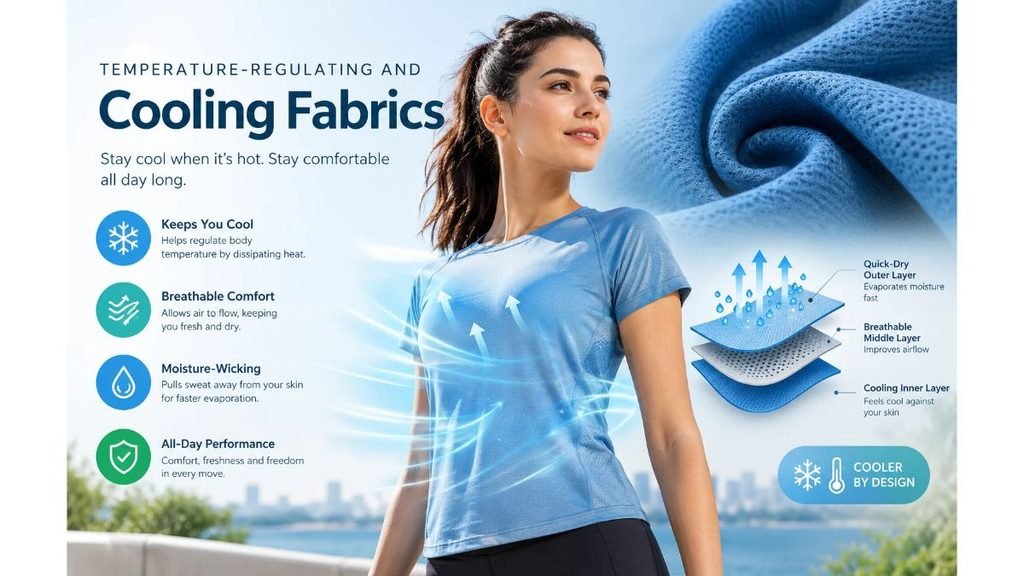
Temperature-Regulating and Cooling Fabrics
Temperature management is another area of textile innovation. Researchers and manufacturers are developing materials designed to improve comfort in hot or cold conditions.
Possible approaches include moisture management, specialized fiber structures, reflective surfaces, and materials that respond to temperature changes.
Cooling fabrics may be useful for sportswear, workwear, outdoor apparel, and protective garments. Their performance must be evaluated under realistic conditions, because laboratory results do not always translate directly into everyday use.
Manufacturers should also consider durability. A fabric that performs well initially may lose some of its properties after repeated washing or wear.
Robotics and On-Demand Apparel Production
Technology is also changing how garments may be produced. Textile industry reporting in September 2026 described a robot-driven microfactory concept designed to support on-demand smart apparel production.
Such approaches could eventually help manufacturers produce customized products with less reliance on large standardized production runs. However, commercial adoption depends on equipment costs, production speed, technical reliability, and the range of products the system can handle.
For small clothing brands, the wider lesson is to watch how automation affects sampling, customization, and minimum order quantities rather than assuming that every new technology is already commercially available.
Fabric Industry News: Materials and Market Trends
Fabric industry news helps businesses understand changes in material development, supply, pricing, performance, and customer demand.
Fabric decisions affect the appearance, comfort, durability, and cost of finished garments. For this reason, clothing brands should follow material developments as closely as fashion trends.
Sustainable and Recycled Fabrics
Recycled polyester, recycled cotton, and fabrics made with reclaimed textile fibers are part of the industry’s broader sustainability discussion.
Each material has different properties and limitations. Recycled polyester may be suitable for some sportswear and outerwear products, while recycled cotton may be considered for casual garments and selected woven or knitted applications.
Brands should ask suppliers about fiber composition, material traceability, testing, and relevant documentation. A recycled-content claim should be supported by appropriate evidence.
Recycled materials do not automatically make a garment sustainable in every respect. Product lifespan, processing methods, transportation, and end-of-life options also matter.
Natural Fibers and Alternative Materials
Cotton, wool, linen, and other natural fibers remain important in textile production. At the same time, researchers and manufacturers continue to explore alternative fiber sources.
Material selection depends on the garment’s purpose. Cotton may suit everyday T-shirts, while polyester blends may offer useful performance properties for activewear. Linen can be valued for its texture and breathability, although its care and wrinkle behavior differ from those of other fibers.
Brands should compare the full material specification rather than selecting fabric based on fiber name alone.
Performance Fabrics for Sportswear
Sportswear and activewear require materials that support movement, comfort, and durability. Depending on the design, manufacturers may use polyester interlock, stretch blends, moisture-wicking fabrics, or four-way stretch materials.
Four-way stretch allows fabric to stretch across both its width and length. This can help support movement in leggings, fitted tops, and other performance garments.
Moisture-wicking fabrics are designed to move moisture away from the skin toward the fabric surface, where it may evaporate. Their performance depends on fiber type, construction, finishing, and garment design.
Brands should test stretch recovery, opacity, colorfastness, seam strength, and wash performance before approving bulk production.
Digital Printing and Fabric Customization
Digital textile printing allows designs to be applied directly to suitable fabrics using specialized printing equipment. It can be useful for detailed graphics, complex color patterns, and selected short-run projects.
Screen printing, sublimation, embroidery, and other decoration methods remain relevant, depending on the fabric and intended result.
No single method is ideal for every project. The right choice depends on fabric composition, order quantity, design complexity, durability expectations, and cost.
Before placing a production order, brands should request samples to assess color accuracy, print quality, fabric feel, and performance after washing.
Textile Manufacturing Technology and Automation
Technology plays an important role in improving production consistency and reducing avoidable waste. Textile mills and garment factories may use digital design systems, automated cutting equipment, computerized knitting machines, and production monitoring tools.
Computer-Aided Design
Computer-aided design software helps technical teams develop patterns, visualize products, and prepare production specifications.
Digital files can improve communication between designers, pattern makers, and manufacturers. They may also make it easier to revise measurements and grading specifications.
However, software does not replace accurate input. Incorrect measurements, unclear construction details, or unsuitable material specifications can still cause production problems.
Automated Cutting and Production Planning
Automated cutting systems can help factories cut fabric according to digital patterns. When correctly configured, they can support consistency and material efficiency.
Production planning software can also help teams coordinate orders, track stages of production, and identify delays.
The benefits depend on factory workflow, staff training, equipment maintenance, and the quality of production data. Automation should be evaluated according to a factory’s actual needs and product range.
Quality Control Through Digital Tools
Digital measurement systems, barcode tracking, and production dashboards can support quality management. They may help teams identify recurring defects or trace problems to particular production stages.
Nevertheless, physical inspections remain important. Fabric appearance, seam strength, fit, print placement, and garment finishing may require direct examination.
A practical quality system combines suitable technology with clear standards, trained workers, documented procedures, and corrective action.
Textile Care Industry News: Better Care and Longer Garment Life
Textile care industry news covers developments in garment washing, fabric maintenance, cleaning products, textile finishing, and technologies designed to preserve material performance.
Textile care matters because a garment’s useful life depends not only on how it is manufactured but also on how it is washed, dried, stored, and worn.
Advances in Fabric Finishing
Textile finishing includes treatments applied to improve a material’s appearance or performance. Depending on the application, finishing may affect softness, wrinkle behavior, water resistance, or surface texture.
Some garments receive enzyme washing, garment dyeing, or other treatments to achieve a particular look and feel.
These processes must be selected carefully. Excessive or unsuitable treatment may weaken fibers, alter measurements, or affect color consistency.
Manufacturers should establish clear finishing specifications and test the results before approving large production quantities.
Washing Durability and Colorfastness
Colorfastness describes a material’s ability to resist color loss or transfer under specified conditions. It is important for garments that may experience frequent washing, rubbing, perspiration, or exposure to light.
Brands can request relevant laboratory tests based on the intended product and market requirements.
Shrinkage testing is also useful, especially for cotton garments and other materials that may change dimensions during washing. Pre-production testing helps teams identify problems before products reach customers.
Easier-Care Fabrics
Consumers often look for clothing that is easy to maintain. Depending on the intended use, manufacturers may select fabrics that dry quickly, resist wrinkles, or retain their shape through regular washing.
Care performance should not be judged by appearance alone. A fabric should be tested for comfort, durability, dimensional stability, and any claims made about its performance.
Clear care labels also help consumers maintain garments correctly.
Sustainability and Environmental Responsibility in Textile Production
Sustainability remains an important theme across textile manufacturing. Manufacturers face pressure to use resources efficiently, reduce waste, manage chemicals responsibly, and improve transparency.
The most useful approach is to focus on measurable practices rather than broad environmental claims.
Reducing Water and Energy Use
Dyeing, washing, and finishing can require substantial water, heat, and energy. Facilities may investigate process optimization, equipment improvements, water reuse, or more efficient heating systems.
The best solution depends on the process, factory infrastructure, local resource availability, and investment requirements.
Businesses should measure consumption before making claims about improvements. Specific data offers a stronger basis for decision-making than vague statements about being environmentally friendly.
Managing Chemical Use
Dyes and finishing chemicals affect product performance and environmental outcomes. Manufacturers should follow applicable chemical requirements and obtain suitable documentation from material and chemical suppliers.
Brands selling into international markets should confirm which chemical restrictions and product-safety rules apply to their products.
Requirements can differ by destination, product type, and intended customer. A supplier’s general assurance may not replace product-specific testing or documentation.
Circular Fashion and Product Design
Circular fashion aims to keep materials and products in use for longer through durability, repair, reuse, and recycling.
Design decisions can influence whether a garment is easy to repair or process at the end of its life. For example, complex fiber blends and difficult-to-remove components can complicate recycling.
Manufacturers and brands can consider material compatibility, durable construction, reduced production waste, and practical repair options during product development.
Circularity is not achieved by using recycled material alone. It requires consideration of the product’s full life cycle.
What Textile Manufacturing News Means for Pakistan
Pakistan has an established textile and apparel sector, making international material trends, export conditions, and production technology particularly relevant to local businesses.
Manufacturers and exporters need to monitor cotton availability, energy costs, international demand, regulatory requirements, and shipping conditions. These factors can influence the price and timing of textile orders.
Sustainability and traceability are also increasingly important for companies supplying international buyers. Reporting in September 2026 discussed how the European Union’s move toward circular textiles could encourage Pakistani businesses to improve recycling systems and supply chain documentation.
The scale of the challenge differs between large mills and smaller manufacturers. Investments in testing, documentation, waste sorting, and digital systems may require additional planning and resources.
For clothing brands sourcing from Pakistan, useful questions include:
- What fabrics and material specifications can the supplier provide?
- Can the supplier arrange sampling before bulk production?
- How are measurements and construction quality checked?
- What documentation is available for materials and compliance?
- What are the minimum order quantities and estimated lead times?
- How will products be packaged and shipped to the destination?
These questions help buyers evaluate manufacturing partners using practical criteria instead of relying only on price.
How Clothing Brands Can Use Textile Industry Updates
Industry news is most valuable when it supports a clear business decision. A new fabric announcement may be interesting, but a brand should evaluate whether the material suits its product, customer, and budget.
1. Review Material Availability
Before finalizing a design, confirm that the selected fabric is available in the required composition, color, weight, and quantity.
A material that is suitable in theory may be difficult to source consistently. Alternative fabrics should be assessed before production begins.
2. Compare Total Production Costs
Fabric price is only one part of a garment’s cost. Cutting waste, decoration, labor, finishing, packaging, testing, and shipping can all affect the final price.
A lower-priced material may require more complicated processing or produce a less durable garment. Compare complete specifications rather than relying on the cost per meter alone.
3. Test New Materials Before Scaling
Request swatches or product samples before committing to bulk production. Evaluate the fabric’s appearance, feel, shrinkage, stretch, and durability.
For performance garments, test the properties that matter most to the intended customer. This could include moisture management, stretch recovery, or abrasion resistance.
4. Monitor Regulations in Target Markets
Importing requirements, chemical restrictions, labeling rules, and environmental policies can change. Brands should check current official requirements for each market where they plan to sell.
Do not assume that a requirement applying in one country automatically applies everywhere.
5. Build Strong Supplier Communication
Share clear technical specifications, artwork, size charts, packaging requirements, and quality expectations with the manufacturer.
A complete tech pack can reduce confusion during sampling and production. When a design changes, communicate the revision clearly and obtain approval before proceeding.
How to Choose a Textile or Garment Manufacturing Partner
Textile mills and garment manufacturers perform different roles. A textile mill may produce yarn or fabric, while a garment factory converts fabric into finished clothing. Some suppliers provide broader services across several stages.
The right partner depends on the product and the level of support required.
Consider the following factors when comparing suppliers:
| Evaluation area | What to check |
|---|---|
| Material options | Fiber composition, GSM, colors, and fabric availability |
| Product development | Pattern making, technical support, and sampling |
| Minimum order quantity | Required quantity per style, color, or size range |
| Quality control | Inspection procedures and testing options |
| Customization | Printing, embroidery, labels, and packaging |
| Production schedule | Sampling and bulk lead times |
| Communication | Responsiveness and clarity of specifications |
| Shipping | Available methods, documentation, and delivery terms |
Fashion Soul International is a factory-owned custom clothing manufacturer based in Sialkot, Pakistan. Its services include product development, fabric sourcing, sampling, bulk garment production, quality control, custom branding, packaging, and international shipping.
These services may be relevant to brands seeking private-label, OEM, ODM, white-label, or cut-and-sew apparel production. Buyers should confirm current minimum quantities, product capabilities, timelines, and shipping terms for their specific project before placing an order.
Where to Follow Reliable Textile Manufacturing News
Readers can monitor several types of industry sources to understand developments across the textile supply chain.
- Textile World: Industry developments, manufacturing technology, materials, and business updates.
- Pakistan Textile Journal: Textile-sector coverage, industry features, exhibitions, and regional developments.
- TextileMedia: Smart textile research and wearable technology updates.
- TexData International: News covering textile processes, recycling, machinery, and industry events.
- Reuters: Broader business, trade, sustainability, and supply-chain reporting.
These sources cover different subjects and markets. Compare publication dates, look for the original announcement or research, and distinguish reported facts from predictions or promotional claims.
For developments involving regulations, check the relevant government or regulatory authority before making business decisions.
Frequently Asked Questions
What does textile manufacturing news cover?
Textile manufacturing news covers developments in fiber production, yarn spinning, fabric manufacturing, dyeing, finishing, machinery, recycling, smart textiles, trade, and industry regulations.
Why is textile manufacturing news important for clothing brands?
It helps brands monitor fabric availability, production costs, new material options, sustainability requirements, and supply chain risks. This information can support better sourcing and product development decisions.
What is included in smart textiles news today?
Smart textile coverage includes wearable sensors, responsive materials, electronic fabrics, temperature-management technologies, and research into garments that collect or respond to data.
What are the major trends in the fabric industry?
Important trends include recycled materials, alternative fibers, performance fabrics, digital printing, manufacturing automation, improved traceability, and more efficient resource use.
Why is textile care important?
Textile care affects garment lifespan, color retention, dimensional stability, and appearance. Suitable washing, finishing, and care instructions help maintain product quality.
How can manufacturers reduce textile waste?
Manufacturers can improve pattern layouts, optimize cutting, reuse suitable fabric remnants, separate recyclable materials, and design products with durability and end-of-life processing in mind.
How often should businesses follow textile industry news?
Businesses should monitor updates regularly, particularly when they affect material sourcing, regulations, trade conditions, or production technology. High-impact developments should be verified before they influence purchasing decisions.
Conclusion
Following textile manufacturing news helps manufacturers, clothing brands, and fabric suppliers understand a rapidly changing industry. Developments in smart textiles, alternative fibers, recycling, automation, and textile care can create opportunities, but they also introduce technical and commercial challenges.
The most effective strategy is to connect industry information with practical decisions. Evaluate new materials carefully, test product performance, monitor relevant regulations, and maintain clear communication with suppliers.
For clothing brands, staying informed can support better product development and sourcing decisions. For manufacturers, it can help identify improvements in quality, efficiency, and material use. By combining reliable news with careful planning, businesses can respond more confidently to changes across the textile industry.