Supply Chain Fashion Industry: A Complete Guide to Clothing Production and Distribution
The supply chain fashion industry depends on many connected activities, from sourcing raw materials to delivering finished clothing to customers. Designers, fabric suppliers, garment factories, logistics companies, wholesalers, retailers, and online stores all play a role in moving products through this system.
A well-managed supply chain helps fashion businesses control costs, maintain product quality, manage inventory, and respond to changing customer demand. Poor coordination, however, can lead to production delays, material shortages, excess stock, and missed delivery deadlines.
Understanding the fashion supply chain is important for clothing brands of every size. Whether you are launching a startup label or managing an established apparel business, knowing how garments move through production helps you make better sourcing and manufacturing decisions.
This guide explains the garment supply chain, the garment manufacturing supply chain, each stage of the garment supply chain process, common challenges, and practical ways to build a more reliable clothing business.
What Is the Supply Chain in the Fashion Industry?
The fashion supply chain is the network of people, businesses, materials, and processes involved in creating and delivering clothing. It begins with raw materials and ends when a finished product reaches a customer.
For example, a cotton T-shirt may pass through several stages before reaching a retail store. Cotton is grown and processed into fibers. The fibers become yarn, which is knitted into fabric. The fabric is dyed, cut, and sewn into a garment. The finished T-shirt is inspected, packaged, shipped, and distributed.
Each stage depends on the previous one. If fabric arrives late, a garment factory may not be able to start cutting on schedule. If production is delayed, a retailer may receive its inventory after the intended selling season.
The fashion supply chain commonly includes:
- Raw material producers and suppliers
- Yarn and fabric manufacturers
- Dyeing and finishing facilities
- Garment manufacturers
- Printing and embroidery providers
- Quality control teams
- Packaging suppliers
- Freight and logistics companies
- Warehouses and distribution centers
- Retailers and online stores
- Final customers
Some companies manage only a few stages, while others coordinate many activities through a network of suppliers and partners.
Why Is the Fashion Supply Chain Important?
A reliable supply chain supports the financial and operational performance of a clothing business. It affects how quickly products can be developed, how much they cost, and whether customers receive the products they ordered.
1. Better Cost Management
Every stage adds costs, including raw materials, labor, processing, packaging, transportation, storage, and import duties where applicable.
Businesses that understand these costs can prepare more accurate budgets and pricing strategies. They can also compare supplier quotations more effectively.
The lowest supplier price does not always create the lowest total cost. A supplier with inconsistent quality may cause rework, returns, or missed deadlines that increase expenses.
2. Consistent Product Quality
Product quality depends on more than the final sewing process. It is influenced by fabric quality, dye consistency, measurements, stitching, trims, printing, and finishing.
Clear specifications and inspections at different stages help identify problems before they affect an entire order.
3. Reliable Delivery
Fashion products often need to reach the market at specific times. Seasonal collections, promotional launches, and retail campaigns may depend on carefully planned delivery schedules.
A coordinated supply chain helps businesses plan material purchasing, production, shipping, and inventory availability.
4. Improved Inventory Planning
Too much inventory ties up money and storage space. Too little inventory can lead to stockouts and lost sales.
Demand forecasting, supplier coordination, and production planning help brands balance inventory with expected customer demand.
5. Greater Customer Satisfaction
Customers expect clothing to match product descriptions, meet quality expectations, and arrive within the stated delivery window.
A reliable supply chain helps businesses meet these expectations and respond more effectively when problems occur.
Understanding the Garment Supply Chain
The garment supply chain focuses specifically on the activities required to turn textile materials into finished clothing and deliver those products to the market.
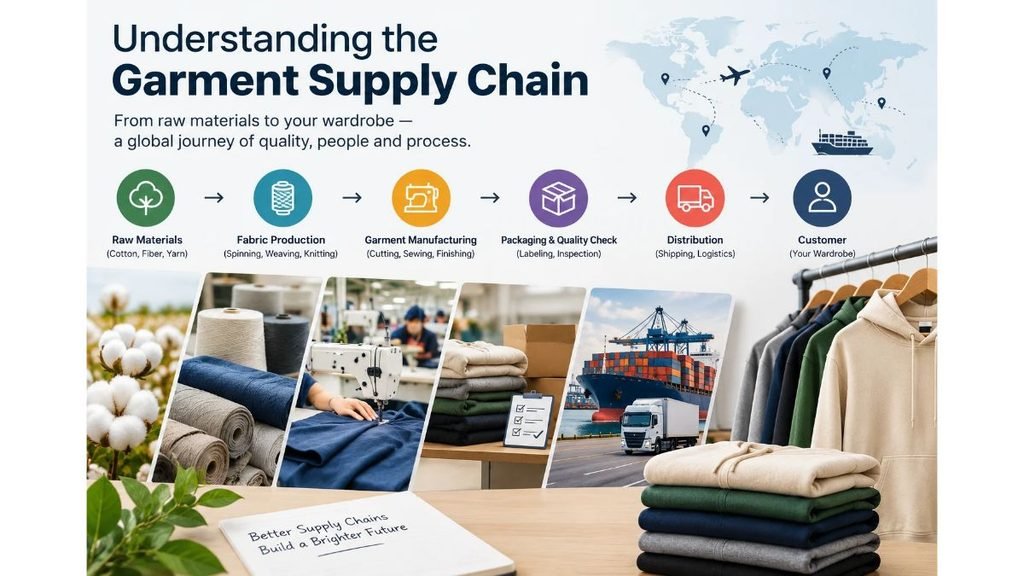
Although supply chains vary by product, a typical garment supply chain includes material sourcing, fabric production, garment manufacturing, quality inspection, packaging, shipping, and distribution.
Consider a brand preparing a new hoodie collection. The brand first defines its design, target price, fabric requirements, and expected order quantity. Suppliers then source suitable materials, and the manufacturer develops a sample.
After the sample is approved, bulk production begins. The garments pass through cutting, sewing, decoration, finishing, and inspection. They are then packed and shipped to the brand or its distribution partner.
Several parties may participate in this process. Some manufacturers manage multiple stages, while others rely on separate suppliers for fabric, washing, printing, or embroidery.
The number of suppliers involved depends on the product’s complexity, the manufacturer’s capabilities, the order quantity, and the brand’s sourcing strategy.
What Is the Garment Manufacturing Supply Chain?
The garment manufacturing supply chain is the part of the wider fashion supply chain that supports the production of clothing. It includes the materials, services, facilities, and planning activities needed to manufacture garments according to approved specifications.
This process is especially important for brands that use custom designs, private-label products, or specialized fabrics.
For example, a custom activewear order may require stretch fabric, elastic trims, specialized stitching, printed graphics, and precise measurements. If one component is unavailable, production may be delayed.
A well-organized manufacturing supply chain coordinates these requirements before and during production.
Important elements include:
- Product design and technical specifications
- Fabric and trim sourcing
- Supplier selection and purchasing
- Pattern development and sampling
- Cutting and garment assembly
- Printing, embroidery, or other decoration
- Finishing and quality inspection
- Labeling and packaging
- Shipment preparation and delivery
The process should connect product development with production planning. This reduces confusion and gives everyone involved a clearer understanding of the required product.
The Garment Supply Chain Process: Step by Step
The garment supply chain process can be divided into several stages. Understanding each stage helps brands identify possible delays and manage production more effectively.
1. Raw Material Sourcing
The process begins with raw materials used to produce fabrics, threads, and garment components.
Depending on the product, materials may include cotton, polyester, wool, linen, elastane, and other fibers. Suppliers may also provide zippers, buttons, elastic, labels, drawcords, and packaging materials.
Material selection affects product quality, comfort, durability, appearance, and cost.
A brand developing heavyweight hoodies, for example, may require a particular fleece construction and fabric weight. An activewear brand may prioritize stretch, moisture management, and recovery.
Before ordering materials, buyers should confirm specifications, availability, color options, minimum purchase requirements, and expected delivery times.
2. Yarn and Fabric Production
Raw fibers are processed into yarn or other textile structures. Yarn may then be knitted or woven into fabric.
Knitted fabrics are common in T-shirts, sweatshirts, and many activewear products. Woven fabrics are frequently used for shirts, trousers, denim, jackets, and workwear.
The choice depends on the garment’s intended use and construction.
Fabric specifications may include fiber composition, weight, width, stretch, texture, and color. GSM, or grams per square metre, measures fabric weight and is one useful specification when comparing materials.
Fabric quality should be evaluated according to the product’s requirements rather than weight alone.
3. Dyeing and Fabric Finishing
Fabric may need dyeing, printing, washing, or finishing before it is ready for garment production.
These processes influence color, texture, shrinkage, surface appearance, and performance. Some garments also require special effects, such as garment dyeing or distressed finishes.
Color consistency is particularly important when a brand orders multiple batches or matching products.
Brands should clarify color standards, finishing requirements, and acceptable variations before production. Testing shrinkage and colorfastness may also be important, depending on the fabric and intended use.
4. Product Design and Development
The design stage establishes what the finished garment should look like and how it should perform.
Designers prepare sketches, reference images, measurements, material requirements, and construction details. More complex products may need a technical pack, also called a tech pack.
A tech pack commonly includes technical drawings, a measurement chart, fabric specifications, trim details, artwork placement, and construction instructions.
Clear documentation helps suppliers understand the product and estimate production requirements.
If some details remain undecided, the brand and manufacturer should resolve them before sampling. Unclear specifications can cause repeated revisions and unnecessary delays.
5. Pattern Making and Sampling
Pattern makers develop the pieces used to cut fabric into the correct garment shapes. These patterns must reflect the intended fit, measurements, and construction.
A sample is then created to evaluate the design in physical form.
During sample review, the brand should check:
- Measurements and fit
- Fabric weight and feel
- Stitching and construction
- Color and artwork placement
- Zippers, buttons, and other trims
- Labels and finishing details
The first sample may require changes. The brand should communicate corrections clearly and approve the final pre-production sample before bulk manufacturing begins.
This approval gives the manufacturer a reference for the bulk order.
6. Fabric Inspection and Cutting
Before cutting begins, fabric should be checked against the agreed specifications. Depending on the project, checks may include color, visible defects, width, shrinkage, and consistency.
The fabric is then spread and cut according to the approved patterns.
Accurate cutting helps ensure that garment panels fit together correctly during sewing. Cutting mistakes can waste material and affect the final measurements.
Factories also plan marker layouts to use fabric efficiently. The cutting method and material usage depend on fabric characteristics, garment design, order size, and equipment.
7. Sewing and Garment Assembly
During sewing, cut fabric pieces are joined to form the garment.
The sewing sequence depends on the product. A T-shirt may require shoulder seams, sleeves, side seams, neckline finishing, and hems. A jacket may need additional panels, pockets, linings, zippers, and reinforcement.
The manufacturer must use appropriate stitching methods, thread, seam allowances, and construction techniques.
Production teams may inspect work during assembly to identify broken stitches, uneven seams, skipped stitches, and other defects before garments move to later stages.
8. Printing, Embroidery, and Branding
Many clothing products need decorative or brand-specific details after assembly or at another suitable point in production.
Common options include screen printing, embroidery, heat transfer, and other compatible decoration methods.
The correct method depends on the design, fabric, required appearance, expected durability, and order quantity.
For example, embroidery can work well for many logos, while printed graphics may be more suitable for large artwork or detailed illustrations. The manufacturer should confirm whether the selected technique is suitable for the garment.
Branding can also include woven labels, printed care labels, hang tags, and custom packaging.
9. Finishing and Quality Control
Finishing prepares garments for delivery. Depending on the product, this stage may include thread trimming, pressing, washing, measurement checks, and final appearance inspections.
Quality control can take place at several points rather than only at the end.
Inline inspection helps identify production problems while they can still be corrected. Final inspection checks whether finished products meet the approved requirements.
Inspection criteria may cover measurements, stitching, decoration, stains, fabric defects, label placement, and overall appearance.
Brands should agree on quality standards before production and clarify how defects will be handled.
10. Packaging and Labeling
After inspection, garments are folded, labeled, and packed according to the order requirements.
Packaging can include individual polybags where appropriate, size stickers, barcodes, hang tags, cartons, and brand-specific packaging.
The packaging plan should protect garments during transportation and support efficient receiving at the destination.
Brands should confirm packaging instructions early, particularly when products require retail-ready presentation or special labeling.
11. Shipping and Distribution
Finished garments are prepared for dispatch. Shipping arrangements depend on the destination, shipment size, delivery schedule, and agreed commercial terms.
Air freight may suit time-sensitive shipments, while sea freight is often considered for larger shipments where transit time allows. Other transport arrangements may be suitable depending on the route.
Export documentation may include commercial invoices, packing lists, and transport documents. Additional requirements depend on the shipment and destination.
Once the products arrive, they may move to a warehouse, distribution center, retailer, or directly to the customer.
Common Types of Fashion Supply Chain Models
Fashion brands use different supply chain models depending on their size, budget, product range, and business goals.
Traditional Retail Supply Chain
In a traditional model, a brand or retailer forecasts demand, places orders, and arranges production before selling the finished products.
This can help ensure inventory is available for a planned launch. However, inaccurate forecasts may result in excess stock or shortages.
Fast Fashion Supply Chain
Fast fashion businesses focus on responding quickly to changing trends and customer demand. Their operations may involve frequent product development, short lead times, and rapid inventory changes.
Speed can create challenges around forecasting, supplier coordination, quality, and environmental impact. The exact approach differs among companies.
Direct-to-Consumer Supply Chain
Direct-to-consumer brands sell through their own websites or other direct channels rather than relying entirely on traditional retail distribution.
This model gives brands more direct contact with customers. It also requires effective order fulfillment, inventory management, returns handling, and customer service.
Made-to-Order Supply Chain
Made-to-order businesses produce garments after receiving orders or confirmed demand.
This approach can reduce the need to hold large amounts of finished inventory. However, customers may need to wait longer, and the business must coordinate production schedules carefully.
Private-Label and Custom Manufacturing
In private-label manufacturing, a brand sells products under its own label that are produced by a manufacturing partner.
OEM, ODM, white-label, and cut-and-sew arrangements offer different levels of design ownership and customization. Buyers should confirm exactly what the supplier provides and which responsibilities remain with the brand.
Major Challenges in the Fashion Supply Chain
Fashion supply chains can involve many suppliers, countries, processes, and delivery schedules. Several challenges can affect performance.
Material Shortages and Supplier Delays
A fabric supplier may experience production delays, limited stock, or transport problems. If the material is essential to the order, garment production may be pushed back.
How to reduce the risk: Confirm material availability before approving the production schedule. Identify suitable alternatives where possible and maintain communication with suppliers.
Quality Inconsistency
Fabric shades, measurements, stitching, and decoration may vary between batches.
How to reduce the risk: Use clear specifications, approved samples, agreed inspection criteria, and documented quality checks.
Poor Demand Forecasting
Ordering too much can create excess inventory, while ordering too little can lead to missed sales.
How to reduce the risk: Use sales data, customer feedback, seasonal trends, and realistic launch plans to guide purchasing decisions.
Rising Production and Shipping Costs
Material prices, labor costs, freight rates, and duties can change. These costs may affect profitability after the initial quotation.
How to reduce the risk: Request detailed quotations, confirm what is included, and account for shipping and destination-related expenses.
Limited Supply Chain Visibility
A brand may not know whether materials have arrived, production has started, or an order has passed inspection.
How to reduce the risk: Agree on milestones and reporting methods. Request updates at key stages, including material readiness, sample approval, production, inspection, and dispatch.
Sustainability and Ethical Sourcing Concerns
Fashion supply chains can involve significant resource use, waste, and complex labor relationships.
How to reduce the risk: Ask suppliers about material origins, production practices, waste management, and relevant supporting documentation. Make claims about sustainability only when there is evidence to support them.
How to Improve Supply Chain Management in Fashion
A strong supply chain requires planning, communication, realistic expectations, and consistent monitoring.
Build Reliable Supplier Relationships
Choose suppliers based on product capability, communication, quality, delivery performance, and commercial terms.
A reliable relationship helps both parties identify problems earlier and clarify requirements before they affect production.
Do not select a supplier based on price alone. Consider the total cost of obtaining garments that meet your specifications and arrive when needed.
Create Clear Product Specifications
Document the garment’s design, fabric, measurements, construction, decoration, and packaging requirements.
When specifications are clear, suppliers can prepare more accurate quotations and reduce avoidable misunderstandings.
Approve Samples Before Bulk Production
A physical sample allows you to check the product before committing to the full order.
Record approved changes and make sure the final sample reflects the intended production standard.
Plan Lead Times Realistically
A production timeline should account for material sourcing, sampling, revisions, manufacturing, inspections, packaging, and shipping.
Do not assume that the sewing stage represents the entire order timeline. Confirm project-specific schedules with suppliers and allow time for unexpected issues.
Monitor Quality at Multiple Stages
Inspection during production can help detect issues before they affect the whole order.
Agree on quality expectations, measurement tolerances, and the process for addressing defects before production begins.
Use Digital Tools Where Helpful
Inventory systems, order tracking, shared production schedules, and digital product documents can improve communication.
Even a simple tracking sheet can help smaller businesses record supplier contacts, order quantities, sample status, delivery estimates, and inspection results.
The most useful system is one that the team can maintain accurately and consistently.
How to Choose a Garment Manufacturer for Your Brand
The manufacturer is an important part of your supply chain. The right partner should understand your product requirements and communicate clearly about feasibility, costs, and timelines.
Before selecting a manufacturer, review these factors.
Product experience: Confirm that the manufacturer can produce your garment type, whether it is streetwear, sportswear, activewear, workwear, denim, or casual clothing.
Minimum order quantity: Ask about the minimum quantity for each style and color. Requirements can vary by fabric, construction, and customization.
Sampling support: Confirm how samples are developed, how revisions are handled, and when bulk production can begin.
Material sourcing: Ask what fabric and trim options are available and whether you can specify materials or provide approved references.
Branding and packaging: Confirm the options for labels, hang tags, printing, embroidery, and packaging.
Quality control: Ask how inspections are performed and how issues are documented and resolved.
Shipping arrangements: Clarify delivery terms, shipping options, export documents, destination requirements, and costs that are not included in the production quotation.
Fashion Soul International and Garment Supply Chains
Fashion Soul International is a factory-owned custom clothing manufacturer based in Sialkot, Pakistan. It works with international apparel brands and offers private-label, OEM, ODM, white-label, cut-and-sew, and full-package production.
Its stated services cover product development, fabric and trim sourcing, sampling, bulk production, quality control, custom branding, packaging, export documentation, and international shipping.
This range of services can help buyers coordinate several parts of the garment manufacturing process with one manufacturing partner. However, the exact responsibilities and arrangements should be confirmed for each project.
Fashion Soul International publishes a standard minimum order quantity starting at 100 pieces. Actual requirements depend on the garment, fabric, color, construction, and customization. Sample development is typically stated as 7–14 business days, and bulk production timelines are generally published as 20–35 business days after sample approval. Confirm current timelines and terms directly for your order.
For a quotation, prepare the product type, design references or tech pack, estimated quantity, fabric preferences, branding requirements, and delivery destination. This information helps the manufacturer assess the project and explain the next steps.
You can learn more about its services at https://fashionsoulintl.com/.
The Role of Sustainability in the Fashion Supply Chain
Sustainability is increasingly relevant to how brands choose materials, design products, manage production, and handle unsold inventory.
The impact of a garment depends on multiple stages, including raw material production, textile processing, manufacturing, transportation, product use, and end-of-life disposal.
No single action solves every sustainability challenge, but brands can make more informed choices.
Select Materials Carefully
Compare material options based on the garment’s intended use, durability, care needs, and available sourcing information.
A material should not be described as sustainable simply because it is natural or recycled. Its actual impact depends on factors such as production methods, processing, durability, and the evidence available.
Reduce Material Waste
Accurate patterns, careful cutting layouts, and better production planning can help reduce fabric waste.
Brands can also consider whether design changes would simplify construction or make more efficient use of available materials.
Avoid Unnecessary Overproduction
Producing more clothing than customers want can lead to markdowns, storage costs, and unsold inventory.
More realistic demand planning and smaller test orders, where commercially feasible, can help brands better match production to demand.
Ask Suppliers for Evidence
Brands should request relevant documentation when making claims about material composition, certifications, environmental practices, or working conditions.
Clear evidence helps avoid misleading statements and supports more responsible purchasing decisions.
Frequently Asked Questions
1. What is the supply chain in the fashion industry?
It is the network of suppliers, manufacturers, logistics providers, retailers, and other businesses involved in turning raw materials into finished fashion products and delivering them to customers.
2. What are the main stages of a garment supply chain?
The main stages generally include raw material sourcing, fabric production, dyeing and finishing, product development, cutting, sewing, decoration, quality inspection, packaging, shipping, and distribution.
3. What is the difference between a garment supply chain and a garment manufacturing supply chain?
The garment supply chain covers the broader journey from materials to the customer. The garment manufacturing supply chain focuses more closely on the sourcing, development, and production activities required to make the clothing.
4. Why is the garment supply chain process important?
It helps businesses coordinate materials, production, quality, costs, and delivery. Better coordination can reduce avoidable delays, limit waste, and improve product consistency.
5. How can a small clothing brand manage its supply chain?
A small brand can start by defining clear product specifications, choosing suitable suppliers, approving samples, confirming order quantities, monitoring production milestones, and planning shipping and inventory carefully.
6. What causes delays in the fashion supply chain?
Common causes include material shortages, late approvals, production capacity constraints, quality problems, inaccurate forecasts, transport disruptions, and incomplete documentation.
7. How can brands improve garment quality?
Brands can improve quality by using clear specifications, checking materials, approving physical samples, monitoring production, and arranging suitable final inspections before shipment.
8. How does sustainability affect the fashion supply chain?
Sustainability affects material selection, textile processing, energy and water use, waste management, transportation, product durability, and the handling of unsold or discarded clothing.
Conclusion
The supply chain fashion industry connects raw materials, textile production, garment manufacturing, quality control, logistics, and retail distribution. Each stage contributes to the cost, quality, availability, and delivery of finished clothing.
Understanding the garment supply chain process helps brands identify risks, plan production, communicate with suppliers, and make more informed purchasing decisions. Clear specifications, approved samples, reliable partners, realistic timelines, and consistent quality checks are essential for managing clothing orders effectively.
For brands developing custom apparel, the garment manufacturing supply chain should be planned from the earliest design stages. When materials, production requirements, branding, packaging, and shipping are coordinated, businesses are better prepared to deliver garments that meet their expectations and customer needs.