Sport Bra Types: A Complete Guide to Choosing the Right Sports Bra
Choosing the right sports bra can make a major difference in comfort, support, and workout performance. Different activities place different demands on the body. A bra that works well for yoga may not provide enough support for running or high-intensity training.
Understanding the different sport bra types helps you choose a design that matches your activity, body shape, and personal comfort. Some sports bras focus on gentle support and flexibility. Others use stronger compression, adjustable straps, and structured cups to reduce breast movement during exercise.
Whether you enjoy walking, running, cycling, strength training, or yoga, the right sports bra should feel secure without restricting movement or breathing.
This guide explains the main types of sports bras, their features, suitable activities, fabric choices, and fitting tips. It also answers the important question: how to pick sports bra styles that provide the right balance of comfort and support.
What Is a Sports Bra?
A sports bra is a specially designed garment that supports the breasts during physical activity. It helps manage movement and provides a more secure fit than many everyday bras.
During exercise, breast movement can cause discomfort, especially during activities involving running, jumping, or sudden changes in direction. A suitable sports bra helps reduce this movement through compression, encapsulation, or a combination of both.
Sports bras are available in different designs, including pullover styles, racerback bras, adjustable bras, padded bras, and high-impact options.
The right design depends on several factors:
- The type of physical activity
- The level of support required
- Breast size and shape
- Fabric stretch and recovery
- Strap and band construction
- Personal comfort and fit preferences
A good sports bra should stay in place during movement. It should also allow comfortable breathing and natural body movement.
Why Are Different Sports Bra Types Important?
Not every workout requires the same level of breast support. A gentle stretching session creates different movement demands from running or jumping exercises.
That is why manufacturers create different sports bra styles for different activities.
Better Support During Exercise
The main purpose of a sports bra is to control breast movement. Different designs use different support features to achieve this.
For example, a compression bra holds the breasts closer to the chest. An encapsulation bra uses separate cups to support each breast individually.
Improved Comfort
A suitable sports bra can help reduce discomfort caused by bouncing, friction, and poorly fitting straps.
Soft materials, smooth seams, and properly designed bands can improve the overall wearing experience.
Greater Freedom of Movement
Sports bras should support the body without making exercise difficult. Stretch fabrics and flexible construction help users move naturally.
Confidence During Workouts
A secure fit can help people feel more comfortable during exercise. When a sports bra stays in place, users can focus more easily on their activities.
10 Common Sport Bra Types
There are several sports bra designs available. Each style has different construction features and support benefits.
Understanding these options makes it easier to select a suitable product.
1. Compression Sports Bra
A compression sports bra holds the breasts close to the chest to reduce movement. It usually has a simple construction without separate cups.
These bras are often designed as pull-on styles. They use stretch fabric and a supportive lower band to create a secure fit.
Key features:
- Holds the breasts close to the body
- Usually has a simple design
- Often uses stretchable fabric
- Available in different support levels
- Suitable for many low- and medium-impact activities
Compression sports bras are commonly used for walking, gym workouts, and general fitness. However, support depends on the garment’s design and fit.
2. Encapsulation Sports Bra
An encapsulation sports bra has separate cups for each breast. Instead of compressing both breasts together, it provides individual support.
This construction can offer a more structured fit. It is available in different styles, including wired and wireless designs.
Key features:
- Separate cups for individual support
- More structured construction
- Can provide good shape definition
- Available with adjustable straps
- Suitable for different breast sizes
Encapsulation styles may be useful for running and other activities that require stronger support. The correct support level depends on the cup structure, band, and overall fit.
3. Combination Sports Bra
A combination sports bra uses both compression and encapsulation.
It holds the breasts closer to the body while also providing separate support. This design can help manage movement during more demanding workouts.
Key features:
- Combines two support methods
- May include structured cups
- Often has a secure underband
- Can include adjustable straps
- Available in medium- and high-support designs
Combination sports bras are worth considering for users who want a balance of shape, support, and movement control.
4. Racerback Sports Bra
A racerback sports bra has straps that meet or cross at the upper back. This creates a different strap arrangement from traditional shoulder straps.
The design can help keep straps in place during exercise. It also allows more freedom around the shoulders, depending on the cut.
Key features:
- Straps meet at the back
- Often provides a secure strap position
- Suitable for active movement
- Available in pullover and adjustable designs
- Works with many sportswear outfits
Racerback bras are common in running, cycling, gym training, and fitness clothing.
5. Padded Sports Bra
A padded sports bra includes additional material inside the cups. Padding may provide shape, coverage, or a smoother appearance under clothing.
Some designs use removable pads, while others have fixed padding.
Key features:
- Additional cup coverage
- May provide a smoother silhouette
- Available with removable or fixed pads
- Offered in different support levels
- Suitable for casual and workout wear
Padding does not automatically mean a sports bra provides high support. Buyers should check the band, straps, cup construction, and intended activity.
6. High-Impact Sports Bra
A high-impact sports bra is designed for activities involving repeated or strong movement.
It often uses a more structured construction, supportive straps, and a firm underband. Some designs combine compression with encapsulation.
Key features:
- Stronger support construction
- Secure band and strap design
- Often uses durable stretch fabrics
- May include adjustable closures
- Designed for demanding physical activities
High-impact styles are commonly used for running, jumping exercises, dance workouts, and high-intensity interval training.
7. Low-Impact Sports Bra
A low-impact sports bra is designed for activities involving gentle movement.
It often has a softer construction and more flexible fabric. Many styles use lightweight materials and simple pull-on designs.
Key features:
- Lightweight construction
- Soft and flexible fabric
- Comfortable everyday fit
- Often has fewer structured elements
- Suitable for gentle movement
These bras may work well for yoga, stretching, walking, and light activities. Users should still choose a fit that provides enough support for their needs.
8. Medium-Impact Sports Bra
A medium-impact sports bra offers support between low- and high-impact designs.
It may include a supportive band, wider straps, moderate compression, or lightly structured cups.
Key features:
- Balanced support
- Flexible construction
- Suitable for regular fitness activities
- Available in different strap designs
- Often combines comfort with movement control
Medium-impact bras can be useful for cycling, brisk walking, strength training, and some dance activities.
9. Longline Sports Bra
A longline sports bra extends farther down the torso than a traditional sports bra.
It often resembles a cropped athletic top. The extended lower section can create a broader contact area around the body.
Key features:
- Extended lower band
- Modern athletic appearance
- Available in different support levels
- Can be worn as a standalone top
- Suitable for gym and casual sportswear
A longline design is not automatically more supportive. Its support still depends on the fabric, band construction, cup design, and fit.
10. Front-Closure Sports Bra
A front-closure sports bra uses a zipper, hook, or another fastening system at the front.
This design can make putting on and removing the garment easier for some users.
Key features:
- Front fastening
- Convenient dressing
- Available in different support levels
- May include adjustable back straps
- Suitable for selected workout and everyday designs
The fastening should remain secure during movement. Zippers and hooks should also be positioned to avoid discomfort or skin irritation.
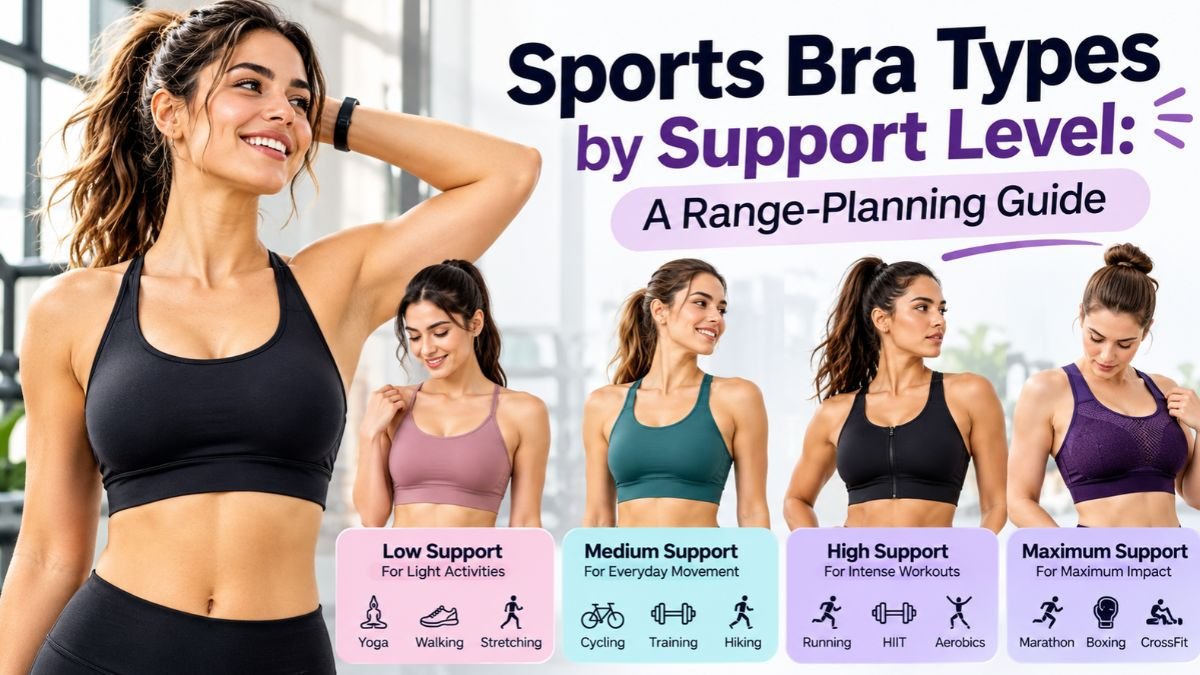
Sports Bra Types by Support Level
Sports bras are also classified according to their support level. This classification helps users match a bra to their workout.
| Support level | Common activities | Typical design features |
|---|---|---|
| Low impact | Yoga, stretching, walking | Soft fabric, flexible construction |
| Medium impact | Cycling, gym training, brisk walking | Supportive band, moderate compression |
| High impact | Running, jumping, intense training | Firm support, structured cups, secure straps |
These categories are general guidelines. A person’s comfort and support needs can vary based on body shape, breast size, and personal preference.
How to Pick Sports Bra Styles for Your Workout
Knowing how to pick sports bra designs starts with understanding your activity and fit requirements.
A sports bra should provide enough support for your workout without feeling painful or restrictive.
1. Identify Your Activity
Start by considering the type of exercise you perform most often.
For yoga and stretching, a low-impact design may provide enough support. For running or jumping, a high-impact style may be more suitable.
Consider the amount of movement involved rather than choosing a bra based only on its appearance.

2. Choose the Correct Support Level
Support level is one of the most important factors.
A low-impact bra may feel comfortable for gentle exercise but may not provide enough movement control during running.
Similarly, a highly structured bra may feel unnecessarily restrictive for light activities.
Choose a design that matches the movement demands of your workout.
3. Check the Band Fit
The lower band provides a large part of the support.
It should sit firmly around the ribcage without digging into the skin. It should also remain in place when you lift your arms or move your upper body.
If the band rides up during movement, the fit may be too loose or the design may not suit your body.
4. Examine the Straps
Straps help maintain the position of the bra.
They should feel secure without pressing painfully into the shoulders. Adjustable straps can help users customise the fit.
Wider straps may improve comfort for some users, particularly in designs intended for stronger support.
5. Check Cup Coverage
The cups should provide suitable coverage without creating uncomfortable gaps or excessive compression.
Look for signs such as breast tissue spilling over the top or sides, wrinkling fabric, or cups that shift during movement.
The right cup design should feel secure while allowing comfortable movement.
6. Consider Fabric Stretch
Sports bras commonly use stretch fabrics such as polyester, nylon, and elastane blends.
The fabric should stretch comfortably and return to its original shape. Poor recovery can affect fit after repeated wear and washing.
For exercise, moisture management and breathability may also be important.
7. Try a Movement Test
If possible, test the sports bra with simple movements.
Try raising your arms, bending forward, twisting, and walking or jogging in place.
Check whether the band stays in position and the straps remain secure. The bra should not create painful pressure or restrict breathing.
8. Review the Care Instructions
Sports bras are washed frequently, so care requirements matter.
Follow the garment’s washing label. Avoid care methods that may damage elastic fibres, padding, or fastening components.
Proper care can help maintain the garment’s fit and useful life.
How to Find the Right Sports Bra Size
A correct size is essential for support and comfort. However, sizing can vary between brands and product designs.
Do not assume that every sports bra will fit exactly like your everyday bra.
Measure Your Underbust
Wrap a measuring tape around your ribcage, directly below the bust.
Keep the tape level and comfortably snug. Record the measurement according to the brand’s sizing instructions.
Measure Your Bust
Measure around the fullest part of your bust. Keep the tape level without pulling it too tightly.
Use the brand’s size chart to compare your measurements.
Check the Fit
When trying on a sports bra, check these areas:
- The band should feel firm but comfortable.
- The straps should not dig into the shoulders.
- The cups should provide suitable coverage.
- The fabric should not wrinkle excessively.
- The bra should stay in place during movement.
- Breathing should feel natural and unrestricted.
If a bra causes pain, numbness, skin irritation, or difficulty breathing, stop wearing it and reassess the fit.
Best Fabrics Used in Sports Bras
Fabric selection affects comfort, stretch, durability, and moisture management.
Manufacturers choose materials based on the intended activity and product design.
Polyester
Polyester is widely used in performance sportswear.
It is lightweight, durable, and can be engineered for moisture management. It is often blended with elastane to improve stretch.
Nylon
Nylon is known for its smooth feel and flexibility.
It is commonly used in fitted activewear because it can create a soft surface and comfortable stretch.
Spandex or Elastane
Spandex, also called elastane, provides stretch and recovery.
It allows the fabric to expand during movement and return toward its original shape. It is usually blended with other fibres rather than used alone.
Cotton Blends
Cotton blends can provide a soft and familiar feel.
They may be suitable for light activities and casual activewear. However, the moisture-management performance depends on the complete fabric construction.
Recycled Performance Fabrics
Some manufacturers offer recycled polyester or nylon options for activewear.
Brands should check the exact fibre composition and request supporting documentation before making recycled-material claims.
Important Features to Look for in a Quality Sports Bra
A sports bra should be designed around comfort, support, and durability.
Moisture management: Suitable fabric can help manage sweat during exercise.
Breathability: Fabric construction should allow comfortable airflow where required.
Stretch and recovery: The material should move with the body and maintain its shape.
Secure stitching: Seams should be strong enough for repeated movement and washing.
Comfortable straps: Strap placement and width should suit the design’s support level.
Reliable closures: Hooks and zippers should remain secure during activity.
Smooth finishing: Labels and seams should not create unnecessary friction against the skin.
These features should be evaluated together. A premium-looking design does not guarantee good support or quality.
How Are Sports Bras Manufactured?
Sports bra manufacturing requires careful attention to fabric stretch, measurements, pattern development, and construction.
Because sports bras are close-fitting garments, small changes in measurements can affect comfort and support.
1. Design Development
The process begins with a design brief.
The brand identifies the intended activity, support level, style, colour, fabric, and target customer.
The design may include a racerback, adjustable straps, separate cups, removable padding, or a front closure.
2. Fabric and Trim Selection
The manufacturer selects suitable fabrics and components.
These may include polyester blends, nylon, elastane, elastic bands, hooks, zippers, labels, and padding.
The selected materials should match the intended support and performance requirements.
3. Pattern Making
Patterns are developed according to the approved design and size specifications.
The manufacturer considers cup shape, underband dimensions, strap placement, seam construction, and stretch behaviour.
Accurate pattern development helps create a consistent fit across sizes.
4. Sample Development
A sample is produced for review.
The brand should examine the fit, stretch, support, coverage, comfort, and finishing.
Any required changes should be discussed before approving the pre-production sample.
5. Cutting and Sewing
After sample approval, fabric is prepared and cut according to the production patterns.
The pieces are then assembled using suitable stitching methods. Elastic bands, straps, cups, and closures are attached according to the design.
6. Quality Control
Quality checks help identify construction and measurement problems.
Important inspection points include:
- Band elasticity
- Strap attachment
- Stitch strength
- Cup symmetry
- Measurement accuracy
- Fabric defects
- Closure function
- Overall appearance
7. Finishing and Packaging
The final garments are checked, trimmed, labelled, folded, and packed.
Brands can specify custom labels, hang tags, and packaging requirements before bulk production.
How to Choose a Sports Bra Manufacturer for Your Clothing Brand
If you are launching an activewear collection, selecting a suitable manufacturer is an important decision.
A manufacturer should understand stretch fabrics, sportswear construction, sampling, and quality requirements.
Before choosing a supplier, consider the following points.
Check Sportswear Experience
Ask whether the manufacturer produces sports bras and other activewear products.
Sports bras require different construction considerations from ordinary T-shirts or casual tops.
Discuss Fabric Options
Explain your preferred fabric composition, stretch requirements, and performance needs.
Ask about fabric availability, material specifications, and supporting documents where applicable.
Review Samples
A physical sample helps you check the fit and construction before bulk production.
Review the measurements, band support, cup coverage, straps, stitching, and overall comfort.
Confirm MOQ and Production Timelines
MOQ means minimum order quantity. It can vary according to fabric, colour, size range, and product complexity.
Confirm the exact quantity and production schedule before placing an order.
Ask About Quality Control
Discuss how the manufacturer checks measurements, stitching, fabric quality, and finished garments.
Agree on the inspection requirements before production begins.
Custom Sports Bra Manufacturing at Fashion Soul International
Fashion Soul International is a factory-owned custom clothing manufacturer based in Sialkot, Pakistan. Its product categories include sportswear and activewear, including sports bras, compression leggings, performance shorts, and gym tanks.
The company offers private-label, OEM, ODM, white-label, cut-and-sew, and full-package apparel manufacturing. Its services cover product development, fabric sourcing, sampling, bulk production, quality control, custom branding, packaging, and international shipping.
For brands developing custom sports bras, the project should begin with clear product specifications. These can include:
- Sports bra style and support level
- Fabric composition and GSM
- Size range and measurement chart
- Cup and padding requirements
- Strap design and width
- Elastic band specifications
- Colour and branding details
- Labels and packaging requirements
Fashion Soul International publishes a standard MOQ starting at 100 pieces per style. Actual requirements should be confirmed during quotation because product specifications can affect production quantities.
Sampling is an important part of development. Brands should review the sample for fit, stretch, construction, coverage, and comfort before approving bulk production.
Quality inspection should also be planned around the product’s requirements. For sports bras, this may include checking measurements, stitching, elastic recovery, strap attachment, and finishing.
This process helps brands establish clear expectations before moving into bulk manufacturing.
Frequently Asked Questions About Sport Bra Types
What Are the Main Sport Bra Types?
The main types include compression, encapsulation, combination, racerback, padded, high-impact, low-impact, medium-impact, longline, and front-closure sports bras. Each design offers different construction features and support options.
Which Sports Bra Is Best for Running?
A well-fitted high-impact sports bra is often suitable for running. Look for a secure band, supportive straps, suitable cup coverage, and a construction that helps control movement.
Which Sports Bra Is Best for Yoga?
A low-impact sports bra may be suitable for many yoga sessions. Choose a comfortable design that allows stretching and movement without slipping or creating pressure.
How to Pick Sports Bra for Gym Workouts?
Start by identifying the exercises you perform. Choose a support level that matches your activity, check the band and straps, review cup coverage, and test the fit with simple movements.
Is a Compression or Encapsulation Sports Bra Better?
Neither style is best for everyone. Compression bras hold the breasts close to the chest, while encapsulation bras support each breast separately. The better option depends on fit, breast shape, activity, and personal preference.
Do Sports Bras Need to Be Tight?
Sports bras should feel secure but not painfully tight. The band should stay in place, the straps should not dig into the shoulders, and breathing should remain comfortable.
What Fabric Is Best for Sports Bras?
Polyester, nylon, and elastane blends are common options for performance sports bras. The best fabric depends on stretch, moisture management, comfort, and the intended activity.
How Often Should You Replace a Sports Bra?
Replace a sports bra when its elastic loses recovery, the band becomes loose, the straps no longer provide support, or the fabric shows significant damage. Replacement timing depends on how often it is worn and washed.
Final Thoughts
Understanding different sport bra types makes it easier to choose activewear that supports your body and workout routine. Compression, encapsulation, combination, racerback, padded, and impact-based designs each offer different benefits.
The best choice depends on your activity, size, fit preferences, and required support. When deciding how to pick sports bra styles, pay attention to the band, straps, cups, fabric, and overall comfort.
For clothing brands, sports bra development requires careful material selection, accurate patterns, suitable construction, and quality inspections. Working with a manufacturer that understands activewear production can help turn a design concept into a finished product that meets the brand’s specifications.