Private Label Clothing: A Complete Guide for Fashion Brands
Private label clothing gives entrepreneurs and established retailers a way to sell garments under their own brand names. Instead of building a factory, businesses work with a clothing manufacturer to develop products, customize designs, and prepare garments for sale. This approach can help fashion businesses create a consistent identity while focusing on marketing, customer service, and growth.
Whether you are launching a new fashion label or expanding an existing collection, understanding private label clothing is essential. You need to choose suitable fabrics, plan product designs, set a realistic budget, understand minimum order quantities, and find a reliable manufacturing partner.
This guide explains how private label clothing works, how to choose a manufacturer, and what to consider before placing your first production order.
What Is Private Label Clothing?
Private label clothing refers to garments manufactured by one company and sold by another business under its own brand name. The manufacturer produces the clothing, while the retailer or fashion business sells it using its branding, labels, and packaging.
For example, an entrepreneur may want to launch a streetwear brand featuring oversized T-shirts, hoodies, and sweatpants. Instead of producing these garments independently, the entrepreneur works with a manufacturer that can create the products according to the brand’s specifications.
The finished garments can feature custom neck labels, hang tags, logos, prints, and packaging. The exact level of customization depends on the manufacturer’s services and the agreement between both parties.
Private label manufacturing can suit:
- New entrepreneurs launching their first clothing brands.
- Online stores expanding their product collections.
- Retailers developing exclusive merchandise.
- Established fashion businesses introducing new categories.
- Fitness brands creating custom activewear.
- Companies producing uniforms or branded apparel.
The main advantage is that a business can build its own clothing identity without owning a manufacturing facility.
How Does Private Label Clothing Work?
The private label process usually begins with a product idea and ends with finished garments ready for distribution. The steps may vary depending on the manufacturer, product complexity, and order size.
1. Develop Your Clothing Brand Concept
Start by deciding what your brand represents and who you want to reach. Consider your target customers, preferred styles, price range, and product category.
For example, a premium casualwear brand may focus on heavyweight cotton T-shirts, relaxed-fit hoodies, and coordinated sweatpants. A fitness brand may prioritize stretch fabrics, moisture management, and comfortable construction.
A clear concept helps you make better decisions about materials, colors, designs, and product pricing.
2. Choose the Products You Want to Manufacture
Select products that match your brand identity and customer needs. Starting with a focused collection can make product development and inventory planning easier.
Common private label clothing products include:
- T-shirts and polo shirts.
- Hoodies and sweatshirts.
- Tracksuits and sweatpants.
- Activewear and sportswear.
- Jackets and outerwear.
- Denim and casual trousers.
- Workwear and uniforms.
- Baby clothing and everyday apparel.
Before selecting products, consider their production complexity, fabric availability, seasonal demand, and expected selling price.
3. Select Fabrics and Materials
Fabric selection affects garment comfort, appearance, durability, and cost. Your manufacturer can help identify suitable materials based on the intended use of each product.
Cotton is popular for everyday clothing because it feels comfortable and breathable. French terry and fleece are common choices for sweatshirts and hoodies. Polyester and stretch blends are often used in sportswear and activewear.
You should also consider fabric weight, commonly measured in GSM, or grams per square metre. A higher GSM generally indicates a heavier fabric, although the actual feel and performance depend on the fibre, knit or weave, and finishing.
Request fabric swatches when possible. Check their texture, color, stretch, thickness, and suitability before approving the material for sampling.
4. Prepare Designs and Technical Details
Manufacturers need clear information about the garments you want to produce. This may include sketches, reference photographs, measurements, color specifications, fabric details, stitching requirements, and branding instructions.
A technical package, commonly called a tech pack, can organize these details in one place. It may include a measurement chart, bill of materials, construction notes, artwork placement, label specifications, and packaging requirements.
If you do not have a complete tech pack, ask whether the manufacturer offers product development assistance. Confirm which documents or samples are required before development begins.
5. Develop and Approve a Sample
A sample allows you to evaluate the product before committing to bulk manufacturing. It helps you assess fit, construction, fabric, colors, artwork, and finishing.
Review the sample carefully. Check measurements, seams, stitching, print placement, label positions, and overall appearance. If changes are necessary, provide clear feedback and request revisions.
Do not approve bulk production until the final sample meets your requirements. Keep a record of the approved version so the production team has a clear reference.
6. Begin Bulk Production
After sample approval, the manufacturer prepares the order for production. This stage may include material purchasing, pattern grading, cutting, sewing, decoration, finishing, and quality inspections.
Production timing depends on the product, order quantity, fabric availability, design complexity, and factory schedule. Confirm the estimated timeline in writing before placing the order.
7. Inspect, Package, and Ship the Garments
Finished garments should be checked against the agreed specifications. Depending on the inspection plan, checks may cover measurements, stitching, print quality, labels, garment appearance, and packaging.
Once the order passes the agreed quality checks, the garments can be packed and prepared for shipment. Confirm carton details, shipping terms, export documents, delivery estimates, and any destination-specific requirements.
Benefits of Private Label Apparel for Fashion Businesses
Private label production offers several advantages, but the results depend on the product strategy and manufacturing partnership.
Build a Distinct Brand Identity
Selling garments under your own label helps establish a recognizable identity. Custom logos, labels, colors, designs, and packaging can create a consistent experience across your collection.
A distinctive product range may also help customers understand what makes your brand different from competing retailers.
Customize Products for Your Audience
Private label clothing can provide more control over product details than simply reselling generic garments. Depending on the manufacturer’s capabilities, you may customize fabric choices, garment measurements, colors, prints, embroidery, trims, and labels.
For example, a streetwear business might request oversized fits, heavyweight fabric, puff printing, and woven labels. An activewear company might need stretch materials, flat seams, and moisture-wicking features.
The available options depend on the product and the manufacturing agreement.
Focus on Business Growth
Working with a manufacturer allows you to concentrate on activities such as product planning, online sales, marketing, customer relationships, and inventory management.
However, outsourcing production does not remove your responsibility for product quality, legal compliance, customer expectations, or stock planning.
Expand Your Product Range
Once you understand your customers and have established a reliable production process, you may add new styles or categories. A brand that begins with T-shirts could later introduce hoodies, sweatpants, jackets, or accessories.
Expanding gradually can help you test demand before investing in a large collection.
Private Label Apparel Manufacturers USA: What Should You Know?
Businesses searching for private label apparel manufacturers USA may be looking for domestic production, easier communication, shorter shipping routes, or access to local suppliers.
However, the right manufacturing location depends on your priorities. Domestic manufacturing may offer logistical advantages for some businesses, while international manufacturers may provide other combinations of product capabilities, pricing, customization, and shipping options.
When evaluating US manufacturers, ask about:
- Their experience with your garment category.
- Available fabrics and construction methods.
- Sample development and revision policies.
- Minimum order quantities.
- Custom labeling and packaging.
- Production schedules and quality checks.
- Shipping costs and delivery arrangements.
- Documentation and compliance requirements.
If you are open to international production, compare overseas manufacturers using the same criteria. Consider the complete landed cost rather than comparing garment prices alone.
Landed cost can include manufacturing, packaging, freight, insurance, duties, taxes, customs charges, and other applicable expenses.
For example, Fashion Soul International is a factory-owned custom clothing manufacturer based in Sialkot, Pakistan. It offers private-label, OEM, ODM, white-label, and cut-and-sew manufacturing services for international clothing brands. Businesses should confirm current product availability, quotations, production timelines, and shipping terms directly with the company.
A manufacturer does not need to be located in your country to serve your business, but you should understand the practical implications of cross-border production before ordering.
How to Choose Private Label Wholesale Clothing Suppliers
Finding a supplier is about more than obtaining a low quote. You need a manufacturing partner that understands your requirements and can produce garments according to the approved specifications.
Use the following factors to evaluate potential suppliers.
Manufacturing Experience
Ask whether the supplier regularly manufactures your type of product. Experience with basic T-shirts does not automatically mean expertise in technical sportswear, structured jackets, or complex outerwear.
Review relevant product examples and ask how the manufacturer handles your specific construction requirements.
Minimum Order Quantity
Minimum order quantity, or MOQ, is the smallest order a supplier accepts under specified conditions. Some manufacturers set minimums by style, color, or product category.
A low MOQ can be useful for new brands because it may reduce the initial inventory commitment. However, a smaller order may have a higher unit cost than a larger production run.
Always confirm the MOQ for your exact product and order structure.
Sampling Process
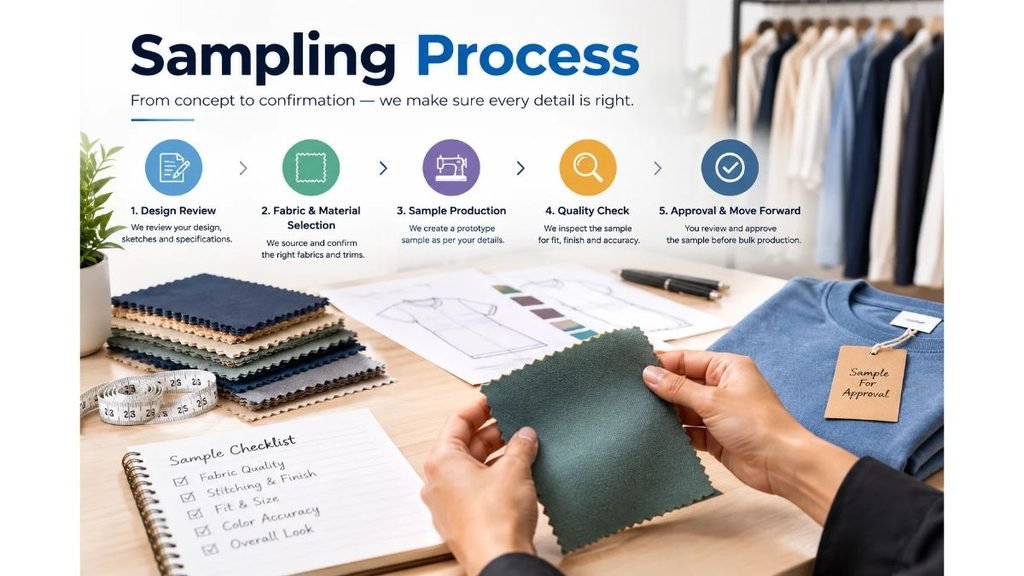
A reliable supplier should explain its sampling process, costs, revision policy, and approval requirements.
Ask whether sample fees are separate from bulk production charges and whether any sample costs can be credited toward a future order. Do not assume that every manufacturer follows the same policy.
Quality Control
Discuss how the supplier checks garments during and after production. Ask about measurement tolerances, fabric inspection, stitching standards, decoration quality, defect handling, and final inspection procedures.
Written specifications and clear acceptance criteria can reduce misunderstandings.
Communication and Transparency
Your supplier should explain what information it needs, what is included in the quotation, and what could affect cost or timing.
Before paying a deposit, clarify payment terms, material substitutions, revision charges, cancellation rules, and what happens if finished products do not meet the agreed specifications.
What Is Private Label Wholesale Clothing?
Private label wholesale clothing refers to garments produced for a business to sell under its own brand, usually in quantities agreed with the manufacturer or supplier.
Wholesale purchasing generally involves buying multiple units rather than individual retail pieces. Private labeling adds the option of branding products with your own identity.
For example, a boutique may order a collection of custom hoodies with its logo, branded neck labels, and retail packaging. The manufacturer produces the garments, and the boutique sells them to its customers.
Before placing an order, confirm whether the wholesale price includes:
- The garment and selected fabric.
- Custom printing or embroidery.
- Woven labels or printed neck labels.
- Hang tags and packaging.
- Sampling or development costs.
- Freight and other shipping charges.
Some quotations include only the basic garment, while others cover more of the production process. A detailed quotation helps you compare suppliers fairly.
Private Label Clothing vs. White Label, OEM, and ODM
These terms are related, but they do not always describe the same manufacturing arrangement.
| Model | How it generally works |
|---|---|
| Private label | A business sells garments under its own brand, with customization determined by the agreement. |
| White label | A supplier offers an existing or standardized product that multiple businesses can brand and sell. |
| OEM | The manufacturer produces goods according to the buyer’s specifications. |
| ODM | The manufacturer provides product design or development capabilities, which the buyer may adapt or brand. |
The exact meaning of these terms can vary by supplier and contract. Ask the manufacturer to explain which services are included rather than relying on the label alone.
Private label production may involve existing garment patterns with customized colors and branding, or more extensive product development. The correct option depends on how unique your products need to be.
Understanding Private Label Clothing Costs
Private label clothing costs vary according to the garment, materials, order quantity, construction, customization, and delivery requirements. There is no single price that applies to every product.
Fabric and Garment Construction
Premium fabrics, specialized finishes, complex patterns, and additional construction steps can increase production costs.
For instance, a basic cotton T-shirt will generally require a different manufacturing process from a technical jacket with multiple panels, zippers, lining, and specialized trims.
Customization
Printing, embroidery, labels, special washes, and custom packaging can affect the total price. Artwork complexity, decoration size, and the number of placements may also matter.
Request an itemized quotation so you can understand which features contribute to the cost.
Order Quantity
Larger orders may spread certain setup costs across more garments, reducing the cost per unit. Smaller orders can provide greater flexibility but may have higher unit prices.
Choose a quantity that matches your budget and realistic demand rather than ordering more inventory simply to obtain a lower quoted price.
Shipping and Import Costs
International buyers should calculate shipping and applicable import charges. Delivery terms such as FOB or DDP allocate responsibilities differently, so confirm what the quoted price includes.
Your final retail price should account for production, logistics, marketing, platform fees, taxes where applicable, and other business expenses.
What Is the Minimum Order Quantity for Private Label Clothing?
The MOQ depends on the manufacturer, garment type, fabric availability, customization, and production requirements.
Some suppliers accept smaller orders for simpler products, while complex garments or specialized materials may require larger quantities.
Fashion Soul International states that its standard MOQ starts at 100 pieces. The actual minimum for a project should be confirmed during quotation because product and customization requirements can affect the order quantity.
If you are starting a clothing brand, ask these questions before committing:
- Is the MOQ calculated per style or color?
- Can sizes be mixed within one order?
- Are different colors subject to separate minimums?
- Does custom fabric require a larger order?
- Are sample costs separate from production costs?
- What deposit and payment schedule apply?
Clear answers can help you build a realistic launch budget.
How Private Label Apparel Brands Build Better Products
Successful private label apparel brands need more than a logo on a garment. They must deliver products that match customer expectations and support a clear market position.
Understand Your Target Customers
Identify the people you want to serve. Consider their preferred styles, sizing expectations, price range, lifestyle, and reasons for buying your products.
Customer research can help you choose the right collection instead of producing garments based only on personal preference.
Create Consistent Product Specifications
Consistency matters when customers purchase the same style in different colors or reorder it later.
Maintain approved measurement charts, fabric details, color references, artwork files, label placements, and construction instructions. These records help your manufacturer understand what should remain consistent between production runs.
Invest in Sampling and Testing
Do not judge a garment only by how it looks in a photograph. Check fit, movement, comfort, stitching, wash performance, and decoration durability where relevant.
For activewear, you may need to assess stretch and recovery. For everyday T-shirts, you may focus on shrinkage, fit, and fabric feel.
Testing should reflect the garment’s intended use and the claims you plan to make about it.
Develop a Realistic Pricing Strategy
Your retail price should cover total costs and fit the expectations of your target market. Consider production costs, packaging, freight, duties, marketing, returns, and selling fees.
Avoid setting prices based only on the manufacturer’s unit quotation. A product can be inexpensive to manufacture but costly to store, ship, or sell.
Plan Inventory Carefully
Demand can be difficult to predict when a brand is new. Start with a collection size and order quantity that your business can reasonably finance and manage.
Track sales, customer feedback, popular sizes, and repeat purchases. Use this information to guide future production decisions.
How Fashion Soul International Supports Private Label Clothing
Fashion Soul International is a factory-owned custom clothing manufacturer based in Sialkot, Pakistan. The company supports international businesses seeking private-label apparel and other custom manufacturing services.
Its stated services include product development, fabric and trim sourcing, sample development, bulk production, quality control, custom branding, packaging, and international shipping.
The company offers several manufacturing models, including private label, OEM, ODM, white label, cut-and-sew, and full-package production. Its product categories include streetwear, activewear, sportswear, workwear, jackets, denim, casualwear, tracksuits, T-shirts, hoodies, and other custom garments.
For a private label project, the process can begin with a product brief, design references, preferred materials, quantity requirements, and branding details. The manufacturer can then discuss feasibility, estimated costs, sampling, and production requirements.
Before bulk production, buyers should review and approve the pre-production sample. They should also confirm the final specifications, agreed quality standards, delivery terms, packaging requirements, and payment schedule.
Fashion Soul International states that its standard MOQ starts at 100 pieces, although the actual requirement depends on the project. Buyers should request a current quotation to confirm the minimum quantity, sample timeline, production schedule, and shipping options for their products.
Common Mistakes to Avoid When Starting a Private Label Brand
A careful launch plan can help reduce avoidable costs and delays.
Choosing a supplier based only on price: A low quote may exclude important services or use specifications that do not match your needs. Compare the full quotation and production capabilities.
Skipping sample approval: Bulk production without an approved sample can lead to differences in fit, materials, construction, or branding.
Providing unclear instructions: Missing measurements, color references, or artwork details can cause production errors. Share complete specifications and confirm any open questions.
Ordering too much inventory: Large orders can tie up cash and leave unsold stock. Estimate demand and consider the financial impact before choosing quantities.
Ignoring shipping costs: Freight, duties, taxes, and customs procedures may significantly affect your final cost. Confirm delivery terms before approving an order.
Failing to agree on quality standards: Define acceptable measurements, construction, decoration, packaging, and defect handling in advance.
Using branding without permission: Ensure that logos, artwork, graphics, and other intellectual property are owned by you or properly licensed for commercial use.
Frequently Asked Questions About Private Label Clothing
Is private label clothing suitable for beginners?
Yes. Private label clothing can suit beginners who want to build a fashion brand without owning a factory. New businesses should begin with a clear product concept, realistic budget, suitable supplier, and approved sample.
Can I customize private label clothing?
Customization depends on the supplier and product. Options may include fabric selection, garment fit, colors, printing, embroidery, labels, trims, and packaging. Confirm available options before development.
How do I find private label apparel manufacturers in the USA?
Search for manufacturers that specialize in your product category, then review their production capabilities, MOQ, sample process, quality checks, and customer requirements. If you are considering international suppliers too, compare total landed cost and delivery terms.
What is the difference between private label and private label wholesale clothing?
Private label describes selling products under your own brand. Wholesale describes purchasing or selling products in quantities rather than as individual retail units. Private label wholesale clothing combines branded garments with wholesale-order arrangements.
How much money do I need to start a private label clothing brand?
The amount depends on product complexity, sample development, order quantity, branding, shipping, marketing, and business expenses. Obtain itemized quotations and prepare a budget before placing your first order.
Do private label clothing manufacturers provide labels and packaging?
Many offer custom labels, hang tags, and packaging, but these services may cost extra. Confirm the exact specifications, included services, and charges in the quotation.
How long does private label clothing production take?
Timelines depend on the garment, materials, sample revisions, order size, and factory schedule. Ask for separate estimates for sampling, bulk production, and shipping, and confirm when the production timeline begins.
Conclusion
Private label clothing allows entrepreneurs, retailers, and established businesses to sell garments under their own brands without operating their own factories. The model offers opportunities for product customization, brand development, and collection expansion, but results depend on careful planning and reliable manufacturing.
Start by defining your target market, choosing suitable products, and preparing clear specifications. Compare manufacturers based on experience, MOQ, sampling, quality control, communication, and total costs. Approve the sample before bulk production and confirm every important detail in writing.
Whether you are comparing private label apparel manufacturers USA, researching private label wholesale clothing, or building one of the next private label apparel brands, the goal is the same: create products that meet customer expectations and support a sustainable business.
If you are planning a custom apparel collection, Fashion Soul International can discuss your product requirements, branding options, MOQ, sampling, and international production arrangements. Prepare your design references, estimated quantities, fabric preferences, and delivery destination to request a project-specific quotation.