Heat Transfer Sublimation Printing: Complete Guide to Custom Apparel Decoration
Printing is an important part of custom clothing manufacturing. It helps clothing brands add logos, artwork, patterns, names, and unique designs to garments. Two popular decoration methods are heat transfer printing and sublimation printing. Both use heat during the application process, but they work differently and produce different results.
Understanding heat transfer sublimation printing can help clothing brands choose the right decoration method for their products. The choice depends on fabric composition, design complexity, garment colour, order quantity, durability, and budget.
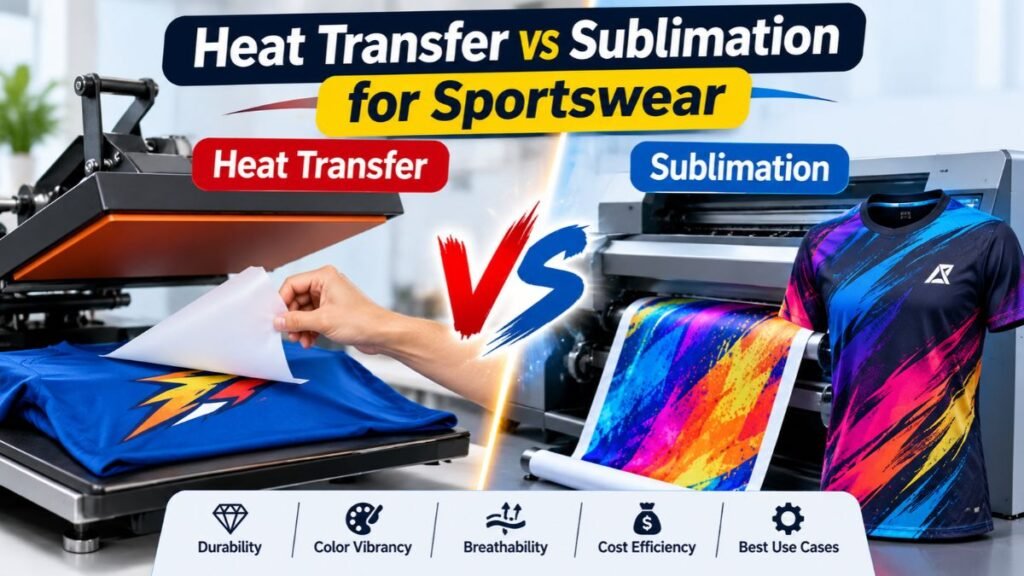
Heat transfer printing is a broad method that uses heat and pressure to apply a design to fabric. Sublimation printing uses heat to turn special ink into gas, allowing the colour to bond with suitable polyester fibres.
In this guide, we explain how both methods work, their benefits, limitations, differences, fabric requirements, and applications in the apparel industry. We also discuss what clothing brands should consider before selecting a printing method for custom garments.
What Is Heat Transfer Printing?
Heat transfer printing is a garment decoration method that uses heat and pressure to apply a design to clothing. The artwork is usually prepared on a special transfer material before being placed onto the garment.
A heat press applies the required temperature and pressure for a set period. This helps transfer the design from the carrier material to the fabric.
The exact process depends on the transfer type. Some methods use printed transfer films, while others use cut vinyl or specialised transfer materials.
Heat transfer printing is commonly used for:
- Custom T-shirts
- Sportswear
- Hoodies
- Sweatshirts
- Team uniforms
- Promotional clothing
- Personalised garments
- Branded merchandise
It is useful for designs that need specific colours, names, numbers, or detailed graphics.
How Does Heat Transfer Printing Work?
The heat transfer process generally involves several steps.
1. Design preparation: The artwork is created using suitable graphic design software. The design may include text, logos, illustrations, or patterns.
2. Transfer preparation: The artwork is printed or cut onto the appropriate transfer material. The material depends on the selected printing technique.
3. Garment positioning: The clothing item is placed on the heat press. The transfer is positioned carefully where the design needs to appear.
4. Heat and pressure application: The heat press applies the required temperature, pressure, and time. These settings depend on the transfer material and fabric.
5. Carrier removal: The carrier sheet or film is removed according to the transfer manufacturer’s instructions. Some transfers require a warm peel, while others require a cold peel.
6. Final inspection: The printed area is checked for alignment, adhesion, appearance, and defects.
Following the correct application instructions is important. Incorrect heat or pressure can affect the final result.
What Is Sublimation Printing?
Sublimation printing is a digital printing method that uses special sublimation ink, transfer paper, heat, and pressure to apply colour to suitable materials.
During the process, heat causes the solid sublimation ink to turn into gas. The gas enters the polyester fibres and forms a lasting colour bond as it cools.
Unlike many surface-applied printing methods, sublimation colour becomes part of the suitable material rather than sitting as a separate layer on top.
This creates a smooth printed finish without the heavy feel of a thick design layer.
Sublimation printing is commonly used for:
- Polyester sportswear
- Athletic jerseys
- Performance T-shirts
- Cycling clothing
- Custom team uniforms
- Polyester tracksuits
- All-over printed garments
- Promotional textile products
It is particularly useful for colourful designs and detailed patterns on suitable polyester fabrics.
How Does Sublimation Printing Work?
Sublimation printing requires a specific process and suitable materials.
1. Artwork creation: The design is created digitally. Colours, patterns, logos, and other graphics are prepared for printing.
2. Printing on transfer paper: Special sublimation ink is printed onto sublimation transfer paper.
3. Fabric preparation: The garment or fabric panel is prepared for printing. It should be suitable for sublimation and able to withstand the required heat.
4. Transfer positioning: The printed paper is placed against the fabric in the correct position.
5. Heat pressing: A heat press applies controlled heat and pressure. The ink changes into gas and bonds with the polyester fibres.
6. Paper removal: Once the transfer process is complete, the paper is removed carefully.
7. Quality inspection: The finished design is checked for colour accuracy, alignment, coverage, and unwanted marks.
For cut-and-sew sublimation garments, fabric panels may be printed before cutting and sewing. This approach allows designs to cover larger areas of the finished garment.
Heat Transfer Sublimation Printing: Are They the Same?
Heat transfer and sublimation printing are related, but they are not exactly the same.
Both processes use heat to apply designs. However, they use different materials and create different finishes.
Heat transfer printing generally applies a design through a transfer layer, adhesive, or specialised film. Sublimation uses heat to convert ink into gas, which bonds with suitable polyester fibres.
The term heat transfer sublimation printing is sometimes used when people discuss these methods together. It is important to understand the difference before choosing a process for clothing production.
| Feature | Heat Transfer Printing | Sublimation Printing |
|---|---|---|
| Main process | Applies a design using heat and pressure | Uses heat to turn ink into gas |
| Material compatibility | Depends on the transfer type | Best suited to polyester and suitable coated materials |
| Design surface | Often forms a layer on the fabric | Colour bonds with suitable fibres |
| Fabric options | Can work on different fabrics with the correct transfer | Most suitable for polyester |
| Cotton compatibility | Some transfer types work on cotton | Standard sublimation is not suitable for untreated cotton |
| Design options | Logos, text, names, numbers, graphics | Detailed images, gradients, and all-over designs |
| Fabric feel | Can feel raised or layered | Usually smooth |
| Common uses | Custom logos and personalised apparel | Sportswear and full-colour polyester garments |
The right method depends on the product requirements rather than one method being universally better.
Main Differences Between Heat Transfer and Sublimation Printing
Understanding the differences helps brands avoid printing problems and choose a suitable decoration method.
1. Printing Process
Heat transfer printing uses a transfer material that carries the design onto the garment. Heat and pressure help attach the design to the fabric.
Sublimation printing uses special ink that changes into gas under heat. The colour bonds with polyester fibres.
The two processes therefore create designs in different ways.
2. Fabric Compatibility
Fabric composition is one of the most important factors.
Many heat transfer methods can be used on cotton, polyester, and certain fabric blends. However, compatibility depends on the specific transfer product and its application instructions.
Sublimation works best on white or light-coloured polyester fabrics. It can also work on specially coated products designed for sublimation.
Standard sublimation does not produce the same results on untreated cotton because the ink is designed to bond with polyester fibres.
3. Print Feel
Heat transfer designs may create a visible layer on the fabric. The feel depends on the transfer material, design size, and thickness.
Sublimation creates a smooth finish because the colour bonds with the suitable fibres.
This difference can affect comfort, especially on lightweight sportswear.
4. Colour and Design Detail
Both methods can produce attractive designs.
Heat transfer can support detailed graphics, text, and logos. Certain transfer types are suitable for multi-colour artwork.
Sublimation is particularly useful for full-colour images, gradients, photographs, and complex patterns on polyester.
5. Durability
Durability depends on the material, application process, garment fabric, and care instructions.
A correctly applied heat transfer can last through repeated use and washing. Poor application may lead to peeling, cracking, or lifting.
Sublimation generally offers good wash durability on suitable polyester because the colour bonds with the fibres. However, fabric quality, printing conditions, and washing practices still matter.
Which Fabrics Are Suitable for Heat Transfer and Sublimation?
Choosing the correct fabric is essential for achieving a good print result.
Cotton
Cotton is widely used in T-shirts, sweatshirts, and casual clothing.
Many heat transfer products are designed for cotton garments. Brands can use suitable transfer materials to apply logos, text, and artwork.
Standard sublimation is not suitable for untreated cotton. The ink does not bond with cotton fibres in the same way it bonds with polyester.
Polyester
Polyester is one of the most suitable materials for sublimation printing.
It is commonly used in sportswear because it can be lightweight, durable, and suitable for moisture-management fabric constructions.
Polyester can also be decorated using compatible heat transfer methods.
Cotton-Polyester Blends
Blended fabrics combine different fibre properties.
Some heat transfer materials are designed for cotton-polyester blends. Sublimation may also be possible on certain blends, but the polyester content affects the result.
When sublimating a blend, the printed appearance may be less vibrant than on a 100% polyester fabric. The exact outcome depends on the composition and fabric construction.
Nylon
Nylon is used in different performance garments and sportswear products.
Some heat transfer materials are compatible with nylon, but the process needs careful selection because heat sensitivity and surface properties can vary.
Standard sublimation is not generally the first choice for untreated nylon. Brands should confirm compatibility with the fabric supplier and printing provider.
Fabric Compatibility Summary
| Fabric | Heat transfer | Sublimation |
|---|---|---|
| Cotton | Suitable transfer types available | Not suitable for standard untreated cotton |
| Polyester | Compatible transfer types available | Highly suitable |
| Cotton-polyester blend | Depends on transfer material | Results depend on polyester content |
| Nylon | Requires compatible transfer material | Requires special consideration |
| Specially coated products | Depends on coating and transfer | Suitable when designed for sublimation |
Always test the selected method on the actual fabric before bulk production.
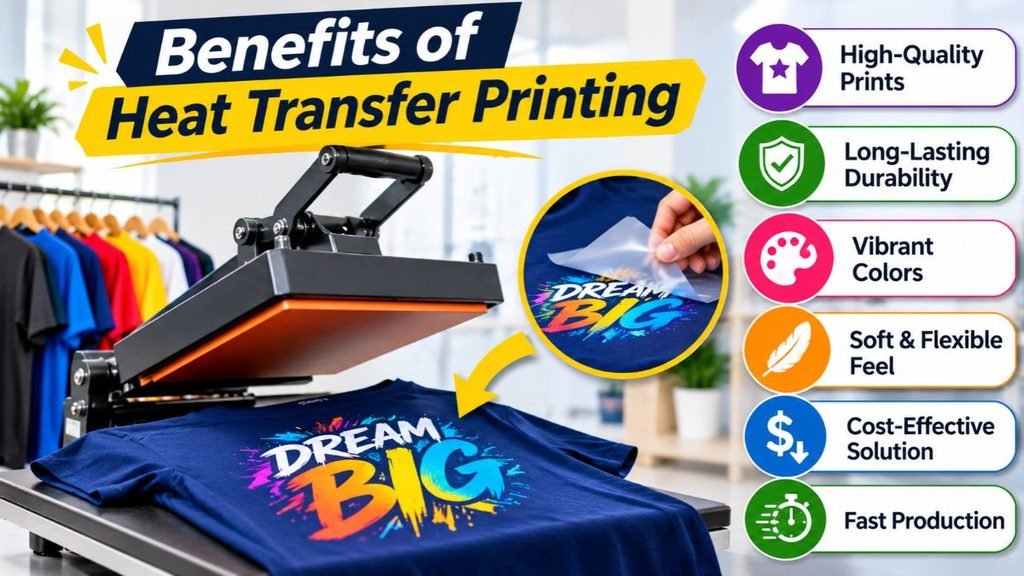
Benefits of Heat Transfer Printing
Heat transfer printing offers several advantages for clothing brands and custom apparel businesses.
Suitable for Different Garment Types
Depending on the transfer material, heat transfer can be used on different fabrics and clothing products.
This makes it useful for T-shirts, hoodies, uniforms, sportswear, and promotional clothing.
Useful for Personalised Designs
Heat transfer is commonly used for names, numbers, logos, and small custom graphics.
It can be a practical option for teamwear, event clothing, and personalised products.
Suitable for Small Production Runs
Some heat transfer processes are suitable for smaller quantities.
Brands may use them for samples, limited collections, or personalised orders without requiring the same setup as certain traditional printing processes.
Supports Detailed Artwork
Suitable transfer materials can reproduce multi-colour artwork and detailed designs.
This gives brands flexibility when creating custom graphics.
Different Finish Options
Heat transfer methods include different materials and finishes. Depending on the process, brands may select matte, glossy, textured, or other visual effects.
The choice should match the fabric and desired appearance.
Benefits of Sublimation Printing
Sublimation printing is popular in performance apparel because it offers a smooth finish and strong design flexibility on suitable materials.
Smooth Printed Finish
The colour bonds with suitable polyester fibres, so the finished print does not create a thick layer on the surface.
This can be useful for lightweight sportswear.
Detailed Full-Colour Designs
Sublimation supports complex patterns, photographs, gradients, and multi-colour artwork.
This makes it suitable for custom jerseys, team uniforms, and colourful activewear collections.
Suitable for All-Over Designs
Sublimation can be used to print large fabric panels before garment assembly.
This allows brands to create designs that extend across sleeves, body panels, and other garment sections.
Good Wash Durability
When applied correctly to suitable fabric, sublimation colour becomes part of the fibre structure.
This helps reduce the peeling and cracking associated with some surface-applied designs.
No Heavy Ink Layer
The smooth finish can help maintain the original fabric feel.
This is useful when a garment needs flexibility and comfort during movement.
Limitations of Heat Transfer Printing
Although heat transfer is versatile, it has some limitations.
Possible peeling: Poor application or incompatible materials can cause the transfer to lift from the fabric.
Cracking over time: Some transfer materials may crack after repeated stretching or washing.
Surface feel: Larger designs may create a noticeable layer on the garment.
Heat sensitivity: Some fabrics and trims can be damaged by excessive temperature.
Application requirements: Correct pressure, temperature, and timing are necessary for a reliable result.
Selecting the correct transfer material and following its instructions can help reduce these problems.
Limitations of Sublimation Printing
Sublimation is useful, but it is not suitable for every garment.
Polyester requirement: Standard sublimation works best on polyester rather than untreated cotton.
Light-colour limitations: Sublimation does not print white ink. Dark fabrics cannot reproduce bright designs in the same way as light fabrics.
Heat requirements: The fabric must tolerate the heat used during the transfer process.
Colour variation: The printed result can vary due to fabric composition, paper, ink, temperature, and other production factors.
Design planning: For cut-and-sew products, artwork must account for seams, panels, and cutting positions.
Understanding these limitations before production helps brands select a suitable printing process.
Common Uses of Heat Transfer and Sublimation in Clothing
Both methods have applications across different areas of the apparel industry.
Custom T-Shirts
Heat transfer can be used to add logos, text, and graphics to cotton or compatible blended T-shirts.
Sublimation is a suitable option for polyester T-shirts with detailed, full-colour designs.
Sportswear and Jerseys
Sublimation is commonly used for polyester sports jerseys.
It allows teams and brands to create colourful patterns, player names, numbers, and coordinated designs.
Heat transfer can also be used for logos and additional details where the selected transfer material is compatible.
Hoodies and Sweatshirts
Heat transfer is a common option for custom hoodie graphics and logos.
The transfer should be selected according to the fabric weight, surface texture, and construction.
Tracksuits
Polyester tracksuits can be suitable for sublimation, especially when brands want full-colour patterns.
Heat transfer can also be used for logos, names, and other decorative details.
Corporate Uniforms
Heat transfer can be used for company logos, staff names, and other branding details.
The method should be selected according to the uniform fabric and expected washing conditions.
How to Choose the Right Printing Method for Your Clothing Brand
Choosing between heat transfer and sublimation requires more than comparing the final appearance.
Brands should consider several practical factors.
1. Identify the Fabric Composition
Start by confirming the fabric content.
If the garment is made from suitable polyester, sublimation may be a strong option for detailed designs.
If it is made from cotton, a compatible heat transfer method may be more suitable.
2. Consider the Design
Think about the artwork you want to apply.
For small logos, names, and text, heat transfer may be practical. For large, colourful patterns on polyester, sublimation may offer greater flexibility.
3. Check the Garment Colour
Sublimation works best on white or light-coloured polyester.
For dark garments, consider a compatible heat transfer method or another suitable decoration process.
4. Evaluate Durability Requirements
Consider how frequently the garment will be worn and washed.
Ask the printing provider about material specifications, application settings, and suitable wash testing.
5. Review the Budget and Quantity
The cost depends on artwork, transfer materials, fabric, production quantity, and setup requirements.
Request a quotation based on the actual garment and design rather than relying on a general price estimate.
6. Test Before Bulk Production
Always review a sample before approving a large order.
Check colour, placement, print feel, adhesion, and garment appearance. Wash testing can help evaluate performance under expected care conditions.
Quality Control for Heat Transfer and Sublimation Printing
Quality control helps ensure that printed garments match the approved design and production specifications.
Important inspection points include:
- Correct design placement
- Accurate logo size
- Colour consistency
- Clear artwork details
- No unwanted marks
- No visible transfer lifting
- No fabric damage
- Correct print coverage
- Consistent appearance across sizes
For sublimation, brands should also check panel alignment and artwork positioning before cutting and sewing.
For heat transfer, inspectors should examine adhesion and edges to identify lifting or other application problems.
A pre-production sample provides a useful reference for bulk production.
Heat Transfer and Sublimation Printing in Custom Apparel Manufacturing
Printing is one part of a larger garment manufacturing process. A successful custom apparel project requires coordination between design, fabric sourcing, printing, cutting, sewing, and quality control.
Fashion Soul International is a factory-owned custom clothing manufacturer based in Sialkot, Pakistan. The company offers private-label, OEM, ODM, white-label, cut-and-sew, and full-package apparel manufacturing.
Its listed printing and decoration options include sublimation, heat transfer, screen printing, DTG, embroidery, puff printing, rubber printing, discharge printing, and foil printing.
The suitable method depends on the garment’s fabric composition, construction, design complexity, required durability, order quantity, target appearance, and budget.
Product Development and Printing Requirements
Brands should provide clear printing instructions before production.
Useful information includes:
- Garment design and reference images
- Fabric composition
- Fabric weight or GSM
- Artwork files
- Print dimensions
- Print placement
- Garment colours
- Required finish
- Target order quantity
These details help the manufacturer evaluate the appropriate printing option.
Sampling and Approval
A physical sample allows brands to review the printed garment before bulk manufacturing.
Check the print position, colour, size, fabric feel, and overall appearance. If necessary, request adjustments before approving the final sample.
Fashion Soul International’s published sample development timeline is 7–14 business days after the required design information is confirmed.
Production and Quality Inspection
After sample approval, bulk production can proceed according to the agreed specifications.
The company’s stated quality process includes inline checks for measurements, stitch quality, print registration, and trim attachment. It also states that orders undergo pre-shipment AQL 2.5 inspection.
MOQ and International Shipping
Fashion Soul International publishes a standard MOQ starting at 100 pieces. Actual requirements may vary depending on product, fabric, colour, construction, and decoration.
The company also supports international shipping. Buyers should confirm production details, packaging, destination requirements, and shipping terms during quotation.
Frequently Asked Questions
What Is Heat Transfer Sublimation Printing?
The phrase is often used to discuss two related garment decoration methods. Heat transfer applies a design using heat and pressure, while sublimation uses heat to turn special ink into gas that bonds with suitable polyester fibres.
Is Sublimation a Type of Heat Transfer Printing?
Sublimation uses heat and pressure to transfer ink from paper to a suitable material. However, it differs from conventional heat transfer methods because the colour bonds with polyester fibres rather than remaining as a separate transfer layer.
Is Heat Transfer Better Than Sublimation?
Neither method is universally better. Heat transfer can work on different fabrics when a compatible transfer is selected. Sublimation is especially useful for colourful designs on suitable polyester materials.
Can You Use Sublimation Printing on Cotton?
Standard sublimation is not suitable for untreated cotton because the ink is designed to bond with polyester fibres. Special coatings or alternative processes may be used for certain products, but they are different from standard direct polyester sublimation.
Does Sublimation Printing Fade After Washing?
Properly applied sublimation on suitable polyester generally has good wash durability. However, fabric quality, ink, transfer conditions, and washing practices can affect the result.
Is Heat Transfer Printing Durable?
Heat transfer can be durable when the correct material is selected and applied according to the manufacturer’s instructions. Poor application may cause peeling, cracking, or lifting.
Can Heat Transfer Be Used on Polyester?
Yes. Many heat transfer products are designed for polyester. The transfer material and heat settings should be checked to avoid fabric damage or dye migration.
Which Method Is Best for Sportswear?
Sublimation is often suitable for polyester sportswear that requires full-colour designs. Heat transfer may be more appropriate for selected logos, numbers, and details. The best choice depends on the garment and design requirements.
Can Sublimation Print All-Over Designs?
Yes. Sublimation can be used to print fabric panels before cutting and sewing. This allows designs to cover large areas of a garment, including sleeves and body panels.
What Should I Check Before Ordering Printed Clothing?
Confirm the fabric composition, printing method, artwork, placement, colour, sample quality, durability requirements, MOQ, and production timeline. Approve a physical sample before bulk production.
Final Thoughts
Heat transfer and sublimation printing are useful methods for custom clothing decoration, but they serve different purposes. Heat transfer is a versatile option for applying logos, text, and graphics to compatible fabrics. Sublimation is particularly suitable for detailed, full-colour designs on polyester materials.
For clothing brands, the right decision depends on fabric composition, design requirements, garment colour, durability, production quantity, and budget. Testing a sample before bulk manufacturing helps confirm that the selected method meets the required appearance and quality standards.
By understanding the differences between these techniques, brands can make better printing decisions and develop custom apparel that matches their product goals.