How Much Does It Cost to Start a Clothing Brand? Complete Budget Guide
Starting a clothing brand can cost anywhere from a few hundred dollars to tens of thousands, depending on your business model, product range, and production plans. A small online brand using print-on-demand may launch with a limited budget. A brand developing custom garments, ordering inventory, and investing in marketing will usually need more capital.
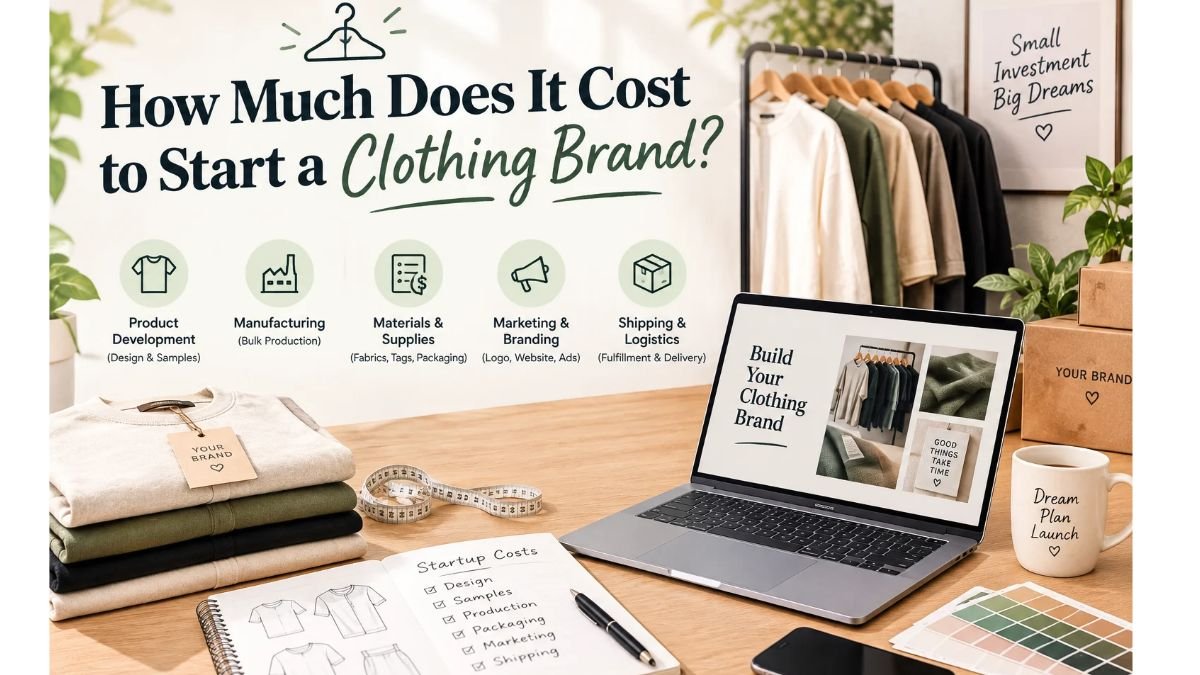
If you are asking how much does it cost to start a clothing brand, the first step is to understand where your money will go. Your budget may include product design, samples, manufacturing, branding, packaging, website development, marketing, shipping, and business expenses.
This guide explains the main startup costs, compares different launch strategies, and shows how to plan a realistic budget for your clothing business.
How Much Does It Cost to Start a Clothing Brand?
The cost depends on how you plan to create, sell, and deliver your products. There is no single startup figure that works for every clothing business.
The following amounts are illustrative estimates in US dollars. They are planning ranges, not guaranteed prices or supplier quotations.
| Business model | Illustrative starting budget |
|---|---|
| Print-on-demand clothing brand | $200–$1,500 |
| Small brand using ready-made or white-label products | $1,000–$5,000 |
| Small custom clothing collection | $3,000–$10,000 |
| Brand with a larger initial inventory | $10,000–$30,000+ |
| Clothing brand with a physical retail store | $20,000–$100,000+ |
These ranges can vary widely by country, product category, order quantity, and business requirements. A physical store in an expensive commercial area may cost substantially more.
For many first-time entrepreneurs, starting online with a limited product range is a practical way to manage risk. You can test customer demand before investing in a large collection.
1. Choose Your Clothing Brand Business Model
Before calculating costs, decide how you will source and sell your clothing. Your business model affects your initial investment, control over product design, and financial risk.
Print-on-Demand Clothing
Print-on-demand allows you to sell designs on existing garments without buying a large quantity of inventory upfront. A production partner makes and ships items after customers place orders.
Your initial expenses may include:
- Website or online store setup
- Design software or freelance design work
- Product mockups and samples
- Branding and domain registration
- Initial advertising
- Test orders
This approach can reduce inventory risk, but the cost per garment is often higher than bulk manufacturing. You may also have less control over fabric choices, garment construction, and packaging.
Best for: Entrepreneurs who want to test designs with a relatively small budget.
White-Label Clothing
White-label clothing typically uses existing products that can be sold under your own branding. The supplier may offer options for labels, packaging, or limited product customization.
You may need money for sample products, minimum orders, branding, freight, and marketing.
This approach can be less complex than developing every garment from scratch. However, product differentiation may be limited if other businesses sell similar items.
Best for: New brands that want branded products without extensive product development.
Private-Label Clothing
Private-label manufacturing allows you to sell garments under your brand name. Depending on the manufacturer, you may customize fabrics, colors, labels, trims, and packaging.
Your budget may include product development, samples, manufacturing, branding, and shipping.
Custom products provide more control, but you must plan carefully for minimum order quantities and production expenses.
Best for: Entrepreneurs building a distinct clothing brand with a recognizable product identity.
Fully Custom Clothing Manufacturing
Fully custom manufacturing is useful when your brand needs unique patterns, fits, fabric specifications, construction details, or finishes.
It may require additional spending on technical packs, pattern development, sampling, revisions, specialized materials, and production.
Best for: Brands that want original garments and greater control over product specifications.
2. Product Design and Development Costs
Product development is one of the first expenses to consider when deciding how much does it cost to create a clothing line.
Your design budget depends on whether you create the designs yourself, hire a freelancer, or work with a manufacturer that provides development support.
Potential costs include:
- Fashion design and illustration
- Technical drawings
- Tech pack preparation
- Pattern development
- Size grading
- Fabric and trim research
- Sample revisions
A tech pack is a document that explains how a garment should be made. It can include measurements, fabric details, stitching requirements, artwork placement, trims, and construction instructions.
Clear specifications reduce misunderstandings during sampling and production.
For a simple T-shirt, the development process may be relatively straightforward. A technical jacket or performance garment can require more development because of its construction, fit, and functional details.
You can reduce early expenses by launching with a focused collection. For example, start with two or three related products instead of developing ten unrelated styles.
Use consistent colors, materials, and branding where practical. This can make your collection easier to manage and help you avoid unnecessary development costs.
3. Fabric, Materials, and Sample Costs
Before manufacturing begins, you need to decide which materials are appropriate for your products.
Fabric choice affects garment quality, comfort, appearance, durability, and cost. Cotton, French terry, fleece, denim, polyester, and stretch fabrics have different properties and prices.
Your materials budget may include:
- Main fabric
- Ribbing and lining
- Zippers and buttons
- Drawcords and elastic
- Woven labels and care labels
- Hang tags
- Printing or embroidery materials
- Packaging components
Sampling lets you inspect the proposed garment before approving bulk production.
During sampling, check fabric weight, measurements, stitching, print placement, color, and finishing. If the garment does not meet your requirements, request revisions before moving forward.
Sample fees depend on the product, development work, materials, and supplier. Complex designs may cost more because they require additional patterns, trims, or construction steps.
Also ask whether sample fees are separate from production charges or can be credited toward a future order.
Avoid selecting materials based only on their price. A cheaper fabric may not provide the appearance, feel, or durability your customers expect.
4. Clothing Manufacturing and Inventory Costs
Manufacturing and inventory are often major expenses for a brand that sells physical products.
Your total depends on the number of garments, construction complexity, material selection, decoration, and production location.
For example, a basic T-shirt may require fewer manufacturing steps than a lined jacket with several pockets and custom hardware. A hoodie may require heavier fabric, ribbing, drawcords, and additional finishing.
Ask manufacturers to explain what their quotations include. The price may cover the garment only, while sampling, labels, packaging, freight, or other services may be charged separately.
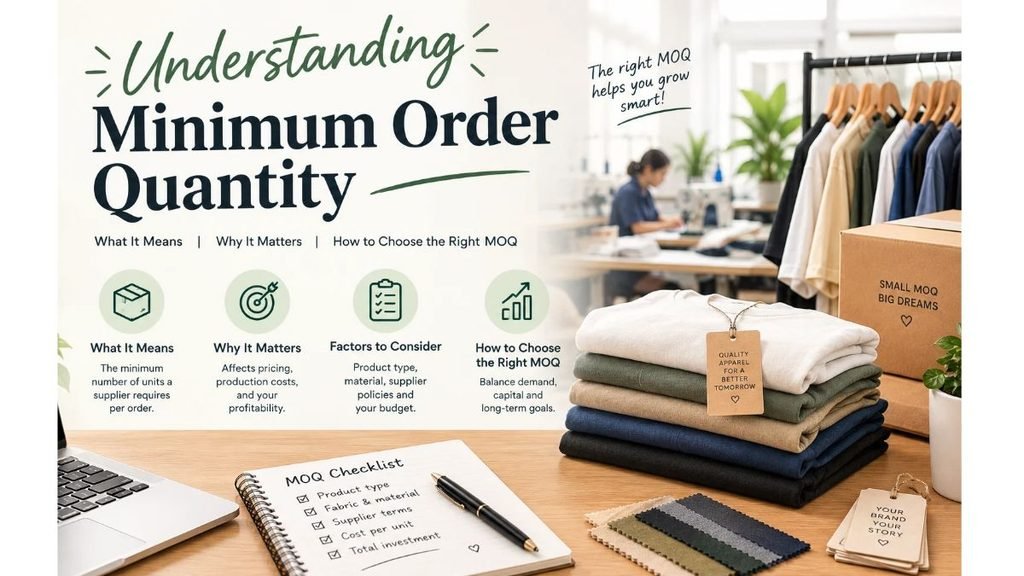
Understanding Minimum Order Quantity
Minimum order quantity, or MOQ, is the smallest order a supplier accepts under its stated terms.
Some manufacturers offer smaller production runs, while others require larger quantities. The MOQ may apply per style, color, or another agreed production unit.
Suppose a manufacturer requires 100 pieces for a style. If you order multiple colors, confirm whether the minimum applies to the combined quantity or separately to each color.
Do not assume that a low MOQ automatically means a low total cost. Smaller production runs may have a higher unit price.
Example: A Small Custom Collection
Imagine you want to launch a small collection of T-shirts and hoodies. Your planning budget might include:
| Expense | Illustrative amount |
|---|---|
| Design and product development | $400 |
| Samples and revisions | $300 |
| Initial manufacturing order | $2,500 |
| Labels and packaging | $250 |
| Freight and import allowance | $500 |
| Estimated subtotal | $3,950 |
This is only an example of how costs can be organized. It is not a standard market price. Your actual quotation may be lower or higher depending on quantities, product specifications, destination, and included services.
You should also reserve money for website expenses, marketing, and unexpected costs.
5. Branding and Packaging Costs
Your brand identity helps customers recognize your products. It also influences how your business looks across your website, packaging, and marketing channels.
Branding expenses may include:
- Logo design
- Brand colors and typography
- Product labels
- Hang tags
- Care labels
- Packaging bags or boxes
- Product photography
- Brand guidelines
You can reduce costs by starting with a simple, consistent identity. A clear logo, readable product information, and professional product photographs may be more useful at launch than an expensive packaging system.
Custom packaging can improve presentation, but it adds cost and may require minimum quantities. Compare the value of each packaging feature against your available budget.
For a new brand, prioritize items customers will notice and use. Make sure the label information is accurate and meets the rules that apply to your sales market.
6. Website and Online Store Expenses
If you plan to sell directly to customers, you need a way to display products, accept payments, and manage orders.
Your online store costs may include:
- Domain registration
- E-commerce platform fees
- Website theme or design
- Product photography
- Payment processing
- Apps or integrations
- Email marketing tools
- Website maintenance
A simple store with a small product range may be inexpensive to establish. A custom-designed website with advanced features can require a larger investment.
You can start with a standard e-commerce theme and improve the site as sales grow. Make sure product pages include clear photographs, sizing information, fabric details, care instructions, shipping information, and return policies.
Remember that website setup is only one expense. You also need to attract visitors and convert them into customers.
If you plan to sell through online marketplaces, review their listing fees, selling fees, advertising costs, and fulfillment requirements before estimating your profit.
7. Marketing and Customer Acquisition Costs
A clothing brand needs a strategy for reaching its target customers. Even attractive products may struggle to sell if potential buyers do not know they exist.
Marketing expenses can include:
- Social media content
- Product photography and video
- Paid advertising
- Influencer partnerships
- Email marketing
- Search engine optimization
- Promotional campaigns
- Samples for creators or media
You do not need to spend heavily on every channel at the beginning. Choose platforms where your target audience is active and create content that communicates your product’s value.
For example, a streetwear brand may focus on styling videos and community content. An activewear brand may emphasize fit, movement, fabric performance, and practical product demonstrations.
Track results rather than judging campaigns only by views or likes. Monitor website visits, conversion rates, order values, and customer acquisition costs.
Your marketing budget should also account for ongoing activity. Spending all available cash on the initial product order can leave you without enough money to promote it.
8. Business Registration, Legal, and Administrative Costs
Business setup costs depend on the country where your business operates and the markets where you sell.
Potential expenses include:
- Business registration
- Tax registration
- Permits or licenses, where required
- Accounting services
- Contracts and legal advice
- Trademark applications
- Business banking
- Insurance
A trademark can help protect your brand identity, but availability and registration requirements vary by jurisdiction. Research your proposed brand name before investing heavily in labels, packaging, and marketing.
If you sell internationally, review the rules that apply to product labeling, consumer protection, import duties, taxes, and returns.
Do not assume that one country’s registration automatically meets the requirements of another. Seek qualified local advice when your circumstances require it.
9. Shipping, Duties, and Fulfillment
Shipping is an important part of your startup budget, especially if your supplier and customers are in different countries.
Your costs may include shipping samples, transporting bulk inventory, customs clearance, duties, taxes, warehousing, and delivery to customers.
Ask suppliers which shipping terms apply to their quotations. Confirm who arranges transport, which charges are included, and who is responsible for import duties and other fees.
Air freight may be suitable for smaller or urgent shipments, while sea freight may be more economical for larger shipments that can accommodate longer transit times. Actual costs depend on the route, shipment size, service, and timing.
If you store inventory yourself, include packaging materials, storage space, order preparation, and returns in your budget.
If you use a fulfillment service, compare its receiving, storage, picking, packing, and shipping charges.
A garment’s factory price is not the same as its final landed cost. Calculate the expenses required to get each product ready for sale.
10. How Much Does It Cost to Start a Clothing Business From Home?
Starting a clothing business from home can reduce overhead because you may not need a retail lease or separate office. However, you still need to pay for products, branding, marketing, and order fulfillment.
A home-based business could use print-on-demand, resell wholesale clothing, or develop custom products.
For example, an entrepreneur testing print-on-demand designs may spend mainly on a domain, samples, a store, and marketing. Someone ordering custom inventory will need additional capital for development, manufacturing, and shipping.
To control costs:
- Start with one product category.
- Use a limited number of designs and colors.
- Test demand before ordering large quantities.
- Handle basic content creation yourself if you have the skills.
- Use simple packaging at launch.
- Keep personal and business finances separate.
- Track every expense and review actual sales performance.
Working from home does not mean the business has no operating costs. Include returns, customer service, software, payment fees, and taxes in your financial plan.
11. How Much Does It Cost to Open a Clothing Store?
Opening a physical clothing store is different from launching an online brand. A store may require a lease deposit, rent, renovations, fixtures, signage, inventory, utilities, insurance, and staff.
Your budget may include:
- Commercial lease and deposit
- Interior design and construction
- Clothing racks and display fixtures
- Lighting and signage
- Point-of-sale equipment
- Initial stock
- Staff wages
- Utilities and insurance
- Local permits and compliance
- Launch marketing
Location has a major effect on cost. A small shop in a lower-rent area may require much less capital than a store in a premium shopping district.
You should also budget for operating expenses while sales are still developing. Rent and wages may continue even during slow periods.
If you are unsure whether demand will support a physical location, consider launching online or testing products at temporary markets and pop-up events first.
12. How Much Money Do You Need to Start a Clothing Brand?
The amount you need depends on your launch strategy and how much work you can handle yourself.
Instead of choosing a budget based on a single online estimate, calculate your own expected costs.
A useful planning formula is:
Startup budget = one-time setup costs + initial product costs + launch marketing + operating reserve
One-time setup costs may include design, website development, and business registration. Initial product costs include samples, manufacturing, and packaging. Launch marketing covers the activities needed to introduce your brand.
Your operating reserve helps cover expenses before sales generate enough cash to support the business.
For example, you may sell products more slowly than expected, face a shipping delay, or need to correct a production issue. A reserve gives you more flexibility when these problems occur.
Avoid spending your entire budget on inventory. Unsold garments can tie up cash that you need for marketing, shipping, and future orders.
13. How to Reduce the Cost of Starting a Clothing Line
You can manage startup costs without ignoring product quality.
Launch a Focused Collection
Start with a few products that suit the same customer and brand identity. A smaller collection makes design, sampling, inventory, and marketing easier to manage.
Choose Materials Strategically
Discuss available fabrics with your manufacturer. Using suitable stock fabrics may reduce complexity compared with developing a custom fabric from scratch.
Do not compromise on material performance simply to obtain the lowest price.
Compare Multiple Suppliers
Request comparable quotations from several manufacturers. Confirm that each quotation covers the same specifications, quantity, decoration, packaging, and shipping terms.
Approve Samples Carefully
Check the sample against your requirements and document changes before production. Unclear instructions can lead to costly revisions or unsellable inventory.
Avoid Unnecessary Customization
Every additional color, trim, print location, or packaging feature can add complexity. Prioritize the details that distinguish your product and matter most to customers.
Test Demand Before Scaling
Use customer feedback, small launches, preorders where appropriate, or limited production runs to learn which products attract interest.
If you accept preorders, communicate realistic timelines and have a clear plan for delays, refunds, and fulfillment.
Keep Track of Cash Flow
Record payments, supplier deposits, inventory purchases, marketing expenses, and incoming sales. Profit on paper does not always mean you have enough cash available to pay upcoming bills.
14. Working With a Custom Clothing Manufacturer
If your goal is to create original products, choosing a manufacturer is an important part of planning your budget.
Fashion Soul International is a factory-owned custom clothing manufacturer based in Sialkot, Pakistan. The company offers private-label, OEM, ODM, white-label, cut-and-sew, and full-package production.
Its services cover product development, fabric sourcing, sampling, bulk manufacturing, quality control, custom branding, packaging, and international shipping. The company publishes a standard MOQ starting at 100 pieces, with project-specific requirements confirmed during quotation.
Sample development is typically stated as 7–14 business days, while published bulk production timelines are generally 20–35 business days after sample approval. Actual timelines depend on the project and should be confirmed with the company.
When requesting a quotation, prepare the following information:
- Product type and design references
- Estimated order quantity
- Fabric and material preferences
- Size range and measurements
- Printing or embroidery requirements
- Labels and packaging details
- Delivery destination
- Target timeline
These details help the manufacturer understand the project and estimate the relevant costs. Ask for a written quotation that explains what is included and what may cost extra.
You can learn more about available services at Fashion Soul International.
15. Calculate Your Clothing Brand’s Break-Even Point
Understanding your startup cost is only part of the process. You also need to know how many garments you must sell to cover your expenses.
Your break-even point is the number of units you need to sell to cover your fixed costs, based on the contribution earned from each unit.
A simplified formula is:
Break-even units = Fixed costs ÷ Contribution per unit
Contribution per unit is your selling price minus the variable costs associated with selling that garment.
For example, suppose you sell a T-shirt for $30. The garment, packaging, payment processing, and other variable costs total $18 per sale. Your contribution is $12 per unit.
If your fixed launch and operating costs are $1,200, you would need to sell 100 units to cover those fixed costs under these assumptions.
This is a simplified example. It does not account for every possible expense, tax, discount, refund, or change in sales volume.
Use realistic estimates when planning your retail price. Include marketing, shipping subsidies, returns, and platform fees where relevant.
16. Common Budgeting Mistakes to Avoid
New clothing entrepreneurs often underestimate the full cost of launching a brand.
Focusing only on manufacturing: The factory price does not include every expense involved in preparing products for sale.
Ordering too much inventory: A large order can create cash-flow problems if products do not sell quickly.
Ignoring sample revisions: Product development may require more than one sample, especially for complex garments.
Underestimating marketing: Products need visibility to reach potential customers.
Forgetting operating expenses: Software, storage, fulfillment, returns, and customer service can continue after launch.
Using unrealistic sales forecasts: Build your plan around cautious assumptions rather than expecting every product to sell immediately.
Failing to maintain a reserve: Unexpected expenses can interrupt production or marketing if no cash remains available.
A realistic budget gives you room to learn and adjust as your business develops.
Frequently Asked Questions
How much does it cost to start a clothing line?
The cost varies by business model. A print-on-demand brand may start with a few hundred dollars, while a custom collection with inventory may require several thousand dollars or more. Product complexity, order quantities, marketing, and shipping all affect the final budget.
How much does it cost to start a clothing business?
A small online clothing business may require a relatively modest initial investment if it uses existing products or print-on-demand services. A business developing custom inventory or opening a retail store will generally need more capital. Calculate product, setup, marketing, shipping, and operating expenses before launching.
How much would it cost to start a clothing line with custom products?
A custom clothing line may require money for design, technical packs, samples, manufacturing, labels, packaging, freight, and marketing. The cost depends on the number of styles, materials, order quantity, and production requirements. Request project-specific quotations to build an accurate estimate.
How much does it cost to make a clothing brand?
Creating a clothing brand involves more than manufacturing garments. You may also need branding, product photography, an online store, packaging, marketing, business registration, and shipping. The total depends on which tasks you handle yourself and which services you purchase.
How much do you need to start a clothing brand with no experience?
Start by choosing a simple business model and learning about your target customers. Print-on-demand or a small, focused product launch can reduce initial inventory risk. Before investing heavily, understand product quality, pricing, supplier terms, and the costs of attracting customers.
Is it cheaper to start a clothing brand online?
An online brand often has lower fixed costs than a physical store because it may not require retail rent, store fixtures, or in-person staff. However, it still needs products, marketing, order fulfillment, and customer support. Online businesses also face competition and customer acquisition costs.
What is the biggest expense when starting a clothing brand?
For a brand that manufactures and holds inventory, product development and the initial production order can be major expenses. For other models, advertising, retail rent, or fulfillment may take a larger share of the budget. Your business model determines which costs matter most.
Final Thoughts
The answer to how much does it cost to start a clothing brand depends on the products you want to sell, how you manufacture them, and how you reach customers.
A lean online launch can reduce upfront spending, while custom manufacturing offers more control over design and branding but requires careful planning. A physical store adds further expenses for rent, fixtures, staff, and inventory.
Start with a clear business model, a realistic cost breakdown, and a manageable product range. Compare suppliers, inspect samples, calculate landed costs, and reserve enough money for marketing and ongoing operations.
The goal is not simply to launch a clothing brand as cheaply as possible. It is to build a business with products customers want, costs you understand, and enough financial flexibility to grow sustainably.