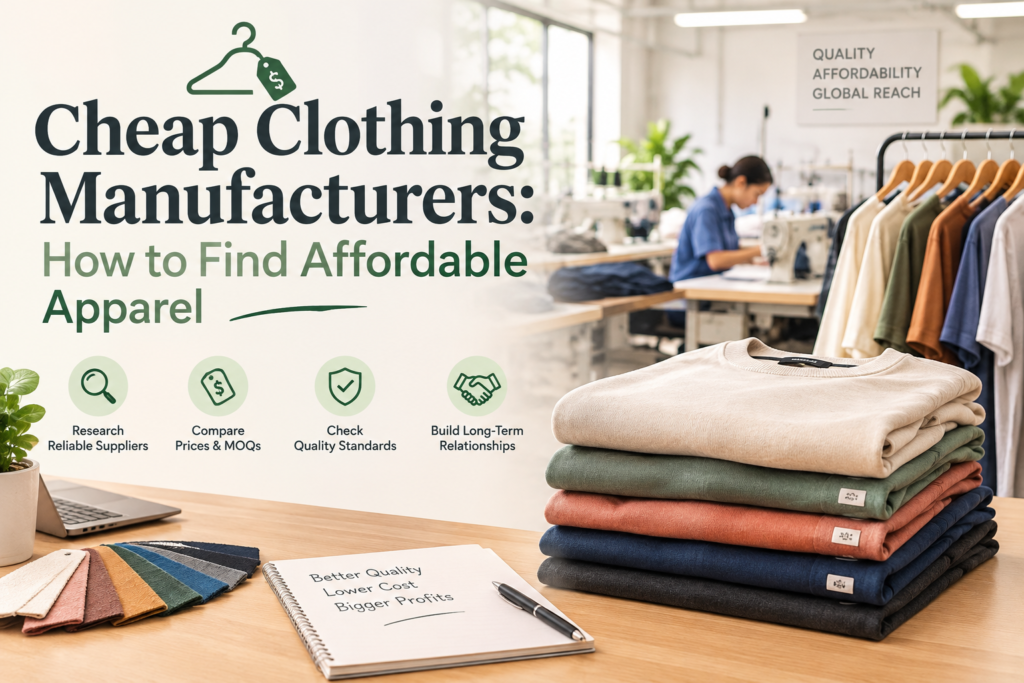
Cheap Clothing Manufacturers: How to Find Affordable Apparel Suppliers
Finding cheap clothing manufacturers can help fashion startups, boutique owners, and established brands manage production costs. However, low prices alone do not guarantee a successful manufacturing partnership. You also need consistent quality, clear communication, suitable minimum order quantities, and dependable delivery.
The best approach is to compare manufacturers based on the complete cost of producing and delivering your garments. This includes fabric, cutting, sewing, printing, labels, packaging, shipping, and other applicable expenses.
Whether you want to launch a clothing brand, manufacture custom hoodies, source wholesale T-shirts, or develop private-label apparel, this guide explains how to find affordable suppliers without compromising essential quality standards.
For tracksuit orders specifically, our tracksuit manufacturer page sets out the minimum order and what moves the price.
What Are Cheap Clothing Manufacturers?
Cheap clothing manufacturers are apparel producers that offer competitive production prices for finished garments. They may manufacture basic T-shirts, hoodies, tracksuits, activewear, jackets, uniforms, and other clothing products.
Affordable manufacturers can operate in different countries and serve different types of businesses. Some specialize in large production runs, while others accept smaller orders for startups and growing brands.
The word “cheap” does not necessarily mean low quality. A manufacturer may offer competitive pricing because of efficient production methods, suitable material sourcing, streamlined operations, or experience with a particular garment category.
However, some low quotations reflect thinner fabrics, limited customization, inconsistent stitching, or additional charges that appear later.
Before selecting a supplier, understand what the quoted price includes and whether the manufacturer can meet your product requirements.
1. Define Your Clothing Production Requirements
Before contacting manufacturers, determine what you want to produce. Clear requirements help suppliers understand your project and prepare more accurate quotations.
Start by identifying your product category. You might need oversized T-shirts, heavyweight hoodies, sportswear, leggings, denim, jackets, or casual clothing.
Next, prepare the following information:
- Product type and design
- Fabric composition and preferred weight
- Available colors and size range
- Measurements and fit requirements
- Printing, embroidery, or other decoration
- Custom labels and packaging
- Estimated order quantity
- Delivery destination and target date
You can organize these details in a product specification sheet or technical pack, commonly called a tech pack.
A tech pack explains how a garment should be made. It may include technical drawings, measurements, material specifications, stitching details, artwork, and branding instructions.
If you do not have a complete tech pack, prepare a design brief and reference images. Ask whether the manufacturer can assist with product development.
Why does this matter? Manufacturers cannot accurately compare costs when they are quoting for different materials, designs, and production requirements.
2. Search Online for Affordable Clothing Manufacturers
Online research is a practical way to discover manufacturers in different regions. Start with searches that describe your product, order size, and manufacturing needs.
Useful search phrases include:
- Cheap clothing manufacturers for startups
- Affordable custom clothing manufacturers
- Low MOQ clothing manufacturers
- Cheap private-label clothing manufacturers
- Wholesale clothing manufacturers
- Affordable T-shirt manufacturers
- Custom hoodie manufacturers
- Small-batch apparel manufacturers
- Affordable activewear manufacturers
- Cut-and-sew clothing manufacturers
You can also add a country to your search if you have a preferred sourcing location.
Review company websites, product categories, customization options, sample policies, and contact information. Look for clear explanations of manufacturing services rather than relying entirely on promotional claims.
A supplier with a lower advertised price may not be cheaper after shipping, duties, labels, packaging, and sampling costs are included.
Create a shortlist of several relevant manufacturers. Send each one the same product requirements so you can compare quotations fairly.
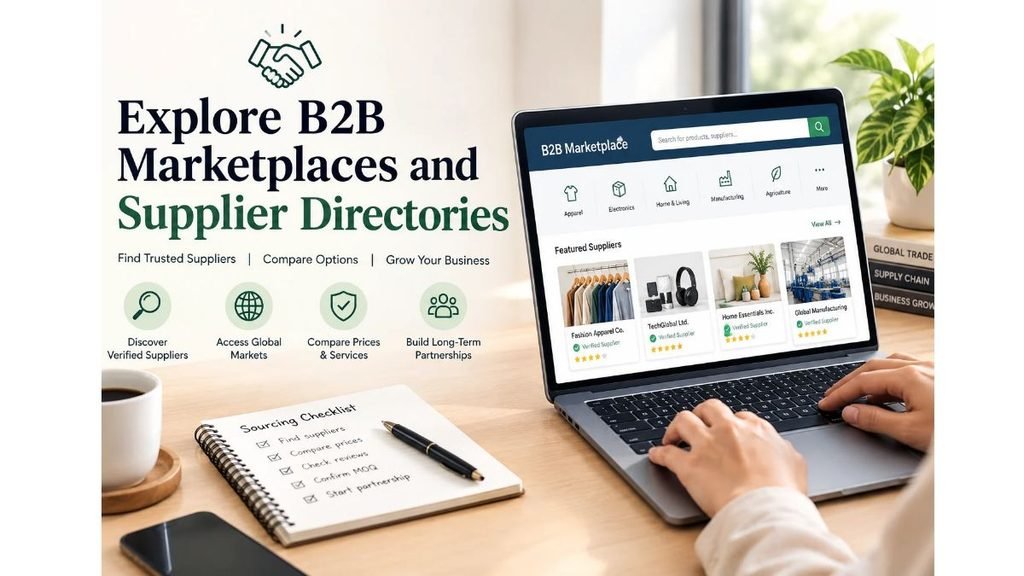
3. Explore B2B Marketplaces and Supplier Directories
B2B marketplaces and supplier directories can help you find apparel producers and wholesalers. They often allow buyers to review product listings, compare suppliers, and request quotations.
However, a marketplace listing does not automatically prove that a supplier owns a factory or can meet your quality standards.
Before proceeding, investigate the following:
- Business identity and contact details
- Manufacturing or sourcing experience
- Product examples relevant to your design
- Minimum order quantity
- Sample availability
- Customization capabilities
- Payment terms
- Quality-control procedures
- Shipping arrangements
Ask whether the business manufactures products directly or purchases them from other factories. Either arrangement may work, but you should understand who is responsible for production quality and delivery.
For larger orders, consider requesting a factory video tour, business documentation, or an independent inspection.
Avoid transferring substantial funds to an unverified supplier simply because it offers the lowest price.
4. Compare Clothing Manufacturers by Country
The best sourcing country depends on your product category, order quantity, budget, shipping destination, and quality requirements.
No country guarantees the lowest total cost for every garment. Compare individual suppliers instead of making decisions based only on location.
China
China has a broad textile and apparel supply chain. Buyers can explore suppliers for basic clothing, streetwear, sportswear, technical garments, and custom products.
When comparing Chinese clothing manufacturers, confirm whether the quoted price includes fabric, decoration, labels, packaging, and other requested services. Also review shipping costs and import requirements for your destination.
Pakistan
Pakistan has an established textile and garment manufacturing sector. Buyers can explore manufacturers for T-shirts, hoodies, tracksuits, sportswear, activewear, workwear, and other custom apparel.
For international buyers, it is important to confirm fabric availability, sample approval, production timelines, export documentation, and shipping terms.
Bangladesh
Bangladesh is an option worth researching for apparel sourcing, particularly for buyers evaluating production at larger quantities. Confirm whether the supplier accepts your order size and can meet your product specifications.
India
India offers a range of textile and apparel suppliers. Depending on the manufacturer, buyers may find options for cotton clothing, casual apparel, printed garments, and other product categories.
Turkey
Turkey may suit businesses seeking apparel production with access to European supply chains. Evaluate each supplier’s capabilities, pricing, lead times, and shipping arrangements.
United States
US-based manufacturers may be suitable for brands that prioritize domestic communication or production. However, local labor, materials, order quantities, and available capacity can affect costs.
When comparing these locations, calculate the landed cost rather than focusing only on the factory price.
5. Understand Minimum Order Quantity Before Choosing a Supplier
Minimum order quantity, or MOQ, is the smallest quantity a supplier agrees to produce or sell under its stated terms.
MOQ is important because it affects how much money you need before selling your products.
Some manufacturers accept small orders, while others require larger quantities to make production economically practical. Custom fabric development, special dyeing, and complicated decoration may increase minimum requirements.
Ask the supplier these questions:
- What is the MOQ per style?
- Does the MOQ apply separately to each color?
- Are there minimums for each size?
- Can different sizes be combined within one order?
- Does custom fabric require a larger quantity?
- Are sample costs separate from bulk production?
For example, a supplier may accept a smaller order for one hoodie design using available fabric. The same supplier may require a larger quantity for custom-dyed fabric or specialized construction.
If you are launching your first collection, consider producing fewer styles and limiting color variations. This can simplify sourcing and reduce the amount of inventory you need to purchase.
Do not assume that every low-MOQ manufacturer offers the same price or customization options. Confirm the details for your particular project.
6. Choose Between Wholesale and Custom Manufacturing
Understanding the difference between wholesale clothing and custom manufacturing can help you find a more affordable solution.
Wholesale Clothing Suppliers
Wholesale suppliers sell finished garments in bulk. You choose from products that are already available.
This option may reduce product-development expenses because you are not creating every garment from scratch. However, your choices for fit, fabric, and design may be limited.
Wholesale can suit boutiques, resellers, and online stores that want to stock clothing quickly.
Custom Clothing Manufacturers
Custom manufacturers produce garments according to your specifications. They may help with fabric sourcing, pattern development, sampling, cutting, sewing, decoration, and finishing.
Custom manufacturing offers more control over product design but may involve additional development costs.
Private-Label Manufacturers
Private-label manufacturers produce clothing that you sell under your own brand. Depending on the service, you may customize labels, hang tags, colors, trims, packaging, and garment details.
White-Label Manufacturers
White-label suppliers generally offer existing products that can be sold under your brand name. Their customization options may be more limited than those of fully custom manufacturers.
Choose the model that fits your budget and goals. If you need unique designs, compare custom manufacturing quotations. If you want to test demand quickly, available wholesale products may be more practical.
7. Compare Quotations and Calculate the Total Cost
Request written quotations from several manufacturers. Give each supplier the same specifications and estimated quantity.
A useful quotation should clearly explain the costs and terms.
| Cost category | What to check |
|---|---|
| Garment production | Price per piece |
| Fabric and trims | Materials included in the price |
| Sampling | Development fees and revision charges |
| Printing and embroidery | Decoration method and cost |
| Branding | Labels, hang tags, and logos |
| Packaging | Individual packaging and cartons |
| Shipping | Freight method and destination |
| Duties and taxes | Included or excluded charges |
| Payment terms | Deposit and remaining balance |
| Production time | Estimated schedule and approval requirements |
Calculate the expected landed cost per garment. Include all relevant expenses between production and receiving the goods.
For example, a supplier with a lower unit price may charge separately for labels, packaging, and shipping. Another supplier may include several of those services in its quotation.
The second option could provide better overall value even if its factory price is higher.
Also consider defect rates, rework, and the potential cost of delayed deliveries. An inexpensive order can become expensive if many garments fail inspection or arrive too late for a planned launch.
8. Request Samples Before Placing a Bulk Order
A sample lets you evaluate a garment before committing to larger production quantities.
Photographs cannot fully show fabric texture, fit, stitching, or how a garment behaves after washing. A physical sample provides a better opportunity to identify problems.
When reviewing samples, check:
- Fabric composition and weight
- Measurements and fit
- Stitching and seam construction
- Print or embroidery quality
- Color consistency
- Zippers, buttons, and other trims
- Label placement
- Finishing and packaging
If you sell clothing under your own brand, compare the sample with your design brief and intended price point.
Document any changes required. These might include adjusting sleeve length, changing fabric weight, improving stitching, or correcting artwork placement.
Ask whether revisions incur additional fees and whether sample charges can be credited toward a bulk order.
Approve the final sample and specifications in writing before production begins. This provides a clear reference for the finished order.
9. Check Fabric Quality and Garment Construction
Fabric is one of the main factors affecting both garment cost and customer satisfaction.
A lower-cost fabric may work well for one product but be unsuitable for another. The correct choice depends on the garment’s intended use, desired appearance, durability, and selling price.
For example, a heavyweight streetwear hoodie may require a different fabric from a lightweight summer T-shirt. Activewear may need stretch, moisture management, and recovery after movement.
GSM means grams per square meter. It describes fabric weight and helps buyers compare materials. However, GSM alone does not determine softness, durability, or overall quality.
Also consider fiber composition, knitting or weaving structure, finishing, shrinkage, and colorfastness.
Garment construction matters just as much. Examine seam strength, stitching consistency, hems, neckline construction, and attachment of trims.
Ask manufacturers which materials they recommend for your target product and budget. Request samples of alternative fabrics when you need to compare options.
The goal is not to select the most expensive material. It is to choose materials that meet your product requirements at a suitable cost.
10. Evaluate Quality Control Procedures
Affordable production should still meet clearly defined quality standards.
Before manufacturing begins, agree on the product specifications and acceptable quality requirements. These should cover measurements, fabric, construction, colors, decoration, labels, and packaging.
Ask how the supplier checks quality throughout production.
Common inspection stages include:
Material inspection: Checking incoming fabric and trims for visible defects.
Cutting inspection: Confirming pattern accuracy and material placement.
Inline inspection: Reviewing garments during sewing and assembly.
Decoration inspection: Checking printing, embroidery, and artwork placement.
Final inspection: Examining completed garments before shipment.
For larger orders, you may consider an independent inspection service. Agree on the inspection scope and acceptance criteria before production begins.
Keep the approved sample available for comparison. If defects appear, document them and agree on corrective action.
A low price is not useful if the finished garments cannot be sold at your intended quality level.
11. Negotiate Pricing Without Sacrificing Quality
Manufacturers may have different ways to reduce production costs. The most useful discussions focus on making the order more efficient rather than demanding an unrealistic price.
Consider these approaches:
- Simplify designs: Fewer complex construction details can reduce production time.
- Reduce unnecessary variations: Fewer colors or styles can simplify purchasing and inventory.
- Use available fabrics: Stock materials may avoid some custom-development costs.
- Plan quantities carefully: A suitable production quantity may improve unit economics.
- Consolidate compatible orders: Combining products may help where the supplier’s terms allow it.
- Confirm specifications early: Fewer revisions can reduce sampling and development expenses.
- Review decoration methods: Compare printing or embroidery options suitable for your design.
- Plan production ahead: Better scheduling may help avoid expensive rush arrangements.
Ask suppliers which changes would meaningfully reduce the price. Request an updated quotation showing how each change affects cost and quality.
Do not automatically choose the thinnest fabric, cheapest trims, or least durable decoration. These choices may damage customer satisfaction and lead to returns.
12. Watch for Hidden Costs and Supplier Scams
Some suppliers advertise very low prices to attract inquiries. The final quotation may be substantially different once all requirements are considered.
Ask whether the price includes fabric, trims, printing, embroidery, labels, packaging, and export preparation.
For international orders, clarify freight costs, insurance, customs duties, taxes, and the responsibilities of each party. Confirm the agreed delivery terms and who will handle import clearance.
Be cautious if a supplier:
- Refuses to provide clear business details
- Avoids questions about samples
- Changes prices without explaining why
- Requests payment to an unrelated account without a credible explanation
- Promises unrealistic production times
- Uses copied or inconsistent product photographs
- Pressures you to make immediate payment
- Refuses to document important specifications
Verify business information and use appropriate payment protections when available. For a significant order, consider independent inspections and a written manufacturing agreement.
No supplier can eliminate every production risk, but verification and documentation can help you make a more informed decision.
13. Understand Production Timelines and Shipping
A cheap garment quotation is only useful if the supplier can deliver within your business schedule.
Production time depends on the product, materials, order size, factory workload, sampling, revisions, and finishing requirements.
Custom clothing often involves several stages:
- Inquiry and quotation
- Material selection
- Pattern development
- Sample creation
- Sample review and approval
- Bulk production
- Quality inspection
- Packaging
- Export preparation and shipping
Ask the supplier when the production clock begins. For many custom projects, bulk production starts after the required sample and specifications have been approved.
Shipping time is separate from manufacturing time. Air freight may be faster but more expensive, while sea freight can be more economical for suitable shipments but generally takes longer.
Confirm the destination, shipping method, estimated transit time, documentation, and responsibility for duties or taxes. Avoid relying on a general delivery estimate without confirming the terms for your order.
14. Affordable Custom Manufacturing With Fashion Soul International
Businesses seeking affordable custom apparel may benefit from working directly with a clothing manufacturer rather than relying only on intermediaries.
Fashion Soul International is a factory-owned custom clothing manufacturer based in Sialkot, Pakistan. The company offers private-label, OEM, ODM, white-label, cut-and-sew, and full-package production.
Its services cover product development, fabric sourcing, sampling, bulk production, quality control, custom branding, packaging, and international shipping.
The company publishes a standard minimum order quantity starting at 100 pieces. Actual requirements depend on the product and project, so buyers should confirm MOQ and pricing during quotation.
Fashion Soul International produces a range of apparel categories, including streetwear, activewear, sportswear, workwear, jackets, denim, casual wear, tracksuits, T-shirts, and hoodies.
For brands planning custom production, the process can begin with a design brief, sketches, reference images, or a tech pack. Before sampling, the manufacturer needs finalized specifications or a suitable reference sample.
Bulk production should proceed after the required sample approval and confirmation of the production details.
If you are comparing affordable clothing manufacturers, evaluate the complete quotation, material options, sample quality, customization requirements, and shipping arrangements.
Visit Fashion Soul International to review its manufacturing services and discuss your apparel project.
15. How to Choose the Best Cheap Clothing Manufacturer
The best manufacturer is not necessarily the one offering the lowest unit price. It is the one that provides suitable value for your specific business.
Use the following criteria when comparing shortlisted suppliers.
| Evaluation factor | What a suitable supplier should provide |
|---|---|
| Product experience | Experience relevant to your garment category |
| Pricing | A clear quotation with defined inclusions |
| MOQ | Quantities that fit your budget and requirements |
| Sampling | A way to evaluate quality before bulk production |
| Communication | Clear answers and documented decisions |
| Quality control | Defined inspection procedures |
| Customization | Capabilities that match your design |
| Production timeline | A realistic schedule for your order |
| Shipping | Clear delivery terms and responsibilities |
| Verification | Business information that can be checked |
You can score each supplier against these factors and compare the results. Give greater weight to the criteria that matter most to your product and customers.
For example, a fashion brand selling premium streetwear may prioritize fabric weight, construction, and embroidery quality. A business selling basic promotional T-shirts may focus more on price, reliable sizing, and delivery.
Make your decision based on your priorities rather than using the same criteria for every project.
Frequently Asked Questions
Where can I find cheap clothing manufacturers?
You can find affordable clothing manufacturers through online searches, B2B marketplaces, trade shows, industry directories, and direct company websites. Search for your specific product category and compare several suppliers using the same specifications.
Which country has the cheapest clothing manufacturers?
There is no single country that is cheapest for every garment. Production costs vary by product, materials, order quantity, customization, and shipping. Compare suppliers from relevant countries using the complete landed cost.
Can small clothing brands work with affordable manufacturers?
Yes. Some manufacturers accept smaller orders, although MOQs and customization options vary. Start by searching for low-MOQ or small-batch clothing manufacturers and confirming their requirements.
Are cheap clothing manufacturers reliable?
Some affordable manufacturers provide dependable products and service, while others may not meet your standards. Review business details, request samples, check relevant experience, and agree on quality requirements before placing a large order.
How can I reduce clothing manufacturing costs?
You can simplify designs, use suitable stock fabrics, limit unnecessary variations, confirm specifications early, and plan production carefully. Compare alternatives with your supplier to understand how each change affects cost and quality.
What is a low MOQ clothing manufacturer?
A low-MOQ clothing manufacturer accepts relatively small production orders compared with suppliers that require larger quantities. The actual minimum depends on the product, fabric, colors, and customization.
Should I choose the cheapest quotation?
Not automatically. Compare material quality, sample results, production terms, shipping, and possible additional charges. A slightly higher quotation may offer better value if it includes important services or reduces quality risks.
How much does a clothing manufacturer charge per piece?
The price depends on garment type, fabric, design complexity, quantity, decoration, labels, packaging, and shipping. Provide your specifications and order quantity to obtain a meaningful quotation from each supplier.
Conclusion
Finding cheap clothing manufacturers requires careful research and realistic cost comparisons. Start by defining your product requirements, searching for suitable suppliers, and understanding the differences between wholesale and custom manufacturing.
Request written quotations, evaluate physical samples, confirm MOQ, and examine the manufacturer’s quality-control process. Include shipping and other applicable expenses when calculating your final cost.
Most importantly, avoid choosing a supplier based only on its advertised price. The right manufacturing partner should offer a workable combination of affordability, product quality, communication, and production reliability.
With a clear sourcing process, you can control your clothing production budget while building products that meet your customers’ expectations.