American Made Clothing: A Complete Guide to U.S.-Made Apparel
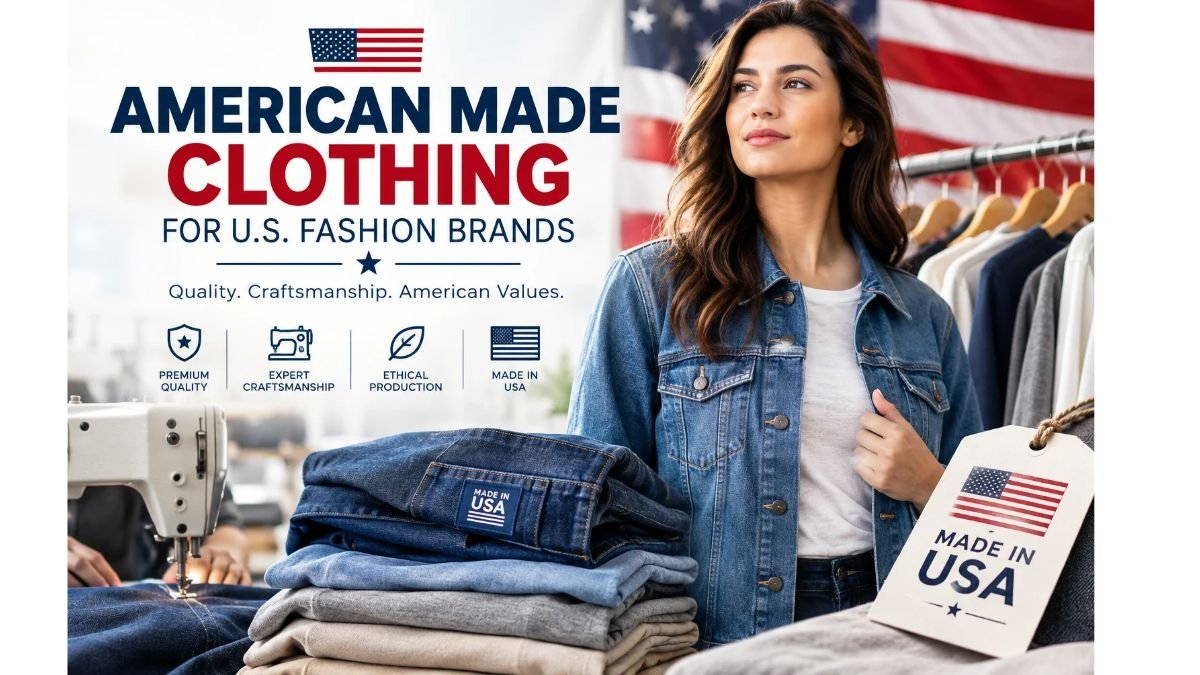
American made clothing has become an important choice for shoppers who value local production, product quality, and transparent manufacturing. Many consumers want to know where their garments are made, how they are produced, and what materials are used. Fashion brands also consider domestic manufacturing when developing products and building customer trust.
From everyday basics to premium fashion, American made clothing covers a wide range of products. These include T-shirts, jeans, hoodies, jackets, activewear, workwear, and clothing for women. However, finding suitable products requires understanding manufacturing costs, material options, production capabilities, and labeling requirements.
This guide explains what made in USA clothing means, how to find clothes made in USA for women, and what to consider when comparing American made clothing brands for women. It also explores how brands can evaluate made in USA apparel manufacturers and make informed sourcing decisions.
What Is American Made Clothing?
American made clothing generally refers to garments manufactured in the United States. However, the exact meaning depends on where and how the product is produced.
A garment may be cut, sewn, assembled, or finished in the United States. Its fabric, thread, buttons, zippers, and other components may come from different countries. Therefore, a product made in America does not automatically use only American materials.
For consumers, understanding these differences helps them make informed purchasing decisions. For businesses, clear manufacturing information supports accurate product descriptions and responsible marketing.
What Does Made in USA Mean?
The phrase Made in USA has specific implications for product labeling in the United States. For most products, the Federal Trade Commission (FTC) requires an unqualified claim to be supported by evidence that the product is all or virtually all made in the United States.
This generally means that the final assembly or processing, as well as significant parts and processing, must take place domestically. Simply sewing imported fabric into a garment in the United States may not be enough to justify an unrestricted Made in USA claim.
Some products may qualify for more limited claims, such as “Made in USA of imported fabric,” when the wording accurately describes the manufacturing process.
Businesses should review the FTC’s current guidance before using origin claims on product labels, websites, packaging, or advertisements. Accurate labeling helps protect customers and reduces the risk of misleading marketing.
Why Do People Choose Clothing Made in America?
Consumers choose American-made garments for different reasons. Some want to support domestic businesses and workers. Others prefer brands that provide more information about production and sourcing.
Common reasons include:
- Domestic manufacturing: Buyers want products made by manufacturers operating in the United States.
- Supply chain visibility: Some brands provide information about factories, materials, and production methods.
- Local economic support: Purchasing domestically produced clothing can support U.S. manufacturers and related businesses.
- Product quality: Some shoppers associate domestic production with careful construction, although quality varies by manufacturer.
- Reduced international shipping: Domestic sourcing can reduce international transportation for some supply chains.
- Brand values: Companies may choose U.S. manufacturing to support their positioning and customer expectations.
American production does not guarantee that every garment will be durable, sustainable, or ethically produced. Buyers should evaluate the actual product, manufacturer, materials, and available evidence.
Benefits of American Made Clothing
American made clothing can offer practical advantages for consumers and fashion businesses. The benefits depend on the product category, factory capabilities, order size, and sourcing strategy.
Supporting U.S. Businesses and Workers
Domestic clothing production can support sewing facilities, textile operations, pattern makers, product developers, and other workers involved in apparel manufacturing.
When customers purchase from U.S.-based manufacturers and brands, they may contribute to domestic business activity. However, the degree of domestic economic contribution depends on the product’s supply chain and the amount of work performed in the country.
Consumers who care about local production should examine a brand’s manufacturing disclosures rather than relying only on its name or marketing language.
Greater Access to Domestic Suppliers
Brands working with American manufacturers may find it easier to arrange factory visits, communicate during local business hours, and discuss product requirements directly.
Geographic proximity can also help with certain sample reviews, product adjustments, and quality inspections. These advantages are not automatic, as they depend on the manufacturer’s location, schedule, and services.
For brands with complex designs, regular communication can be especially valuable during development and production.
Potentially Shorter Shipping Times
Domestic manufacturing may reduce international freight requirements when both the factory and final customer are in the United States.
This can be useful for replenishing popular products, testing new collections, or responding to seasonal demand. However, total lead time also depends on fabric availability, factory capacity, production scheduling, and finishing requirements.
A domestic factory may still need imported fabric or trims. Brands should therefore ask suppliers about material lead times instead of assuming every component is locally sourced.
More Direct Quality Communication
Working closely with a manufacturer can help brands communicate measurements, construction details, stitching requirements, and finishing expectations.
A clear development process may reduce misunderstandings and make product revisions easier. Still, quality depends on the manufacturer’s skills, equipment, inspection methods, and agreed specifications.
Brands should request samples, review construction, and establish written quality standards before approving bulk production.
Types of American Made Clothing
American-made apparel includes many styles and product categories. The best choice depends on the intended customer, price range, material preferences, and purpose of the garment.
T-Shirts and Everyday Basics
T-shirts are common products for casual clothing brands, promotional businesses, and merchandise companies.
Buyers may compare cotton T-shirts, blended fabrics, different weights, relaxed fits, fitted designs, and oversized silhouettes. Construction details such as neckline ribbing, shoulder seams, stitching, and fabric shrinkage can affect how a shirt performs.
Brands should review fabric composition, size consistency, and print compatibility before placing an order.
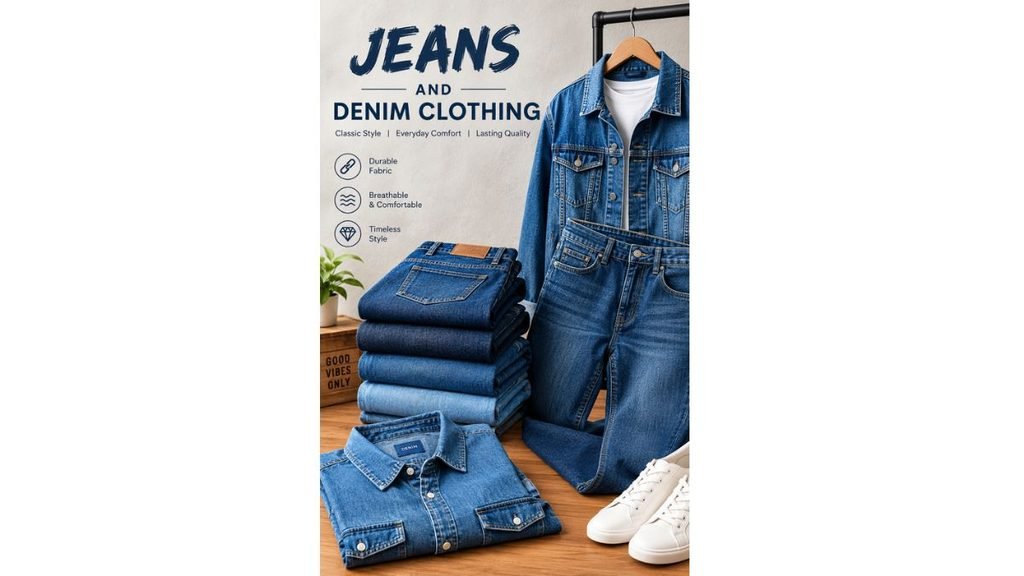
Jeans and Denim Clothing
Denim products include jeans, jackets, skirts, shorts, and other casual garments.
Important considerations include denim weight, fiber composition, stretch, wash effects, seam construction, and hardware. Buyers should also evaluate how the garment fits after washing.
Brands seeking American-made denim should confirm which production stages take place in the United States. Fabric weaving, garment cutting, sewing, washing, and finishing may occur in different locations.
Hoodies and Sweatshirts
Hoodies and sweatshirts are popular products for streetwear, sports merchandise, and casual fashion brands.
They may use cotton fleece, French terry, cotton-polyester blends, or other knit fabrics. Buyers should compare fabric weight, softness, shrinkage, cuffs, waistband construction, hood shape, and drawcord details.
Printed graphics, embroidery, patches, and custom labels can also influence product cost and production time.
Activewear and Sportswear
Activewear includes leggings, sports bras, training tops, shorts, tracksuits, and performance shirts.
These products may require stretch fabrics, moisture-management features, supportive construction, and secure seams. Fit testing is especially important because activewear must perform during movement.
Brands should ask manufacturers about stretch recovery, opacity, durability, seam strength, and available testing procedures. Marketing claims about performance should be supported by appropriate product evidence.
Workwear and Uniforms
Workwear includes uniforms, protective garments, industrial clothing, hospitality apparel, and branded staff clothing.
The requirements vary by industry. Some products need durable fabrics, reinforced seams, practical pockets, and frequent-washing resistance. Garments intended for regulated or hazardous environments may also require specific protective properties.
Businesses should confirm that the manufacturer can meet the relevant specifications and applicable safety requirements.
Women’s Fashion
Women’s apparel includes dresses, blouses, skirts, trousers, casual tops, jackets, and coordinated sets.
Fit and construction can vary considerably between styles. Brands should evaluate sizing, fabric drape, lining, closures, finishing, and comfort.
When searching for American-made women’s clothing, shoppers should check individual product descriptions because a brand may manufacture some products domestically and source others internationally.
Made in USA Clothing for Women
Made in USA clothing for women appeals to shoppers who want to understand where their garments are produced. Available options may include everyday basics, denim, knitwear, dresses, outerwear, and specialty clothing.
The best approach is to assess each product individually rather than assuming every item from a particular brand is manufactured domestically.
Everyday Clothing for Women
Basic clothing is often a useful starting point for shoppers interested in domestic production.
Common options include T-shirts, tank tops, sweatshirts, leggings, casual trousers, and simple dresses. These garments can suit everyday wear and may be available in a variety of colors, sizes, and fabric compositions.
Before purchasing, review the product’s origin statement, fabric information, care instructions, and sizing chart.
Premium and Designer Women’s Apparel
Some premium brands emphasize domestic manufacturing, detailed construction, and limited production runs.
Their products may include tailored garments, specialty knitwear, dresses, and carefully finished outerwear. Prices can be higher because of labor, materials, design, and production scale.
However, a premium price does not automatically indicate domestic production or superior quality. Look for specific information about where the garment is made and how it is constructed.
Sustainable Options for Women
Some shoppers look for American-made clothing because they want a more transparent supply chain. Domestic manufacturing can make certain production details easier to investigate, but it does not automatically make a product sustainable.
Consider factors such as fabric composition, garment durability, repairability, packaging, and manufacturing practices. Organic or recycled material claims should also be supported by credible product information.
Buying fewer, longer-lasting garments and caring for them properly can help extend their useful life, regardless of where they are manufactured.
How to Verify Women’s Clothing Origin
Use these steps when evaluating a product:
- Read the complete product description and origin statement.
- Check whether the claim applies to the finished garment or only specific components.
- Look for details about fabric sourcing, cutting, sewing, and finishing.
- Contact the brand if the manufacturing information is unclear.
- Compare the label with the brand’s published sourcing policies.
- Review current FTC guidance if you need to understand the meaning of a Made in USA claim.
These checks can help shoppers distinguish verified manufacturing information from vague promotional language.
American Made Clothing Brands for Women
American made clothing brands for women range from everyday basics labels to premium fashion companies and specialist manufacturers. Their domestic production practices may differ by product, collection, and season.
Instead of assuming a brand manufactures everything in the United States, evaluate its current product-level disclosures.
What to Look for in a Brand
A useful starting point is to check whether the brand clearly identifies where its garments are made.
Look for details about domestic sewing, fabric sourcing, factory locations, and production methods. Brands that provide specific information make it easier for shoppers to understand their claims.
Also consider whether the product matches your needs. Fit, comfort, durability, price, and care requirements remain important even when domestic manufacturing is a priority.
Compare Product Quality
Examine the garment’s stitching, seams, fabric weight, closures, and finishing. If shopping online, look for clear product photographs, measurements, fabric details, and care instructions.
Customer reviews may help identify recurring concerns about sizing or durability, but individual experiences are not guarantees of future performance.
For higher-priced purchases, review the return policy and warranty terms before ordering.
Compare Price and Value
American-made clothing may cost more than some imported alternatives because of differences in labor, operating expenses, materials, and production scale.
However, prices vary by brand and product category. A higher price may reflect design, branding, materials, or retail costs rather than manufacturing location alone.
Compare the expected lifespan, construction, comfort, and care requirements of each garment to assess its overall value.
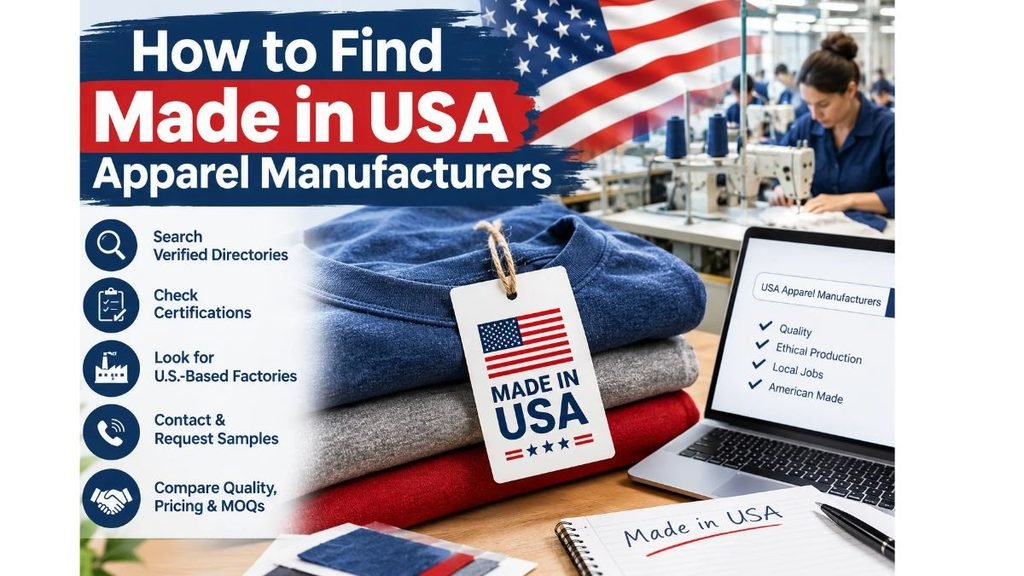
How to Find Made in USA Apparel Manufacturers
Fashion businesses searching for made in USA apparel manufacturers should begin by defining their product and production requirements.
A manufacturer suitable for basic cotton T-shirts may not have the equipment or experience needed for tailored garments, technical activewear, denim washing, or complex outerwear.
Step 1: Define Your Product
Prepare a clear description of the garments you want to produce.
Include product categories, target customers, expected retail price, fabric preferences, size range, design details, and estimated order quantities.
For example, a brand developing women’s casualwear may need knit tops and dresses. A performance brand may require stretch fabrics and specialized seam construction.
A detailed brief helps suppliers determine whether the project fits their capabilities.
Step 2: Prepare a Tech Pack
A tech pack communicates how a garment should be made. It commonly includes technical drawings, measurements, materials, colors, construction details, labels, trims, and finishing requirements.
A complete tech pack reduces uncertainty and helps manufacturers estimate costs more accurately.
If your designs are still developing, ask whether the supplier offers pattern development, sampling, grading, and technical design support.
Step 3: Check Factory Capabilities
Ask manufacturers which products they regularly produce and which operations they perform in-house.
Useful questions include:
- Do you manufacture this garment category?
- Where do cutting, sewing, printing, and finishing take place?
- Which fabrics and trims can you source?
- Can you accommodate my required order quantity?
- What sampling and production timelines should I expect?
- How do you inspect products during production?
- Can you provide references or evidence of relevant experience?
Request specific answers rather than relying on general claims about factory capabilities.
Step 4: Understand Minimum Order Quantities
Minimum order quantity, or MOQ, is the smallest order a manufacturer agrees to produce under specified conditions.
MOQ may depend on fabric availability, garment complexity, color choices, printing methods, and production efficiency. A factory may have different minimums for stock materials and custom-developed fabrics.
Ask whether minimums apply per style, color, size, or total order. Clarifying these terms helps you estimate inventory and avoid unexpected costs.
Step 5: Request Samples
Samples allow brands to evaluate fit, material, construction, and finishing before bulk production.
Review the sample against the tech pack. Check measurements, stitching, seam strength, print placement, color consistency, and comfort.
For products that require repeated washing or performance testing, agree on appropriate evaluation methods before production approval.
Step 6: Confirm Quality Control
Quality expectations should be written into the purchase agreement or product specification.
Discuss inspection stages, measurement tolerances, acceptable defects, labeling, packaging, and how nonconforming products will be handled.
A defined process gives both the brand and manufacturer a shared understanding of acceptable quality.
Step 7: Compare Total Cost
The quoted unit price is only one part of the total cost.
Consider development charges, samples, fabric, trims, labels, printing, packaging, freight, duties, inspection, and possible storage costs.
A detailed comparison can help you decide whether domestic manufacturing fits your budget and commercial strategy.
Understanding Clothing in America and the U.S. Apparel Industry
Clothing in America includes products made domestically as well as garments imported from international manufacturing centers. The U.S. apparel market is supplied through a combination of domestic factories, global suppliers, distributors, retailers, and direct-to-consumer brands.
Domestic manufacturers may specialize in particular product types or production stages. Some focus on small batches and specialized garments, while others serve larger commercial orders.
The availability of a suitable supplier depends on product complexity, pricing expectations, fabric sourcing, and required production capacity.
Domestic Production Versus Overseas Manufacturing
Neither domestic nor overseas manufacturing is automatically the best choice for every clothing brand. The right option depends on the project’s goals.
Domestic production may offer easier local communication, shorter transportation routes for U.S. buyers, and opportunities for closer collaboration. It may also involve higher labor and operating costs for certain products.
Overseas production may provide different cost structures, specialized capabilities, or access to established supply chains. However, international orders can require additional planning for freight, customs, communication, and lead times.
Brands should compare suppliers using the same specifications and quality requirements. This makes cost and capability comparisons more meaningful.
Can a Brand Use Both Domestic and International Suppliers?
Yes. Some businesses use different sourcing strategies for different products.
A brand might manufacture a limited collection domestically while sourcing other products from overseas. The decision can depend on production volume, design complexity, price targets, and supplier availability.
When using multiple countries, maintain accurate product-level origin information. Do not apply a blanket Made in USA claim to products that do not meet the relevant requirements.
Common Challenges When Buying American Made Clothing
Understanding potential challenges can help consumers and businesses make better decisions.
Higher Production Costs
Domestic labor and operating costs can affect garment prices. Smaller production runs may also increase the cost per unit because setup and development expenses are spread across fewer garments.
Businesses should request itemized quotes and compare total landed costs rather than focusing only on the unit price.
Limited Availability for Certain Products
Not every manufacturer specializes in every garment type. Technical sportswear, specialized fabric development, complex washes, and certain trims may require capabilities that are not available from every domestic supplier.
Allow time for supplier research, sample development, and testing.
Material Sourcing Differences
A garment may be sewn in the United States while using imported fabric and components.
If domestic materials are important to your purchasing decision, ask suppliers about the origin of the fabric, thread, buttons, zippers, labels, and other components.
Misleading Origin Claims
Terms such as “American style,” “designed in America,” and “Made in USA” do not necessarily mean the same thing.
Read product descriptions carefully and seek clarification when claims are vague. Businesses should ensure that all origin statements accurately reflect the product’s manufacturing history.
How Fashion Brands Can Choose the Right Manufacturing Partner
Selecting a manufacturing partner requires more than comparing prices. Brands should evaluate communication, technical expertise, production planning, quality systems, and commercial terms.
Start by reviewing the supplier’s experience with your product category. Ask for relevant samples and discuss how the factory manages changes, production schedules, and quality concerns.
Make sure both parties understand the approved specifications before bulk production begins. Confirm payment terms, delivery responsibilities, packaging details, and the process for resolving production issues.
For brands comparing U.S. factories with international suppliers, use the same product requirements and inspection standards. This approach supports a fairer evaluation.
Fashion Soul International, for example, is a custom clothing manufacturer based in Sialkot, Pakistan. It serves businesses seeking custom apparel and private-label production. It is an international sourcing option rather than a U.S.-based manufacturer, so brands specifically requiring domestic American production should verify the factory location and product-origin requirements before proceeding.
Learn more about available services at Fashion Soul International.
Tips for Starting a Clothing Brand With American Manufacturing
If you plan to launch a brand using American-made apparel, start with a focused product range.
Research Your Target Market
Identify your intended customers, price range, product category, and competitors. Understand why customers might choose your products and which manufacturing claims matter to them.
Develop a Realistic Budget
Include design, sampling, production, labels, packaging, marketing, shipping, and operating expenses. Allow for revisions and unexpected costs.
Start With a Manageable Collection
Launching a small collection can help you evaluate demand before committing to a broad product range. Choose products that share fabrics or trims where practical, but do not compromise quality to simplify production.
Test Samples Before Launch
Check fit, comfort, sizing, construction, and wash performance as appropriate. Correcting issues before bulk production can prevent avoidable inventory problems.
Communicate Your Sourcing Clearly
If domestic production is central to your brand, explain what is made in the United States and what materials or components come from elsewhere.
Use specific, supportable language. Clear sourcing information helps customers understand your products and reduces confusion about origin claims.
Frequently Asked Questions
What Is American Made Clothing?
American made clothing generally refers to garments manufactured in the United States. The exact meaning depends on the manufacturing stages and the origin of the product’s components. An unqualified Made in USA claim must meet the applicable FTC standard.
Is Made in USA Clothing Always Better Quality?
No. Quality depends on fabric, construction, manufacturing skill, quality control, and product design. Domestic origin alone does not guarantee durability or superior performance.
Where Can I Find Clothes Made in USA for Women?
Look for brands that clearly disclose the origin of individual products. Check product descriptions, labels, sourcing policies, and manufacturing information. Contact the brand if you need additional clarification.
Are All Products From American Made Clothing Brands for Women Manufactured Domestically?
Not necessarily. Some brands manufacture certain products in the United States and source others internationally. Verify the origin of each item rather than assuming every product has the same manufacturing location.
How Do I Find Made in USA Apparel Manufacturers?
Search for manufacturers specializing in your product category, then evaluate their factory location, capabilities, MOQ, sampling services, quality-control process, and pricing. Request samples and written quotations before making a decision.
Does American Made Clothing Use American Fabric?
Not always. A garment may be manufactured in the United States using imported fabric or trims. If domestic material sourcing matters to you, check the origin information for the relevant components.
Is American-Made Clothing More Expensive?
It can be, but prices vary. Labor costs, materials, design complexity, order volume, and production methods all influence the final price. Compare quality and total cost before deciding.
What Should I Check Before Ordering From a Clothing Manufacturer?
Review product capabilities, MOQ, sample quality, production timelines, pricing, payment terms, inspection standards, packaging, shipping, and origin claims. Put important requirements in writing.
Conclusion
American made clothing gives consumers and fashion businesses an option for sourcing garments produced in the United States. From everyday basics and denim to women’s fashion, activewear, and workwear, available products vary by manufacturer and production capability.
When shopping for made in USA clothing, check product-level origin information, material details, construction, fit, and price. If you are comparing American made clothing brands for women, look for clear sourcing disclosures and evaluate the actual garment rather than relying on branding alone.
For businesses, selecting made in USA apparel manufacturers requires careful research, clear specifications, sample approval, realistic budgeting, and written quality standards. Domestic manufacturing can offer useful advantages, but the right sourcing strategy depends on your product, customers, and business goals.
By evaluating suppliers carefully and communicating sourcing information accurately, shoppers and fashion brands can make better-informed decisions about clothing in America and the wider apparel market.