Brands Made in the USA: A Guide to American-Made Clothing and Products
Finding brands made in the USA can help shoppers discover products manufactured closer to home and understand where their purchases come from. Many consumers look for American-made clothing, footwear, accessories, home goods, and everyday essentials because they want greater transparency about production. Others want to support domestic businesses and American manufacturing jobs.
However, finding genuinely American-made products requires more than choosing a brand with an American name. Some companies design products in the United States but manufacture them overseas. Others produce certain items domestically while importing the rest of their collections.
This guide explains how to identify brands made in America, what to check before buying, which product categories to explore, and how to evaluate USA-made companies. It also explains why manufacturing location, material sourcing, product quality, and transparent labeling matter.
What Does “Made in the USA” Mean?
“Made in the USA” generally means a product is manufactured in the United States rather than simply designed, marketed, or shipped from the country. The exact meaning depends on the product and the claim being made.
The Federal Trade Commission (FTC) uses an “all or virtually all” standard for unqualified Made in USA claims. In general, final assembly or processing must take place in the United States, significant processing must occur there, and nearly all ingredients or components must be of U.S. origin. Businesses must have a reasonable basis for supporting their claims. The FTC’s Made in USA guidance explains these requirements.
This distinction matters because a product may involve several countries during production. Fabric might come from one country, buttons from another, and final sewing from the United States. In that situation, a business needs to describe the product’s origin accurately.
Made in the USA vs. Assembled in the USA
These phrases do not mean the same thing.
- Made in the USA: An unqualified claim generally means the product meets the FTC’s “all or virtually all” standard.
- Assembled in the USA: The product is assembled domestically, but some components may come from other countries.
- Designed in the USA: The design work took place in the United States, but manufacturing may happen elsewhere.
- Ships from the USA: The item is shipped from a location in the country, which does not establish where it was manufactured.
- Made in the USA with imported materials: This is a qualified claim that describes domestic production while disclosing foreign materials.
Always check the exact wording on the product page and label. A company’s American headquarters alone does not prove that its products are made domestically.
Why Do Consumers Look for Brands Made in America?
People choose American-made products for different reasons. Understanding these motivations can help shoppers decide whether domestic manufacturing is a priority for them.
1. Supporting Domestic Manufacturing
Buying products made in the United States can direct spending toward domestic manufacturers, workers, suppliers, and other businesses involved in production.
A locally manufactured product may involve several businesses, including fabric mills, cutting facilities, sewing factories, packaging suppliers, and transportation providers. The precise economic benefit depends on the product’s supply chain and how much production occurs domestically.
2. Understanding Where Products Come From
Some shoppers want more information about how products are manufactured. Clear country-of-origin labeling can help them compare products and understand the differences between domestic production, imported materials, and overseas manufacturing.
Transparent brands make it easier to find information about their factories, materials, production methods, and sourcing policies.
3. Finding Products With Specific Quality Standards
Some American-made brands focus on particular construction methods, materials, or manufacturing standards. For example, a clothing company may emphasize durable stitching, heavier fabrics, reinforced seams, or repairable designs.
However, American manufacturing does not automatically guarantee superior quality. Buyers should evaluate the product’s materials, construction, fit, testing, warranty, and customer feedback rather than relying on country of origin alone.
4. Exploring Distinctive Designs
Domestic manufacturers may offer specialized products, small production runs, made-to-order goods, or traditional manufacturing techniques. These options can appeal to shoppers looking for distinctive clothing and products that are not widely available in mass-market collections.
Availability varies by industry, manufacturer, and product type.
Types of Brands Made in the USA
American manufacturing covers many industries. Clothing and footwear are useful starting points, but consumers can also explore furniture, home goods, tools, personal accessories, and other product categories.
Clothing and Apparel Brands
Clothing is one of the most useful categories to research because brands can manufacture different garments in different countries. Some businesses specialize in domestically produced T-shirts, denim, sweatshirts, underwear, or workwear.
When researching American-made clothing, check the origin of each specific garment. A brand may manufacture one collection in the United States and source another from overseas.
Look for details such as:
- Country of origin on the garment label.
- Fabric and fiber information.
- Where cutting and sewing take place.
- Whether the brand identifies its manufacturing partners.
- Product-specific statements about domestic production.
Do not assume that every item from a brand is American-made simply because the company advertises a domestic collection.
Footwear and Leather Goods
Some footwear and leather-goods manufacturers produce selected items in the United States. These products may include boots, leather belts, wallets, work footwear, and other accessories.
Construction details can be especially important for footwear. Examine the upper material, sole, stitching, lining, and repair options. For leather goods, check the stated material composition and whether the product is made domestically or assembled using imported components.
A brand may use both domestic and international facilities, so confirm the origin of the exact item you want.
Home Goods and Furniture
American-made home products may include furniture, bedding, kitchen items, lighting, and selected household accessories. Domestic production can involve woodworking shops, upholstery facilities, metalworking businesses, and other specialist manufacturers.
Before purchasing, check whether the company manufactures the entire product in the United States or performs only selected stages domestically. A product assembled in the country may still contain imported components.
Tools and Everyday Products
Some USA-made companies manufacture tools, outdoor products, office supplies, and other practical items domestically. Buyers may be interested in durability, repairability, replacement parts, and long-term availability.
Read product specifications carefully. A brand can offer a mixture of domestic and imported products, even within the same category.
How to Find Reliable USA Made Companies
Finding a suitable American-made brand becomes easier when you use a consistent research process. Instead of relying on advertising alone, examine the evidence behind the product’s origin claim.
Step 1: Search for the Specific Product
Begin with the item you need. Searches such as “T-shirts made in the USA,” “American-made denim,” or “USA-made work boots” are often more useful than a broad search for American companies.
Specific searches help you compare products within the same category and identify brands that discuss manufacturing locations.
Step 2: Visit the Official Website
Read the company’s product descriptions and manufacturing information. Look for a clear explanation of where the product is made and whether imported materials or components are used.
Useful pages may include:
- Manufacturing or sourcing information.
- Product specifications.
- Frequently asked questions.
- Country-of-origin statements.
- Sustainability or supply-chain reports.
- Warranty and repair policies.
If the website only says that a product is “American-designed” or “American-owned,” do not interpret that as proof of domestic manufacturing.
Step 3: Check the Product Label
For clothing and many textile products, labels provide important information about fiber content and country of origin. Check the physical label when possible and compare it with the information published online.
A product listing may describe a whole brand as American-made even though the individual item you want comes from another country. Product-level verification helps prevent that confusion.
Step 4: Ask the Company Direct Questions
If the information is unclear, contact customer service. Ask where the product is cut, sewn, assembled, or finished. You can also ask whether the materials and major components are domestically sourced.
A transparent company should be able to explain its claims without relying only on patriotic imagery or vague marketing language.
Step 5: Compare Quality and Value
After confirming the product’s origin, evaluate whether it meets your needs. Compare material quality, construction, fit, product lifespan, repair options, warranty, and price.
Domestic production may have a higher retail price in some categories, but this is not universal. A fair comparison considers the product’s actual features and expected useful life.
What to Check Before Buying American-Made Clothing
If your main interest is apparel, several manufacturing details can help you assess quality and transparency.
Fabric Composition
Check whether a garment uses cotton, polyester, wool, linen, elastane, or a blend. Fiber content affects softness, breathability, stretch, drying time, durability, and care requirements.
Natural fibers are not automatically better for every use. Polyester, for example, may be appropriate for performance garments, while cotton can suit everyday T-shirts and sweatshirts. Choose based on how you plan to wear the product.
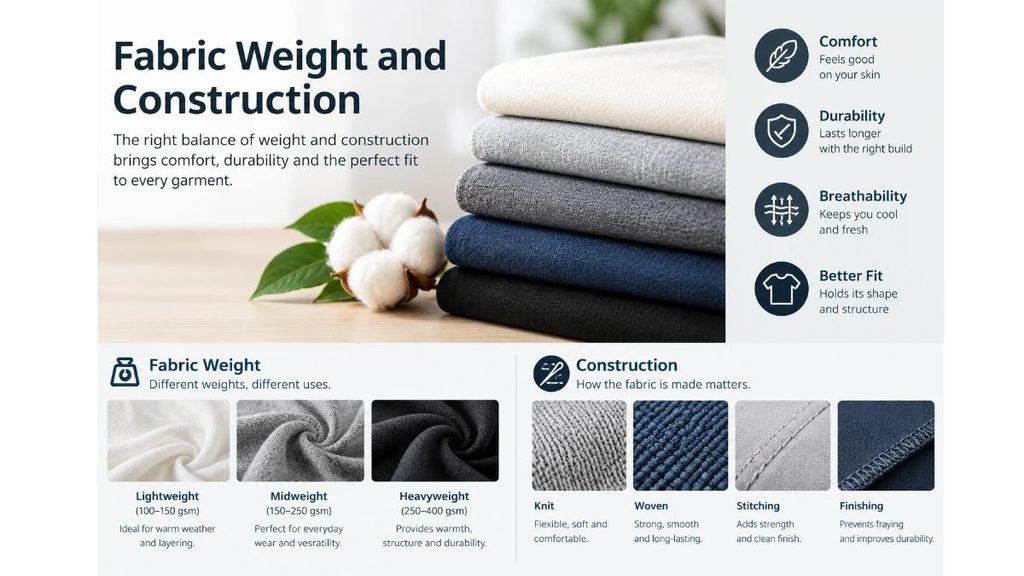
Fabric Weight and Construction
Fabric weight can influence how a garment feels and performs. In textiles, GSM means grams per square meter and measures fabric mass per unit of area.
A higher GSM usually indicates a heavier fabric, but it does not automatically mean better quality. Fiber type, knitting or weaving, finishing, and garment construction also matter.
Look for consistent stitching, secure seams, suitable reinforcement, and clean finishing. These details can help you evaluate a garment beyond its country-of-origin label.
Fit and Sizing
Check the brand’s size chart and measurement instructions before ordering. Sizing can vary between manufacturers, and domestic production does not guarantee a particular fit.
For online purchases, compare garment measurements with an item you already own. Review return policies, especially if the product is made to order or customized.
Care and Durability
Read washing and care instructions. Some garments need cold washing, air drying, or special treatment to preserve their shape and color.
If long-term value matters to you, look for repair services, replacement parts, warranties, or clear guidance on garment care.
Are All Products From an American Brand Made in America?
No. A company can be based in the United States and manufacture some or all of its products abroad.
Brands may use international suppliers for reasons that include material availability, specialized production methods, costs, and existing supplier relationships. They may also bring selected products back to domestic factories while continuing to import others.
This is why consumers should distinguish between an American company and an American-made product.
The FTC warns businesses not to imply that an entire product line is made in the United States when only some products meet the applicable standard. For details, review the FTC’s guidance on Made in USA claims.
When evaluating a brand, ask three separate questions:
- Where is the company headquartered?
- Where is the specific product manufactured?
- Where do its major materials and components come from?
These questions provide a more accurate picture than the brand name alone.
How to Compare American-Made Brands
A simple comparison can help you select products that match your priorities.
| Factor | What to check |
|---|---|
| Manufacturing location | Is the specific product made in the United States? |
| Materials | Are fibers, components, or raw materials identified? |
| Quality | Are construction, specifications, and durability explained? |
| Price | Does the cost match the materials, design, and expected lifespan? |
| Transparency | Does the company explain its sourcing and production? |
| Customer support | Are returns, repairs, and warranties clearly stated? |
| Availability | Is the product in stock, made to order, or produced in limited runs? |
You can also compare several products in the same category. For example, if you are buying T-shirts, compare fabric weight, fiber composition, stitching, fit, care instructions, and the stated country of origin.
This approach makes the buying decision more objective and helps you avoid paying extra for a label without understanding what it represents.
Benefits and Limitations of Buying Products Made in the USA
American-made products can offer benefits, but they are not automatically the best choice for every shopper.
Potential Benefits
- More information about domestic production: Some manufacturers provide details about their facilities and supply chains.
- Support for domestic businesses: Purchases may contribute to U.S. manufacturing and related industries.
- Specialized production options: Certain domestic manufacturers offer small runs, custom orders, or made-to-order products.
- Access to customer support: Some companies offer domestic repair services or easier communication, although this varies by brand.
- Product traceability: Clear sourcing information can help buyers understand manufacturing origins.
Possible Limitations
- Higher prices in some categories: Domestic labor and operating costs can affect retail prices.
- Limited product selection: Some materials and specialized components may not be readily available domestically.
- Mixed supply chains: A product may include imported components even when final assembly happens in the United States.
- Inconsistent availability: Small manufacturers may offer fewer sizes, colors, or inventory options.
- Quality differences: Domestic origin alone does not guarantee durability, ethical working conditions, or environmental performance.
The best choice depends on your priorities. A well-made imported product may suit some needs better than a poorly constructed domestic product. Compare evidence, specifications, and value before deciding.
What Does “American-Made Company” Mean?
An American-made company may refer to a business that manufactures products in the United States, but the phrase should not be confused with an American-owned or American-headquartered company.
For clarity, consider these differences:
- An American-owned business may manufacture products overseas.
- A U.S.-based company may sell goods made by independent factories in several countries.
- A domestic manufacturer may produce goods in the United States using imported materials.
- A brand may offer some American-made products alongside imported items.
These distinctions are important for both consumers and businesses. A company should explain its manufacturing model accurately, and shoppers should verify product-level details when domestic origin is a deciding factor.
How Clothing Brands Can Choose a Manufacturing Partner
For entrepreneurs planning to launch an apparel label, finding the right manufacturing partner involves more than comparing country names. The right supplier must meet the brand’s product, quality, quantity, budget, and delivery requirements.
Define the Product Clearly
Prepare a design brief, sketches, reference images, size specifications, fabric preferences, and decoration requirements. A detailed tech pack is especially useful because it communicates measurements, construction, materials, trims, and finishing instructions.
If you do not have a complete tech pack, ask the manufacturer what information is needed to develop a sample.
Confirm Minimum Order Quantities
Manufacturers set minimum order quantities (MOQs) based on their production model, fabric requirements, and operational costs. Some suppliers support small batches, while others focus on larger orders.
Ask whether the MOQ applies per style, color, or size run. Confirm the details in a written quotation before paying for production.
Approve a Physical Sample
A sample lets you review fit, fabric, stitching, print placement, labels, and finishing before bulk manufacturing begins. Document any changes and approve the final specifications in writing.
Do not assume that a digital mock-up represents the finished garment perfectly.
Review Quality Control and Delivery Terms
Ask how measurements, stitching, decoration, and packaging will be checked. Confirm the expected production timeline, payment terms, shipping method, and responsibility for import duties.
If you require U.S. manufacturing, verify that the supplier’s production location and origin claims meet your requirements. If you are open to international production, compare the complete offer, including quality controls, logistics, and landed costs.
Consider International Manufacturers When Appropriate
A clothing brand may choose a domestic manufacturer for one collection and an international supplier for another. The decision depends on product complexity, target price, order quantity, materials, lead time, and the brand’s sourcing strategy.
For example, Fashion Soul International is a factory-owned custom clothing manufacturer based in Sialkot, Pakistan. It offers private-label, OEM, ODM, white-label, cut-and-sew, and full-package apparel production for international brands. Its services include product development, fabric sourcing, sampling, bulk production, quality control, custom branding, packaging, and international shipping.
Fashion Soul International is not a USA-based manufacturer, so it should not be presented as a brand that manufactures clothing in the United States. It may be relevant to businesses comparing international production options with domestic manufacturing.
The important lesson for apparel entrepreneurs is to choose a supplier based on verified production capabilities and clearly stated terms—not just the country associated with a brand.
Frequently Asked Questions
What are the best brands made in the USA?
The best option depends on the product category, budget, quality requirements, and manufacturing preferences. Start by researching brands that publish clear, product-specific manufacturing information. Confirm the origin of the exact item before purchasing because a company may manufacture only part of its range domestically.
Are brands made in America always better quality?
No. Country of origin does not automatically determine quality. Compare materials, stitching, construction, product testing, warranty coverage, customer feedback, and expected lifespan.
How can I tell if a product is genuinely made in the USA?
Read the product label, review the manufacturer’s official information, and ask questions if the claim is unclear. For unqualified Made in USA claims, the FTC’s standard generally requires that the product be “all or virtually all” made in the United States.
Does a U.S. company always manufacture its products in America?
No. U.S.-based companies may manufacture products domestically, internationally, or through a combination of suppliers. Verify the manufacturing origin of each product rather than relying on the company’s headquarters.
Are products assembled in the USA considered American-made?
Not necessarily. “Assembled in the USA” indicates domestic assembly, but components may come from other countries. The phrase is different from an unqualified “Made in USA” claim.
Why might American-made clothing cost more?
Prices may reflect labor, materials, manufacturing methods, order volume, distribution, and other operating expenses. However, price varies by product and company. Compare the complete specifications and expected lifespan rather than assuming every domestic garment is expensive or every imported garment is inexpensive.
Can small clothing brands manufacture in the United States?
Yes, some domestic manufacturers accept orders from smaller brands. Availability and minimum quantities vary. Entrepreneurs should ask about sampling, minimum order quantities, fabric sourcing, customization, and production timelines before selecting a supplier.
Should clothing brands use domestic or international manufacturers?
There is no universal answer. Domestic manufacturing may suit brands prioritizing U.S. production, while international manufacturing may offer different material options, capabilities, or production economics. Compare suppliers using clear specifications, sample quality, total costs, communication, quality control, and delivery requirements.
Final Thoughts
Finding brands made in the USA requires careful research, especially when companies sell products made in multiple countries. A brand’s name, headquarters, or American-inspired marketing does not establish where a product was manufactured.
Check labels, read official product information, ask direct questions, and compare quality before buying. Pay attention to materials, construction, warranty coverage, and the evidence supporting country-of-origin claims.
For shoppers, this process makes it easier to find products that match their preferences. For clothing entrepreneurs, it provides a practical way to compare domestic and international suppliers while making accurate claims about their own products.
Ultimately, the strongest purchasing decision is one based on transparent sourcing, suitable quality, fair value, and verified manufacturing information.