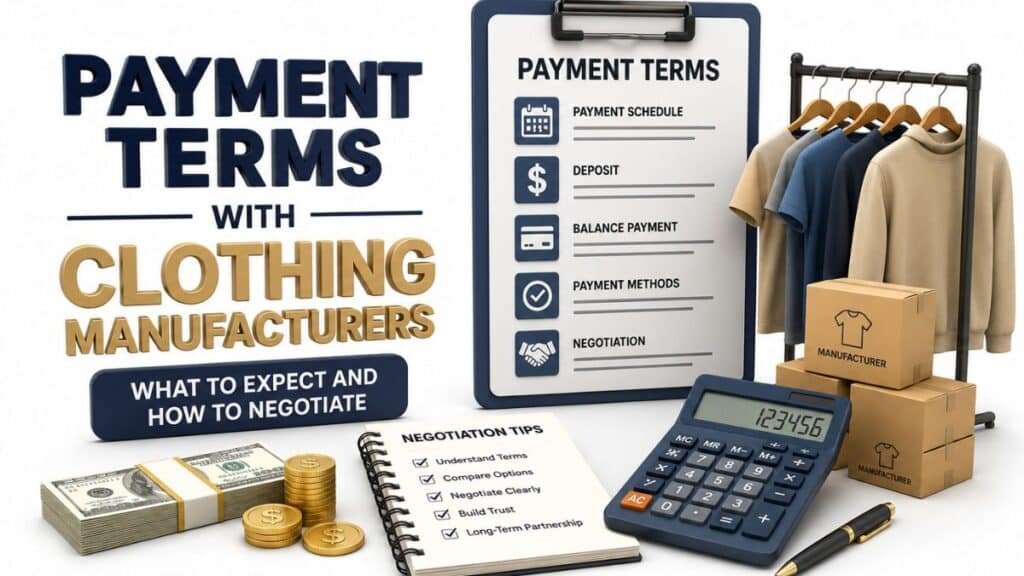
Payment terms are one of the least discussed but most important parts of working with a clothing manufacturer — and one of the easiest places for a new brand to either get taken advantage of or, just as often, unknowingly ask for terms no legitimate factory would accept. Understanding how payment actually works in garment manufacturing protects your capital, builds trust with your factory, and prevents costly misunderstandings on your first order.
This guide breaks down standard payment structures in apparel manufacturing, what’s realistic to negotiate, and the red flags that signal a payment request isn’t standard industry practice.
Fashion Soul International is a Sialkot, Pakistan-based manufacturer with 10+ years of experience structuring payment terms for 2,500+ brands, from first-time founders to established labels — this guide reflects how those conversations actually go in practice.
Table of Contents
- Why Payment Terms Matter More Than Founders Realize
- Standard Payment Structures in Garment Manufacturing
- Understanding the 30/70 Payment Model
- Other Common Payment Splits
- What Each Payment Milestone Actually Covers
- Payment Methods Used in International Apparel Manufacturing
- How to Negotiate Payment Terms
- What Affects the Payment Terms You’re Offered
- Payment Terms for First-Time vs. Repeat Orders
- Red Flags in Payment Requests
- Protecting Yourself: Documentation and Verification
- Sample Payment Terms Negotiation Script
- Common Mistakes New Brands Make with Payment Terms
- Frequently Asked Questions
- Final Thoughts
Why Payment Terms Matter More Than Founders Realize
Payment structure directly affects your cash flow, your risk exposure, and your leverage throughout the production process. Pay too much upfront with no protection, and you’re financially exposed if something goes wrong. Refuse to pay any deposit at all, and you’ll struggle to find any legitimate manufacturer willing to work with you — deposits exist for real operational reasons, not just as a formality.
Understanding standard terms lets you negotiate from an informed position instead of either overpaying out of inexperience or asking for terms that signal (unintentionally) that you don’t understand how the industry works.
Standard Payment Structures in Garment Manufacturing
Across the apparel manufacturing industry, a small number of payment structures account for the vast majority of orders:
| Structure | How It Works |
|---|---|
| 30/70 | 30% deposit to start production, 70% balance before shipment |
| 50/50 | 50% deposit to start production, 50% balance before shipment |
| 40/60 | 40% deposit, 60% balance before shipment |
| 100% upfront | Full payment before production begins (less common, typically smaller orders or established trust) |
| LC (Letter of Credit) | Bank-mediated payment, common on very large orders |
The 30/70 and 50/50 splits are by far the most common structures for small-to-mid-size clothing brands working with overseas manufacturers.
Understanding the 30/70 Payment Model
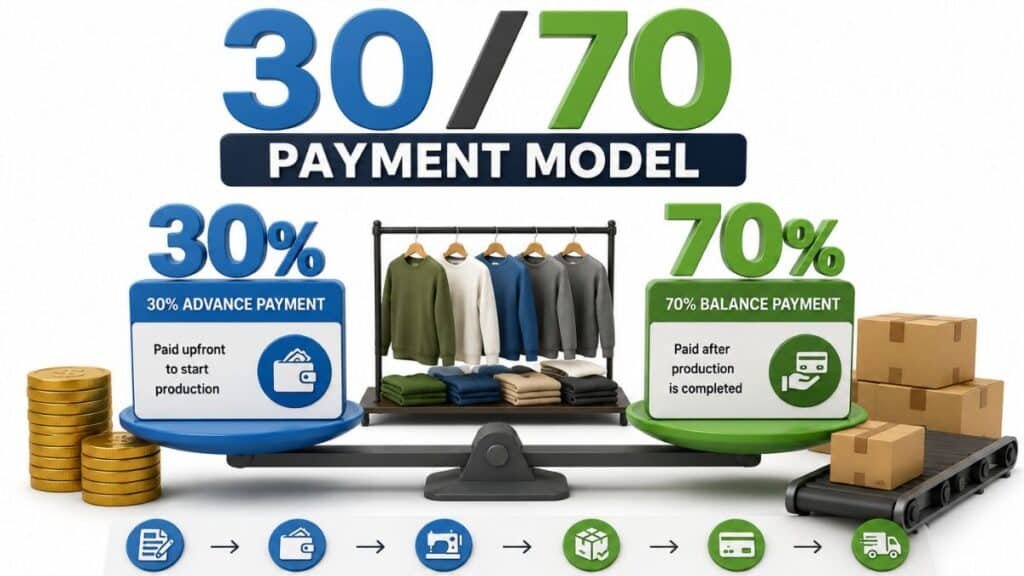
The 30/70 structure is one of the most widely used payment models in apparel manufacturing, and for good reason — it balances risk fairly between both sides.
How it typically works:
- 30% deposit is paid once the order is confirmed and the pre-production (PP) sample is approved. This deposit covers the factory’s fabric purchase and initial production setup costs — the largest upfront expenses on the factory’s side.
- Production begins using the deposit to fund fabric, trims, and labor.
- 70% balance is paid once production is complete and quality-inspected, typically just before shipment — sometimes against photos or a video of the finished, packed goods.
This structure protects both sides: the factory isn’t financing your entire order out of pocket, and you’re not paying the full amount before confirming the goods actually exist and meet your approved sample.
Other Common Payment Splits
50/50 is common with newer manufacturer relationships or smaller total order values, where the factory wants a larger upfront commitment to offset setup risk on a first-time client relationship.
40/60 sits between the two and is sometimes offered as a middle-ground compromise during negotiation, particularly for mid-size orders with an established manufacturer relationship.
100% upfront is less common for bulk production but can appear on very small sample orders, or once a brand has an established, trusted, multi-order history with a manufacturer.
Letter of Credit (LC) arrangements — where a bank guarantees payment upon presentation of shipping documents — are typically reserved for large-volume orders, since they involve bank fees and more administrative overhead than smaller orders can justify.
What Each Payment Milestone Actually Covers
Understanding what your deposit and balance actually fund helps make sense of why the structure exists:
- Deposit (30–50%) — covers fabric purchase, trims, initial labor, and production setup (cutting, machine configuration)
- Balance (50–70%) — covers remaining labor, finishing, customization (printing/embroidery), quality inspection, and packing, released once the factory can demonstrate the goods are complete and inspected
This is why factories are generally unwilling to start cutting fabric without a deposit — fabric purchase is typically their single largest upfront cash outlay, and it’s a cost they can’t recover if a buyer walks away mid-production.
Payment Methods Used in International Apparel Manufacturing
- Bank wire transfer (T/T) — the most common method for international orders, typically via SWIFT
- Letter of Credit (LC) — bank-guaranteed payment, mainly for large orders
- Escrow services — increasingly used for new buyer-manufacturer relationships, holding funds until agreed milestones are met
- Trade platform payment protection — available through certain B2B sourcing platforms, offering built-in dispute resolution
For a first order with a new manufacturer, using a payment method with some form of documentation trail (bank transfer with clear invoicing, or escrow) is strongly preferable to informal payment methods with no paper trail.
How to Negotiate Payment Terms
Step 1 — Ask what’s standard before proposing changes. Understanding the factory’s default terms (usually 30/70 or 50/50) gives you a baseline to negotiate from, rather than guessing.
Step 2 — Tie payment flexibility to order commitment. A factory is more likely to consider a smaller deposit percentage for a buyer proposing a larger order, or one signaling a repeat-order relationship.
Step 3 — Request milestone documentation. Ask for photos or video of fabric cutting, mid-production, and final packed goods tied to each payment stage — this is a completely standard, reasonable request that most established manufacturers accommodate without issue.
Step 4 — Negotiate around the sample stage, not just the bulk order. A well-managed sample approval process (clear tech pack, prompt feedback, approved PP sample) builds the trust that often makes a factory more flexible on your bulk order’s payment terms.
Step 5 — Put agreed terms in writing in your proforma invoice or purchase agreement before sending your deposit, including what happens in case of production delays, quality disputes, or order changes.
What Affects the Payment Terms You’re Offered
- Order value and volume — larger, higher-value orders sometimes unlock more favorable terms, since the relationship is worth more to the factory long-term
- First-time vs. repeat client status — established relationships often move toward smaller deposits over time
- Certifications and business verification — a manufacturer with ISO certification and formal legal registration (such as SECP verification) typically operates with more standardized, transparent terms than an unverified supplier
- Customization complexity — highly customized orders with expensive trims or specialty fabric may require a larger deposit to cover higher upfront material cost
- Manufacturer size and stability — larger, well-established factories with strong production capacity (such as 100,000+ garments/month) are often more able to offer flexible terms than smaller operations with tighter cash flow
Payment Terms for First-Time vs. Repeat Orders
| Order Stage | Typical Terms |
|---|---|
| First sample order | Often 100% upfront (small dollar value) |
| First bulk order (new relationship) | 50/50, sometimes 40/60 |
| Established relationship (2nd+ bulk order) | 30/70, occasionally more buyer-favorable |
| Large-volume repeat client | Negotiated terms, sometimes LC or extended terms |
This progression is normal and expected — manufacturers naturally extend more favorable terms as trust and order history build, which is one more reason a staged, small-batch approach to your first few orders (rather than one large first commitment) can work in your favor over time.
Red Flags in Payment Terms
- Requesting 100% upfront on a large bulk order with no sample or milestone verification — legitimate manufacturers rarely require this on sizable first orders
- Refusing to provide any production documentation or updates tied to your deposit
- Pressuring immediate payment before a signed agreement or clear invoice is provided
- No verifiable business registration or certifications backing up the manufacturer’s claims
- Payment requested only through untraceable methods (personal accounts, informal transfer apps) rather than a documented business account
- Refusing to discuss payment terms at all, treating the structure as non-negotiable without explanation
A transparent manufacturer will walk you through its manufacturing process and quality inspection standards as part of explaining why payment is structured the way it is — hesitation to explain this is itself a signal worth taking seriously.
Protecting Yourself: Documentation and Verification
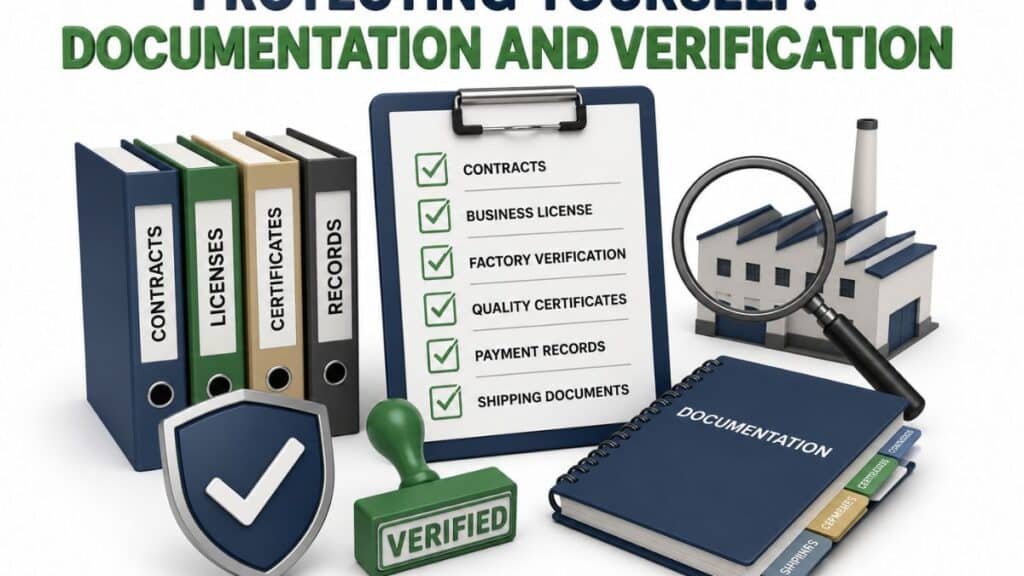
Before sending any deposit:
- Verify business registration — for a Pakistan-based manufacturer, SECP verification confirms the company is a legally registered corporate entity
- Check for quality and export certifications — ISO 9001, ISO 14001, and REX (Registered Exporter) certification indicate an audited, standardized operation rather than an informal setup
- Get a clear proforma invoice detailing order specs, quantities, pricing, and payment milestones before transferring any funds
- Request references or a track record — a manufacturer that has served 2,500+ brands over 10+ years should be able to speak to that history clearly
- Start with a sample order before committing to full payment terms on a large bulk order, to build trust incrementally
Sample Payment Terms Negotiation Script
“Thanks for the quote — can you confirm your standard payment terms for an order of this size? We’re planning [order volume] across [number of styles], with the goal of a repeat order within [timeframe] if this first run performs well. Would you be able to work with a [X]/[Y] split, with progress photos at cutting and a final inspection video before the balance is due?”
This framing signals genuine intent (specific volume, realistic timeline), asks a direct question rather than demanding a specific number, and proposes a reasonable documentation checkpoint that most manufacturers will readily agree to.
Common Mistakes New Brands Make with Payment Terms
- Refusing to pay any deposit at all, which signals inexperience and will disqualify you from working with most legitimate manufacturers
- Paying the full balance before requesting inspection documentation or photos of the finished goods
- Not getting payment terms in writing before transferring the deposit
- Assuming payment terms are fixed and non-negotiable everywhere, when many manufacturers have real flexibility based on order size and relationship stage
- Using untraceable payment methods to save on transfer fees, losing documentation protection in the process
- Not asking what the deposit specifically covers, and being surprised later by what’s included versus billed separately (e.g., sampling, freight)
Frequently Asked Questions
What is a standard payment term in the clothing manufacturing industry? A 30/70 split — 30% deposit to begin production, 70% balance before shipment — is one of the most widely used payment structures in apparel manufacturing, particularly for established buyer-manufacturer relationships. A 50/50 split is also common, especially for first-time orders.
Is it normal to pay a deposit before production starts? Yes. A deposit covers the factory’s upfront costs — primarily fabric purchase and production setup — which they cannot recover if a buyer cancels mid-production. Refusing to pay any deposit is generally not accepted by legitimate manufacturers.
Should I pay 100% upfront for a bulk clothing order? Generally, no — for a bulk order of meaningful size, 100% upfront payment removes your leverage and financial protection if issues arise during production. A milestone-based split (deposit plus balance before shipment) is the standard, safer approach.
How do I know if a manufacturer’s payment terms are legitimate? Legitimate manufacturers typically offer standard splits (30/70, 50/50), provide a clear proforma invoice, accept traceable payment methods, and are willing to explain their production and quality process. Verifiable certifications (ISO, export registration, business registration) add further confidence.
Can payment terms be negotiated on a first order? Yes, though flexibility is often more limited on a true first-time order compared to a repeat relationship. Signaling a clear order plan, realistic volume, and intent for future orders can help open room for negotiation even on a first order.
Final Thoughts
Understanding standard payment structures — and knowing what’s reasonable to negotiate — protects your capital and sets the foundation for a trustworthy, long-term manufacturer relationship. A 30/70 or 50/50 split, tied to clear milestones and documentation, is the industry norm for good reason: it balances risk fairly on both sides of the transaction.
Fashion Soul International structures payment terms transparently for every client, backed by SECP verification, ISO 9001 and ISO 14001 certification, and REX export certification — giving new and established brands alike a clear, documented, and fair path from deposit to final shipment across 2,500+ brands served over 10+ years.
If you’re planning your first order and want a clear breakdown of payment terms, timelines, and what to expect at each production milestone, get in touch with the Fashion Soul International team or browse the full clothing catalogue to start shaping your first order before requesting a formal quote.