Most new fashion brands don’t fail because their designs were bad — they fail because they tied up all their capital in one large production run before knowing what would actually sell. Low MOQ (Minimum Order Quantity) manufacturing flips that model: instead of betting everything on one big bet, you build your brand in small, validated steps.
This guide is about strategy, not just definitions — how to actually structure a fashion brand around small-batch manufacturing, so that low MOQ becomes a growth advantage rather than just a way to save money on your first order.
Fashion Soul International is a Sialkot, Pakistan-based manufacturer that has supported 2,500+ brands over 10+ years, many of them built from the ground up using exactly this small-batch, low-MOQ approach — starting at 100 pieces per style and scaling from there.
Table of Contents
- Why Low MOQ Changes How You Should Build a Brand
- The Small-Batch Brand-Building Model
- Step 1: Design a Testable Core Collection
- Step 2: Choose a Manufacturer Built for Small-Batch Growth
- Step 3: Launch in Waves, Not All at Once
- Step 4: Use Small Batches as a Marketing Advantage
- Step 5: Read Your Data Before You Reorder
- Step 6: Scale the Winners, Retire the Rest
- Financial Planning for a Low-MOQ Brand
- Small-Batch vs. Mass Production: A Strategic Comparison
- Case-Study Style Example: A Hoodie Brand Built on 100-Unit Drops
- Common Pitfalls When Building on Low MOQ
- How Low MOQ Supports Long-Term Brand Authority
- Frequently Asked Questions
- Final Thoughts
Why Low MOQ Changes How You Should Build a Brand
Traditional apparel wisdom says bigger orders mean lower unit cost, so bigger is always better. That’s true on a spreadsheet — but it ignores the biggest risk a new brand faces: not knowing what will sell before you’ve made it.
A low MOQ model (100 pieces per style, for example) means:
- Less capital tied up in unsold inventory
- Faster ability to test multiple designs before committing to your “hero” products
- Room to adjust fit, fabric, or design based on real customer feedback
- A natural, built-in reason to create urgency (“limited drop”) that mass-produced brands have to manufacture artificially through marketing
In other words, low MOQ isn’t just a budget-friendly starting point — it’s a legitimate long-term brand strategy used by successful direct-to-consumer labels well past their first year.
The Small-Batch Brand-Building Model
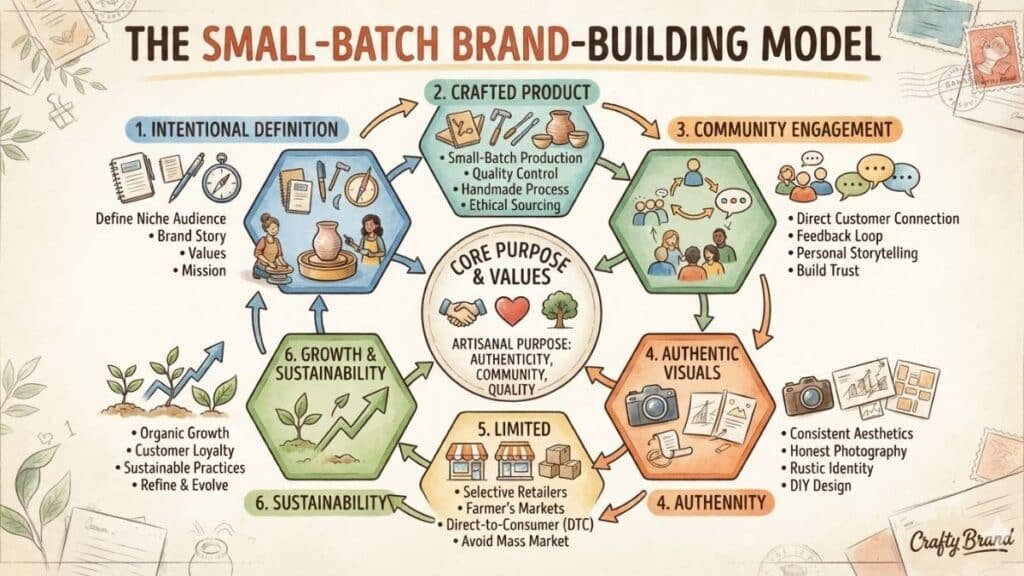
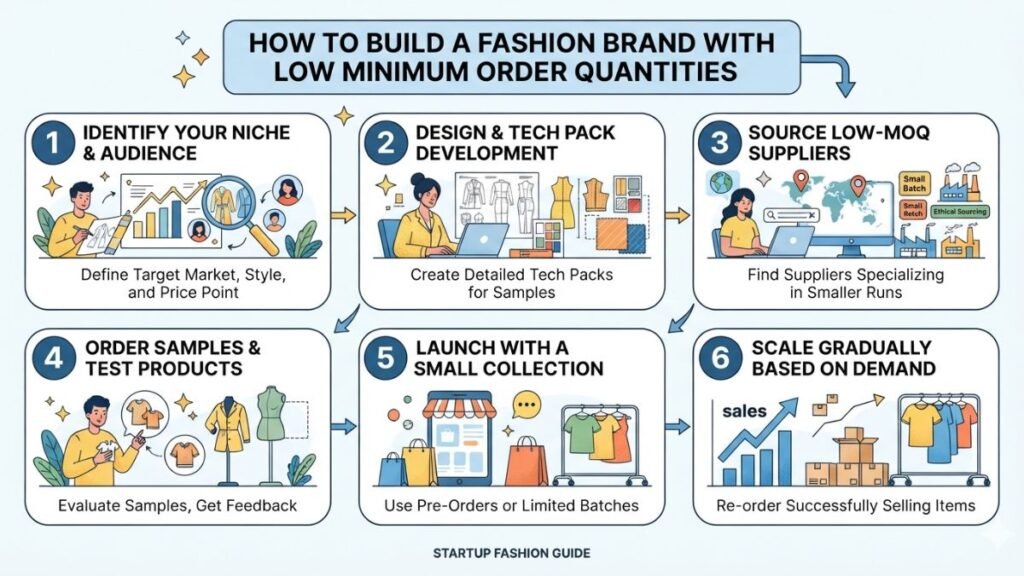
Instead of the traditional “design everything, produce everything, launch everything” approach, a low-MOQ brand-building model looks like this:
- Design a small, focused core collection (2–4 styles)
- Manufacture in small batches (100–150 units per style)
- Launch in a structured drop, not a quiet soft-launch
- Sell through and gather real data — which sizes, colors, and styles moved fastest
- Reorder only the validated winners, at a larger volume
- Retire or redesign anything that underperformed
- Repeat the cycle, expanding your catalogue only with proven concepts
This loop is what turns a low MOQ from a “starter” arrangement into an ongoing brand-building system.
Step 1: Design a Testable Core Collection
Resist the urge to launch 10 styles at once. A focused core collection — 2 to 4 pieces — gives you:
- Faster sampling and approval (fewer rounds to manage simultaneously)
- A cleaner brand story (“the hoodie brand,” “the modest wear label”) rather than a scattered catalogue
- Enough total order volume to unlock proper bulk pricing across styles, even at 100 units each
Review real product categories — including casual wear, sportswear, denim, leather, and home textile products — to decide which 2–4 items make the strongest, most cohesive starting lineup for your brand identity.
Step 2: Choose a Manufacturer Built for Small-Batch Growth
Not every manufacturer is structured to support a brand that starts small and scales. Look for:
- A genuinely low MOQ (100 pieces per style, not just marketed as “low” while requiring 500+)
- In-house customization — printing, embroidery, and labeling under one roof, so small orders don’t require juggling multiple vendors
- Certifications that signal real capacity — ISO 9001 and ISO 14001 certification indicate standardized processes that hold up whether you’re ordering 100 units or 10,000
- A production scale that can grow with you — a facility producing 100,000+ garments monthly with 250+ skilled workers can take you from a 100-unit test order to a 5,000-unit reorder without switching manufacturers mid-growth
This continuity matters more than founders often realize — switching manufacturers between your test batch and your scale-up reorder often means re-sampling, re-approving fit, and risking inconsistency in a product your early customers already loved. You can review the full manufacturing process to see how a single production pipeline is designed to support both stages.
Step 3: Launch in Waves, Not All at Once
Rather than producing your entire core collection simultaneously, consider staggering it:
- Wave 1: your most confident 1–2 styles, in 2–3 colors, at MOQ (100 units/style)
- Wave 2: 4–6 weeks later, introduce 1–2 more styles based on early feedback and social response from Wave 1
- Wave 3: reorder proven winners at higher volume while testing 1 new design alongside them
This staggered approach spreads your production and cash flow commitments over time instead of requiring your full inventory budget upfront, while still giving you a real, evolving product line within your first 2–3 months.
Step 4: Use Small Batches as a Marketing Advantage
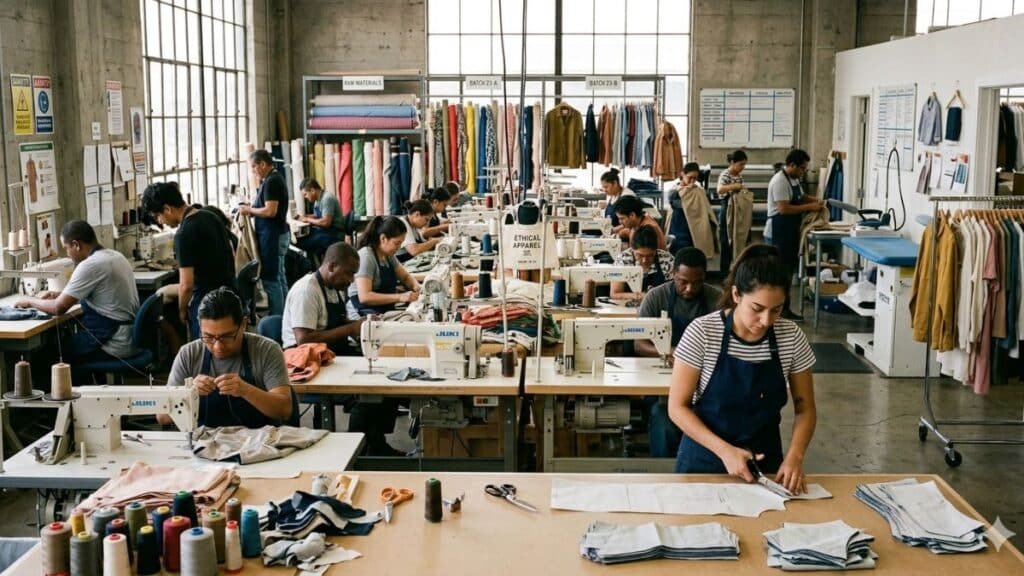
Limited quantity isn’t just a manufacturing constraint — it’s a proven marketing lever. Brands across fashion, sneakers, and streetwear have built entire business models around “drop culture,” where scarcity itself creates demand.
With a 100-unit batch, you can genuinely (not artificially) market:
- “Limited drop — only 100 made” — an honest scarcity message, since it’s literally true
- Numbered or dated releases, which appeal to early customers who want to feel part of a brand’s founding story
- Fast sell-through as social proof — a style that sells out at 100 units looks and feels more successful than the same demand spread across an unsold 1,000-unit batch
This is a structural advantage mass-production brands don’t have without inflating their marketing budget to manufacture the same sense of scarcity.
Step 5: Read Your Data Before You Reorder
Before committing to a bigger reorder, review:
- Sell-through rate by style, size, and color — not just total units sold
- Return/exchange rate, which often signals fit or fabric issues worth correcting before scaling
- Customer feedback and reviews, especially recurring comments about fit, fabric feel, or sizing
- Which marketing channel drove the most sales, so your next launch wave can double down deliberately
This is the step mass-production brands skip entirely, because they’ve already committed to volume before knowing any of this. A low-MOQ model gives you the rare chance to make your second order smarter than your first.
Step 6: Scale the Winners, Retire the Rest
Once you have real sell-through data:
- Reorder your top-performing styles at a higher volume (300–1,000+ units), now qualifying for better per-unit pricing
- Refine underperformers — a design that sold slowly might just need a fit adjustment, different fabric weight, or better color options, not full abandonment
- Cut styles that consistently underperform, freeing up budget and catalogue focus for what’s actually working
This is how a small-batch brand grows into a larger one without ever having carried a warehouse full of unsold stock along the way.
Financial Planning for a Low-MOQ Brand
A rough first-year budget structure for a brand built on 100-unit drops:
| Stage | Approx. Units | Purpose |
|---|---|---|
| Wave 1 (Launch) | 100–200 units (1–2 styles) | Market validation |
| Wave 2 | 200–400 units (add 1–2 styles) | Expand catalogue, test more designs |
| Wave 3 (Scale reorder) | 500–1,000+ units (proven styles only) | Volume pricing, established demand |
Because per-unit cost is somewhat higher at 100-unit volumes than at 500+, budget for a slightly thinner margin in Wave 1 — this is the cost of the market data you’re buying, not a mistake in your pricing. Margins typically improve meaningfully by Wave 3 as order volume increases.
Small-Batch vs. Mass Production: A Strategic Comparison
| Factor | Small-Batch (Low MOQ) Model | Mass Production Model |
|---|---|---|
| Upfront capital required | Lower | Higher |
| Risk of unsold inventory | Lower | Higher |
| Per-unit cost | Higher | Lower |
| Speed to market | Faster (less design/sampling overhead) | Slower (bigger commitment upfront) |
| Ability to test multiple designs | High | Low (fewer, bigger bets) |
| Natural scarcity/marketing angle | Built-in | Requires artificial creation |
| Best suited for | New brands, capsule drops, testing | Established brands with proven demand |
Neither model is universally superior — but for a brand still finding its product-market fit, small-batch manufacturing is generally the lower-risk path to the same eventual scale.
Case-Study Style Example: A Hoodie Brand Built on 100-Unit Drops
A hypothetical (but realistic) sequence for a streetwear hoodie brand:
- Wave 1: 1 hoodie style, 2 colors, 100 units total (50 per color) — sold out in 3 weeks through social media and a small paid ad budget
- Wave 2: Reorders the same hoodie at 300 units (based on sell-through data), adds a second style (joggers) at 100 units to test
- Wave 3: Hoodie reordered again at 600 units; joggers, which sold more slowly, get a fit and fabric-weight adjustment before their next batch
By the third wave, the brand has real sales data behind every production decision — something a brand that launched all three products at 500 units each on day one would have had to guess at.
Common Pitfalls When Building on Low MOQ
- Treating every small batch as “final” instead of a controlled test — the point of small batches is to learn, not just to produce cheaply
- Launching too many styles at once, which defeats the purpose of focused, readable sales data
- Ignoring sell-through data and reordering out of instinct rather than evidence
- Switching manufacturers between test batch and scale-up, risking fit and quality inconsistency your early customers will notice
- Underpricing Wave 1 products without accounting for the naturally higher per-unit cost at small volumes
- Not using the scarcity of small batches in marketing — many brands manufacture small but market like they have unlimited stock, missing a genuine growth lever
How Low MOQ Supports Long-Term Brand Authority
Beyond the financial logic, a small-batch model shapes how customers perceive your brand:
- Perceived exclusivity — limited runs feel more premium than always-available basics, even at similar price points
- Faster iteration means better products over time — a brand that adjusts fit and fabric every 2–3 months based on real feedback improves faster than one locked into a single large production run
- Stronger brand storytelling — “founding collection,” “drop 001,” and evolving small releases give customers a narrative to follow, which supports repeat engagement and community-building
- Lower financial risk supports longer brand survival — brands that don’t over-commit capital early are simply more likely to still be operating in year two and three
This is why low MOQ shouldn’t be thought of only as a stepping stone toward eventual mass production — for many successful fashion brands, staged small-batch releases remain the core operating model well beyond the startup phase.
Frequently Asked Questions
Can I build a real, scalable brand only using small batches? Yes — the small-batch model scales naturally by increasing order volume on proven styles over successive waves, while continuing to test new designs at low volume. Many established direct-to-consumer brands maintain a drop-based, limited-run model permanently rather than transitioning fully to mass production.
Is low MOQ manufacturing more expensive long-term? Per-unit cost is typically higher at small volumes, but total financial risk is lower, since you’re not committing large capital to unvalidated designs. Most brands find the higher per-unit cost of early batches is offset by avoiding unsold inventory from oversized first orders.
How many styles should I launch with on a low-MOQ model? A focused range of 2–4 styles is generally recommended for a first drop — enough to give customers real choice, but few enough to keep sampling, quality control, and sales-data analysis manageable.
What MOQ is realistic for a small-batch fashion brand? 100 pieces per style is a common, realistic entry point offered by manufacturers built for startup-stage brands, allowing access to standard bulk manufacturing pricing and full customization without committing to a much larger volume upfront.
Do I need a different manufacturer once I’m ready to scale up? Not necessarily — choosing a manufacturer with both a low entry MOQ and large-scale production capacity (for example, 100,000+ garments per month) means you can move from a 100-unit test batch to a several-thousand-unit reorder with the same approved samples, fabric sourcing, and quality standards.
Final Thoughts
Building a fashion brand on low MOQ isn’t a compromise you make until you can afford to manufacture at scale — it’s a legitimate, lower-risk strategy that lets you test, learn, and grow using real customer data instead of guesswork. The brands that use this model well don’t just save money early on; they build a more responsive, better-fitting, more accurately positioned product line by the time they do scale up.
Fashion Soul International supports exactly this growth path, offering a 100-piece MOQ alongside ISO 9001 and ISO 14001 certification, REX export certification, SECP verification, and a 100,000-garment monthly production capacity across a 250+ person skilled workforce in Sialkot, Pakistan — able to take a brand from its first small-batch drop through large-scale reorders without switching production partners.
If you’re ready to plan your first small-batch collection, get in touch with the Fashion Soul International team or browse the full clothing catalogue to shape your initial core collection before requesting your first quote.