The hoodie is the single most competitive garment in apparel sourcing right now — practically every clothing manufacturer on earth lists it as a core product, MOQs range from 20 pieces to 300 depending on who you ask, and pricing quotes for what sounds like the same garment can vary by 20-40% between suppliers. Cutting through that noise means understanding what actually drives hoodie sourcing decisions beyond the sticker price on a quote.
Custom hoodie manufacturing produces hoodies based on a brand’s fabric, fit, and branding needs. Brands can choose fully custom development, private label production, or wholesale manufacturing. Fabric weight, construction, and decoration methods define quality more than price alone.
This guide breaks down what separates private label hoodie manufacturing from custom hoodie production and wholesale hoodie manufacturing, the fabric and construction choices that actually define hoodie quality, realistic MOQs in 2026’s fast-evolving low-MOQ market, and what to check before committing to a supplier. Fashion Soul International draws on 10+ years manufacturing hoodies for 2,500+ brands to write this from direct production experience.
What Is Custom Hoodie Manufacturing?
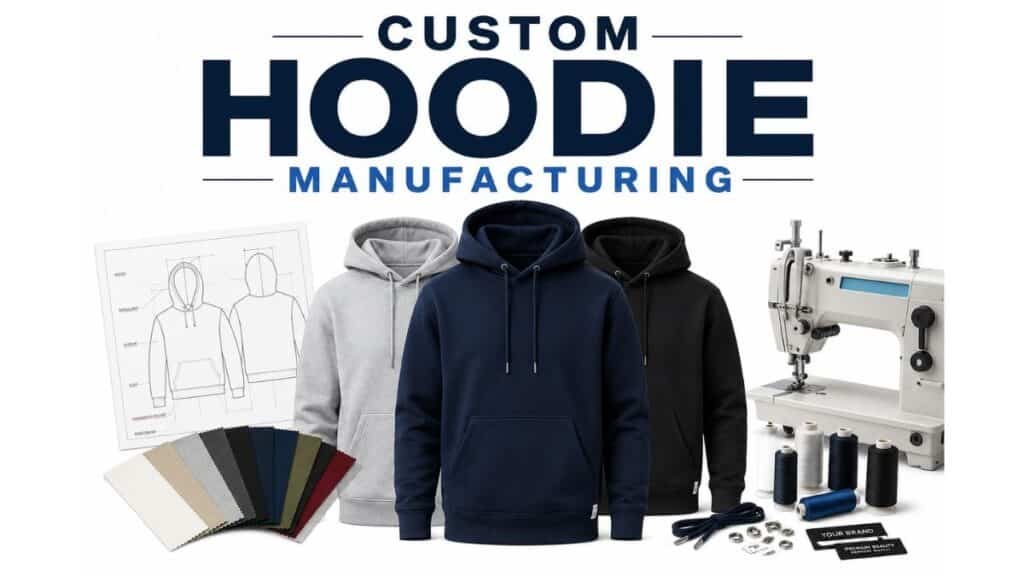
Custom hoodie manufacturing covers the design, fabric sourcing, pattern development, cut-and-sew production, and decoration of hoodies built to a brand’s specifications rather than sold as a pre-made, generic design. This includes:
- Fabric selection — fleece, French terry, or cotton-poly blends, chosen by GSM weight, hand-feel, and intended use
- Fit and silhouette — regular, oversized, boxy, or cropped cuts, each requiring different pattern development
- Construction details — hood shape and lining, kangaroo pocket style, drawstring type and color, ribbed cuffs and waistband
- Branding — embroidery, screen printing, DTG, sublimation, and puff print for logos and graphics, plus woven labels and hang tags
- Trims — zipper style for zip-up hoodies, drawstring hardware, and rib fabric composition
This differs from private labeling a factory’s existing blank hoodie with your logo, and it differs from ordering a supplier’s stock design in bulk with minimal customization — which is closer to wholesale manufacturing. Most growing brands actually move through all three models over time, starting with private label to test a design before investing in custom development. Fashion Soul International’s dedicated custom hoodie supplier program covers this full range under one facility.
Private Label Hoodie Manufacturer vs. Custom Hoodie Production vs. Wholesale Hoodie Manufacturer
| Model | What It Means | Best For | Typical Lead Time |
|---|---|---|---|
| Private label hoodie manufacturer | Factory’s existing base hoodie pattern and fabric, your logo/label/packaging applied | Fast launch, lower budget, testing a design before committing further | 2–4 weeks |
| Custom hoodie production | Fully bespoke pattern, fabric, fit, and construction built from your spec or tech pack | Brands with a defined fit and fabric identity wanting genuine differentiation | 4–7 weeks including sampling |
| Wholesale hoodie manufacturer | Bulk production of a factory’s stock design, minimal customization | Retailers and distributors buying to resell as-is or with light branding | 3–5 weeks |
Private label orders use an existing hoodie pattern, which allows faster sampling. Custom production develops your own fit, fabric weight, and construction details. The process takes longer, but it creates a more distinctive hoodie. Fashion Soul International supports all three models, including white label, wholesale, and custom production. Brands can switch between these options as they grow.
Fabric Choices That Define Hoodie Quality
Fabric is where most of a hoodie’s perceived value comes from, arguably more than any other single decision in the sourcing process.
| Fabric | Feel & Weight | Best For | Typical GSM |
|---|---|---|---|
| Fleece (brushed interior) | Soft, warm, substantial | Classic hoodies, streetwear, year-round wear | 280–400 GSM |
| French terry | Looped interior, lighter, breathable | Transitional-season hoodies, athleisure | 240–320 GSM |
| Organic cotton fleece | Similar hand-feel to standard fleece, lower environmental footprint | Sustainability-positioned brands | 280–380 GSM |
| Cotton-poly blends | Balanced softness, less shrinkage, more affordable | Everyday basics, promotional hoodies | 220–300 GSM |
| Recycled polyester fleece | Comparable performance to virgin fleece | Eco-conscious performance-leaning hoodies | 260–350 GSM |
Heavier GSM fleece (350+ GSM) delivers the substantial, boxy drape associated with premium streetwear positioning, while lighter French terry suits a softer, more casual everyday hoodie. According to current industry MOQ data, fabric availability drives cost and minimums as much as the fabric type itself — a factory with 400 GSM organic cotton fleece already in stock can quote a far lower MOQ than one that would need to custom-knit and certify that same fabric from scratch. See our fabric selection page for a deeper breakdown of composition and sourcing.
Hoodie Construction Details That Actually Matter
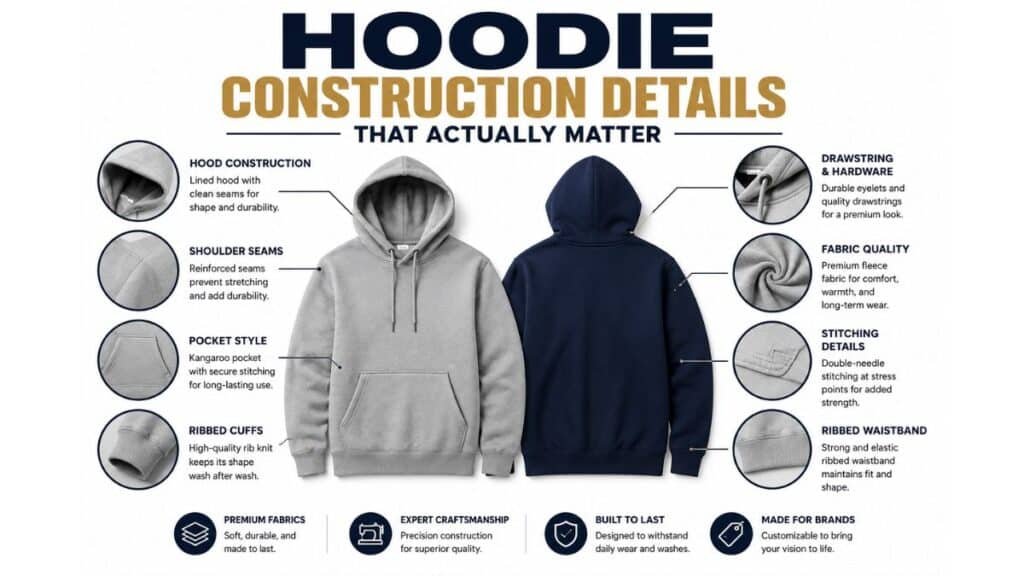
A hoodie looks simple, but several construction choices meaningfully affect how it wears, ages, and reads to a customer:
- Hood shape and lining — a two-piece hood sits closer to the head than a three-piece construction; a jersey or fleece-lined hood adds warmth and structure versus an unlined hood
- Kangaroo pocket vs. split pockets — the classic single kangaroo pocket remains standard for most streetwear-positioned hoodies, while split hand pockets suit a more athletic or utilitarian design direction
- Drawstring hardware and color — contrast drawstrings (a colored cord against a neutral hoodie body) have become a common branding detail in current streetwear positioning; metal or branded aglets add a premium touch
- Ribbed cuffs and waistband — rib fabric composition needs to hold its shape through repeated wear and washing without stretching out; a factory using cheap, unstable rib fabric is one of the most common sources of a hoodie looking worn out prematurely
- Zipper quality (for zip-up hoodies) — branded zippers (YKK or equivalent) reduce the most common zip-up hoodie failure point: teeth misaligning or pulls separating after repeated use
- Seam and stitch density — double-needle stitching at stress points (shoulder seams, pocket attachment) adds durability that becomes noticeable specifically after repeated washing
A factory quoting a hoodie without asking about hood construction, pocket style, or rib fabric quality is often defaulting to its cheapest standard configuration rather than actually building to a brand’s specific design intent.
The Custom Hoodie Production Process
- Design brief or tech pack submission — including fabric weight preference, fit (regular, oversized, boxy), and construction details
- Fabric sourcing and lab dips — color-matched swatches submitted for approval before bulk fabric is committed
- Pattern making — built from a dedicated block for custom programs, or selected from an existing base pattern for private label
- Sample production — a physical sample sewn and shipped for fit, fabric, and construction review
- Revisions — fit and construction adjustments, particularly around hood shape and body proportion for oversized styles
- Bulk fabric cutting — computerized cutting for consistency across the full size run
- Sewing and assembly — including hood construction, pocket attachment, and rib trim application
- Decoration — embroidery, screen printing, DTG, sublimation, or puff print applied per your branding spec
- Finishing and labeling — woven labels, care tags, hang tags, and folding
- Quality inspection — checking stitching, sizing consistency, drawstring symmetry, and decoration placement
- Export and shipping
Full detail on how each stage runs is available on our manufacturing process and quality inspection pages.
MOQ for Hoodies in 2026: What’s Realistic
Hoodie MOQs have shifted meaningfully in recent years — 2026 industry data shows low-MOQ manufacturing
(50–200 units) has become increasingly accessible, a real change from the 500–1000 piece minimums that were standard in the category not long ago. That said, the range across suppliers remains wide:
- Ultra-low-MOQ specialists advertise as low as 20 pieces per design, useful for genuinely testing a design before committing further, though these often come with a real speed premium — some low-MOQ operations charge 20–40% more per unit than standard production in exchange for faster turnaround
- Standard mid-range suppliers commonly sit in the 50–200 piece range per style, the most typical benchmark for hoodies specifically given the fabric and construction complexity involved
- Decoration complexity raises the practical floor — a plain hoodie might be quoted at a 100-piece MOQ, but adding embroidery and custom trims can push that same style’s minimum to 250+ at some factories, since embroidery setup and trim sourcing carry their own cost thresholds
Fashion Soul International’s 100-piece MOQ per style sits within the standard mid-range benchmark for hoodies specifically — low enough to be accessible for a genuinely growing brand, while high enough to support fabric batching and construction consistency across a real production run, without the 20-40% speed premium that comes with the lowest-MOQ specialists in the market.
Branding and Decoration Options for Hoodies
- Embroidery — flat or 3D puff embroidery for chest logos, sleeve branding, or hood details; durable and premium-feeling, though limited to smaller, less detailed designs than print methods
- Screen printing — cost-effective for bold, large-format graphics at volume; the most common method for large back or chest graphics
- DTG (direct-to-garment) — suits detailed, full-color, or photographic designs, particularly useful for smaller runs where screen setup costs wouldn’t make sense
- Sublimation — bonds dye directly into polyester-content fabric for full-color, all-over designs that won’t crack under stretch, though it works best on poly-blend rather than 100% cotton fleece
- Puff print — a specialty screen printing technique using foaming ink for a raised, 3D texture, popular in current streetwear-positioned hoodie designs
- Woven labels and hang tags — placed at the neck and inside pocket for private label branding, alongside branded packaging
See our custom embroidery design options and best printing methods guide for a deeper comparison, plus custom hang tags for apparel for packaging and tagging.
Oversized and Boxy Hoodies: A Pattern Decision, Not Just a Size Choice
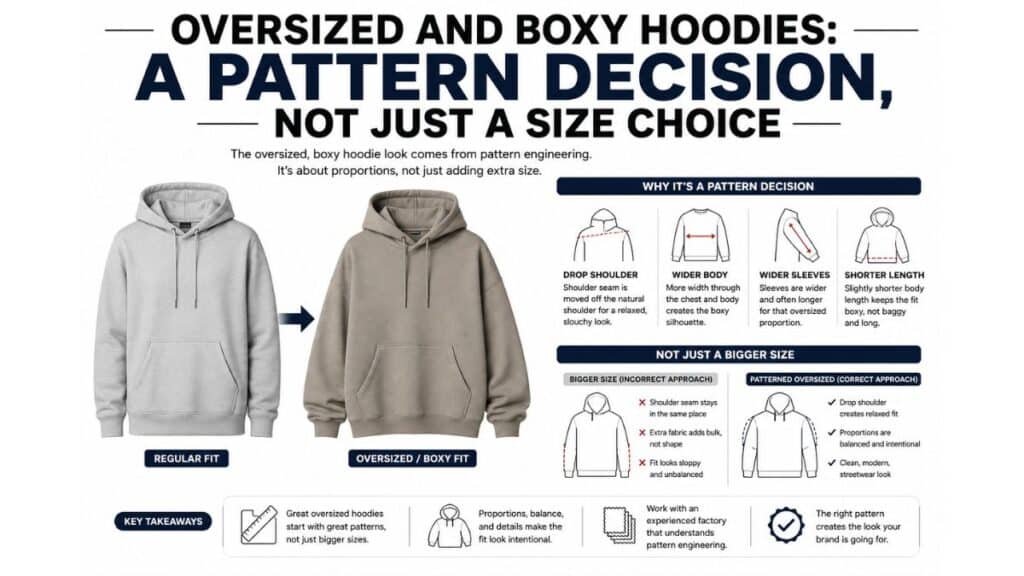
These remain one of the most requested styles in current streetwear-adjacent sourcing, and it’s worth understanding that a genuinely oversized silhouette is a pattern decision, not simply an XL cut in a regular-fit block.
A few specific measurements separate an intentionally oversized hoodie from one that just looks large:
- Dropped shoulder seam — the shoulder seam sits below the natural shoulder point rather than at it, which is what creates the relaxed, dropped-shoulder look central to most oversized streetwear silhouettes
- Body width-to-length ratio — an oversized hoodie isn’t simply wider; the proportion between width and length needs to be deliberately calculated so the garment reads as intentionally oversized rather than accidentally baggy
- Sleeve drop and taper — the sleeve needs a specific drop and taper to hang correctly from a dropped shoulder seam without pulling or bunching at the underarm
- Hood proportion — an oversized hoodie typically pairs with a slightly larger hood to stay visually balanced with the wider body, rather than reusing the standard-fit hood pattern at a larger body size
A factory that simply grades a standard-fit hoodie pattern up a size or two — rather than developing a dedicated oversized block — tends to produce a garment that looks large without reading as deliberately, proportionally oversized. Brands specifically pursuing this silhouette should ask a prospective manufacturer directly whether they maintain a dedicated oversized pattern block, since the answer is a strong signal of genuine streetwear-specific pattern experience.
Certifications and Quality Standards That Matter
Certifications remain a meaningful signal when sourcing internationally — particularly from Pakistan, one of the largest global garment export hubs alongside Bangladesh, China, and Vietnam.
- ISO 9001 (Quality Management System) — confirms documented, repeatable quality control rather than informal inspection
- ISO 14001 (Environmental Management System) — relevant for brands sourcing organic cotton or recycled polyester fleece specifically
- REX (Registered Exporter) certification — enables preferential tariff treatment for qualifying exports into the EU under the Generalized Scheme of Preferences
- SECP verification — confirms the manufacturer is a legally registered company rather than an unregistered trading intermediary
Fashion Soul International holds ISO 9001 and ISO 14001 certification, is a REX certified exporter, and is fully SECP-verified, operating out of Sialkot, Pakistan. These standards back 10+ years of manufacturing experience across 2,500+ brands served, produced by a 250+ person skilled workforce with capacity exceeding 100,000 garments per month.
What Drives Hoodie Pricing
- Fabric weight and composition — heavyweight fleece (350+ GSM) and organic or recycled options cost more per yard than standard cotton-poly blends
- Fabric availability — in-stock fabric keeps both cost and MOQ lower than a custom-knitted or certified fabric requiring mill-level sourcing
- Decoration method and complexity — embroidery and puff print cost more per unit than standard screen printing, and multi-color designs add setup cost
- Construction complexity — lined hoods, contrast drawstrings, and reinforced stitching add labor cost over a basic configuration
- Order volume — per-unit cost drops meaningfully as volume increases, as with all apparel categories
- Speed premium — ultra-low-MOQ, fast-turnaround suppliers often charge a real premium (20-40% per unit in some cases) in exchange for smaller commitments and faster delivery
A quote significantly below market for an equivalent spec (same GSM, same decoration method) is the clearest early signal a supplier may be using lighter fabric or unstable rib trim than advertised — details that won’t show up until the bulk goods arrive and go through a few wash cycles.
Shipping and Compliance for International Hoodie Orders
- USA — standard customs and fiber-content/country-of-origin labeling requirements apply
- UK and EU — REX certification enables preferential tariff treatment under GSP for qualifying exporters
- Canada — bilingual (English/French) fiber content and care labeling required under the Textile Labelling Act
- Australia — Australian Consumer Law requires accurate fiber content and care labeling disclosure
Fashion Soul International ships to the USA, UK, Australia, Canada, and Europe as core export markets, with export documentation and REX-based tariff eligibility handled as part of the standard order process. Our dedicated hoodie supplier in USA page covers market-specific details for brands sourcing primarily for the US.
How to Choose a Hoodie Manufacturer: A Practical Checklist
- Physical fabric swatches, not just GSM listed on a spec sheet — hand-feel and drape are difficult to judge otherwise
- Sample approval before bulk production, with sample cost credited toward the bulk order where possible
- Clarity on which model you’re actually being quoted — private label, custom, or wholesale, since the terms are used loosely
- Verifiable certifications — ISO, REX, or local business registration
- Realistic MOQ for your stage, with clear understanding of how decoration complexity affects that minimum
- Construction details confirmed upfront — hood lining, pocket style, rib fabric quality, zipper brand for zip-ups
- Documented QC process — ask specifically how sizing consistency and decoration placement are checked across a bulk run
Why Brands Choose Fashion Soul International for Hoodie Manufacturing
Fashion Soul International is a Sialkot, Pakistan-based manufacturer with 10+ years of manufacturing experience, having served 2,500+ brands across the USA, UK, Australia, Canada, and Europe. Our 250+ person skilled workforce and 100,000+ garment per month production capacity are backed by ISO 9001 and ISO 14001 certification, REX certified exporter status, and full SECP verification.
Our custom hoodie supplier program supports private label, custom, and wholesale hoodie production with a 100-piece MOQ per style, decoration capability spanning embroidery, screen printing, DTG, sublimation, and puff print, and fabric options from standard fleece through organic and recycled alternatives. Brands sourcing across a broader apparel range alongside hoodies may also want to review our private label clothing supplier program.
FAQs
A private label hoodie manufacturer applies your branding to an existing base pattern the factory already produces, offering faster turnaround at lower cost. Custom hoodie production builds a fully bespoke pattern, fabric spec, and construction from your original design or tech pack, taking longer but delivering a genuinely differentiated product.
It typically ranges from 20 pieces at ultra-low-MOQ specialists (often with a real price premium) up to 200-300 pieces at standard mid-range suppliers, with decoration complexity like embroidery sometimes pushing minimums even higher. Fashion Soul International’s MOQ is 100 pieces per style.
Heavyweight fleece in the 350-400 GSM range delivers the substantial, boxy drape associated with premium streetwear positioning, while lighter French terry (240-320 GSM) suits a softer, more transitional-season hoodie.
MOQ depends heavily on fabric availability (in-stock fabric supports lower minimums than custom-knitted or certified fabric), decoration complexity, and how a factory counts MOQ (per style versus per color and size combination).
Embroidery gives a more durable, premium result for smaller logos, while screen printing is more cost-effective for bold, large-format graphics at volume. The right choice depends on your design’s size, detail level, and budget.
Yes — any reputable manufacturer should produce a physical sample for fit, fabric, and construction review before bulk fabric is cut, regardless of which model (private label, custom, or wholesale) you’re sourcing under.
Typically 4-7 weeks from tech pack approval to shipment for fully custom programs, including sampling, fabric sourcing, revisions, and quality inspection. Private label orders using existing base patterns can move faster, often 2-4 weeks.